
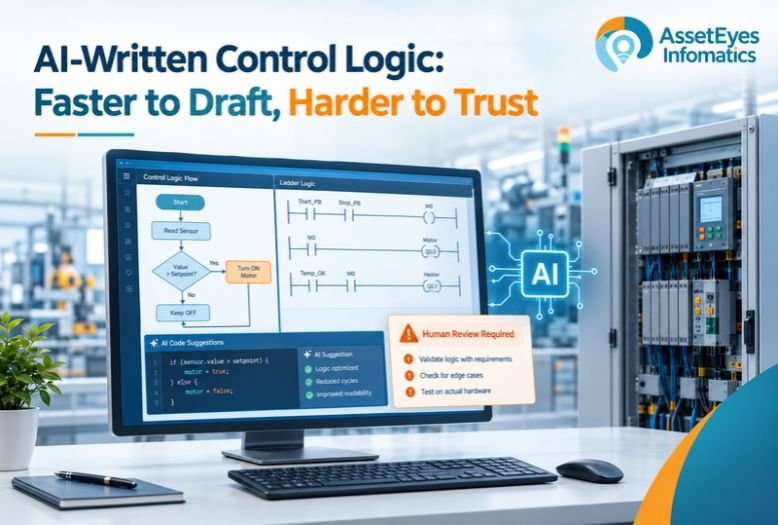
Picture a controls engineer on a Monday morning. A requirement comes in for a new conveyor transfer station, and by the time the coffee cools there’s a first draft of the PLC logic on screen. It’s tidy and well structured, and it compiles. Would you trust it to run equipment next to people?
That question is now practical. As of October 2026, Siemens’ Eigen Engineering Agent is generally available, and it handles PLC coding, HMI design and device configuration tasks inside TIA Portal [editor: confirm exact availability date and scope against Siemens’ announcement]. Drafting control logic in minutes is no longer a demo. This article looks at where AI-assisted PLC programming helps, where it can quietly fail, and how your team can review AI-drafted logic with confidence. You’ll find a review checklist and a look at why documentation quality sets the ceiling on what these tools can do. Teams working with automation engineering services partners will recognize much of this, because the inputs matter as much as the tool.
1. The Landscape: Vendors Are Racing to Shorten the First Draft
The pressure is capacity. A Siemens executive has said that automation engineering is becoming a bottleneck as demand outpaces the people available to do the work [editor: add executive name, title and date from the source]. That framing explains why vendors are investing here. More projects are arriving than engineering teams can staff.
Vendors are responding with copilots and agents. Siemens’ agent works inside its engineering environment. Schneider Electric and Unitronics have also introduced AI-assisted programming features [editor: verify the specific products, names and release status for Schneider and Unitronics before publishing; this outline doesn’t supply them]. The details differ, but the pattern is the same: describe what you need in plain language and get draft logic back.
Time savings are reported, not independently verified. A Wipro PARI project reported cutting PLC code generation from three to four days to about ten minutes per requirement, at up to 85% accuracy. Those numbers are self-reported by the project [editor: add source and date]. It’s also worth asking what “accuracy” means in that context. A figure of up to 85% still leaves a meaningful share of output that needs correction, and in control logic, the part that needs correcting is often the part that matters most.
2. Why Control Code Is Different
Control code runs physical equipment. A bug in a web app shows an error message. A bug in a motion sequence can jam a machine, damage tooling or put someone in harm’s way. That changes what “good” means.
Behavior matters more than syntax. Generated logic can be syntactically clean and still wrong about the things that count: interlocks, safe states, what happens when a guard opens mid-cycle, and how the machine behaves when power returns. Think of it like a recipe written by someone who has never cooked. Every instruction reads well, but nobody has checked whether the oven is on.
The code is only as sound as its assumptions. Logic depends on how sensors are wired, which contacts are normally open or normally closed, and how drives behave on a fault. None of that is visible in the logic itself. It lives in the electrical design and the machine’s mechanical behavior.
3. Common Failure Modes
A recent industry piece warns that clean-looking generated code can still miss a failed sensor, operator intervention, mode transition or restart condition [editor: name the publication, author and date]. These gaps show up repeatedly:
- Sensor faults and signal loss: The draft assumes every sensor always reports truthfully. A broken wire or stuck proximity switch can leave the sequence waiting forever, or worse, advancing on bad data.
- Manual and auto transitions: Switching modes mid-cycle is where many sequences get confused. Outputs left energized from one mode can surprise an operator in the other.
- Power loss and restart: After an outage, does the machine resume, reset or stop and wait? The right answer depends on the process, and a generic draft rarely knows it.
- Operator interventions: People clear jams, reposition parts and open guards at unplanned moments. Logic written for the ideal cycle often has no plan for them.
- E-stop recovery: An emergency stop is the easy part. The restart afterward, including which outputs stay off and what the operator must acknowledge, is where drafts tend to be thin.
The common thread is that these are all situations the requirement document probably never mentioned. AI drafts what it was told. It doesn’t know what nobody wrote down.
4. Practical Takeaway: A Review Checklist for AI-Drafted Logic
This is guidance for your own team’s review process, and you can adapt it to your standards and machine types. Review the draft against three source documents: the written requirements, the I/O list and the electrical schematics.
Against the requirements
- Every stated requirement maps to identifiable logic, and nothing in the logic lacks a requirement behind it.
- Start-up, shutdown, pause and abort behavior are all defined, not just the normal cycle.
- Mode transitions between manual and automatic are explicitly handled.
Against the I/O list
- Every tag matches the I/O list by address, description and signal type.
- Nothing is addressed to a channel that doesn’t exist, or to one that serves a different function.
- Scaling, ranges and units are confirmed for analog signals.
Against the electrical schematics
- Normally open and normally closed assumptions match the actual wiring.
- Sensor and device fault behavior reflects how the circuit really responds to a broken wire or lost supply.
- Safety circuits and their related signals are treated as defined by the electrical design, not rewritten by the draft.
Against failure behavior
| Scenario | Question to ask |
| Sensor failure | Does the logic detect it and move to a defined state? |
| Power loss | Does restart behavior match what the process requires? |
| Operator intervention | Is there a safe path for unplanned manual action? |
| E-stop recovery | Do outputs stay off until a deliberate reset? |
Version control habits
- Save the prompt and inputs: Keep the requirements and documents the AI was given alongside the generated output, so a review can trace why the logic looks the way it does.
- Tag AI-drafted sections: Mark them in the project history so reviewers know which logic needs the closest look.
- Commit small and often: Small changes are far easier to review than one large generated block.
- Record every human edit: Note what was changed and why, so corrections become lessons for the next requirement.
5. What AI Output Depends On
AI works from the documents it’s given. If the requirements are vague, the logic will fill the gaps with plausible guesses. If the I/O list has an error, the code will faithfully inherit it. If the electrical drawings are out of date, the draft will be confidently wrong about how the machine is wired.
Documentation quality sets the ceiling. A faster drafting tool doesn’t remove the need for good source material. It makes good source material more valuable, because errors now spread faster and look more convincing. Think of the tool as a very quick junior engineer who never asks clarifying questions. The better the brief, the better the first draft.
Three inputs carry most of the weight:
- Clear requirements: They cover normal operation, abnormal conditions, modes and restart behavior in plain words.
- Accurate I/O documentation: Every signal is listed with its address, type, range and function.
- Correct electrical drawings: Schematics reflect the machine as designed, so device behavior and wiring assumptions can be checked rather than guessed.
6. Where Asset-Eyes Fits
Asset-Eyes is a machine design and engineering services company, and our work sits upstream of the code. Our automation engineering services support teams with the design documentation that controls work depends on. That includes electrical system design documentation such as schematics, I/O lists and control panel design documentation. Documents like these give your engineers, and any AI tool they use, a reliable source of truth to work from.
If your team is adopting AI-assisted programming, the question worth asking early is whether your documentation can support it. Our role is to design and document the electrical and control architecture clearly and consistently, so the people reviewing the logic have something dependable to check it against. For manufacturers and OEMs with growing project loads and limited in-house capacity, that documentation work is often where a design partner helps most.
7. Conclusion
AI-assisted PLC programming is real, available and genuinely faster at producing a first draft. But a draft in minutes isn’t the same as logic you can trust. The risk sits in behavior the code doesn’t show: failed sensors, mode changes, restarts and the unplanned things people do around machines. A structured review against your requirements, I/O list and electrical schematics catches much of it, and good version control habits keep the process traceable. Above all, the quality of what comes out depends on the quality of the documents that go in.
If you’re planning for AI-assisted controls work and want your electrical and I/O documentation ready for it, we’d be glad to talk through your requirements.

Request Engineering Support
Contact Us Now:
📞 +91 9840895134