
It’s Friday at 5 PM. Your engineering team is staring down a critical project bottleneck. The design revision needs completion before Tuesday’s client review, but your team is burnt out, and frankly, everyone’s mental capacity for problem-solving is depleted. You leave the office knowing the weekend will haunt you with this unfinished work lingering in the back of your mind. Then Monday Morning Blues arrives. You open your laptop, grab your coffee, and brace yourself for a stressful week ahead. But instead of diving into that revision, you see it’s already done.
The overseas branch of your distributed team completed the drawings and uploaded the comments. The work didn’t wait for Monday, it was already solved.
That’s the psychological magic of follow-the-sun engineering. And it’s not just about getting work done faster. It’s about something far more human: the relief of waking up to progress instead of problems.
1. What Does “Follow-the-Sun” Engineering Actually Mean?
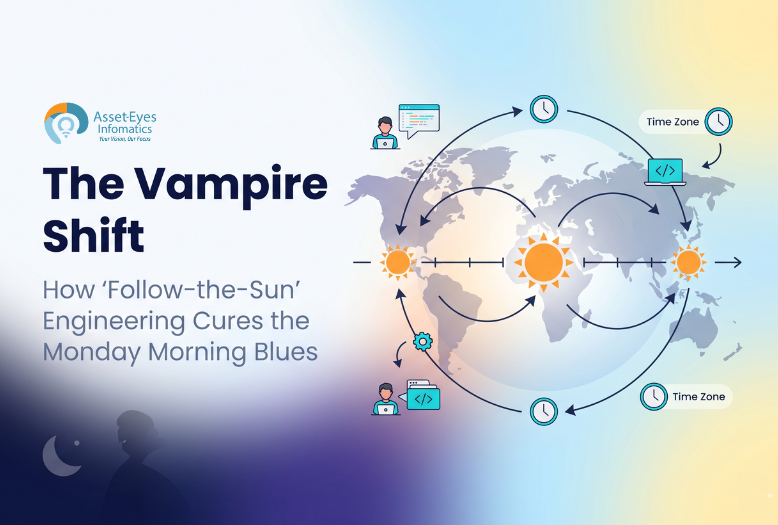
Follow-the-sun is a distributed work model where engineering teams across different time zones essentially hand off work like a relay race around the globe. As one team wraps up their day, another team on the opposite side of the world is just starting theirs. The project never actually stops, it keeps moving forward continuously.
Think of it as literal 24-hour progress. When your US team clocks out Friday evening, your Indian counterpart picks up the drafting work. By the time your team logs in Monday, what was yesterday’s problem is now today’s completed asset.
2. Why This Model Hits Different Than Traditional Scheduling
Traditional project management assumes all work happens during standard business hours in one location. Your engineering manager juggles task dependencies, waits for team members to become available, and generally watches productivity get squeezed into those 8-9 working hours. Urgent revisions? They become overtime, stressed weekends, or delayed timelines.
Follow-the-sun flips this entirely. The project keeps moving through the night not because someone is sacrificing their personal time, but because someone else’s “business day” is your “off hours.” It’s a strategic business workflow, not a workaround.
The psychological difference is enormous. Instead of dreading Monday because work has piled up, you’re actually energized by arriving at completed deliverables. That manager who left Friday stressed? They spend their weekend genuinely relaxing because the work is already progressing somewhere else in the world.
3. The Real Engineering Challenges That Follow the Sun Solves – Monday Morning Blues
Most engineering bottlenecks aren’t about raw capability, they’re about timing and sequencing. You might have a brilliant CAD drafting team, but if they’re all in the same time zone waiting on feedback or for the previous phase to complete, you’re looking at idle time despite having skilled people available.
Follow-the-sun eliminates this artificial waiting. When your team needs a design revision on electrical control panel design, a distributed team across time zones means you’re not asking one overtaxed person to stay late. Instead, you’re leveraging existing capacity that would otherwise be offline.
For complex technical work whether it’s SolidWorks 2D drafting, HVAC CAD drafting, or industrial ventilation system design layouts this model is particularly powerful. The handoff between teams naturally creates checkpoints. Your Monday morning review of completed work acts as quality assurance, catching issues fresh rather than discovering problems days later when they’re more expensive to fix.
4. The Monday Morning Blues: A Real Scenario
Let’s walk through this objectively. A stressed engineering manager handles a critical project with a tight deadline. The work involves detailed general assembly drawing and motor control panel design specifications. It’s complex, it’s high-stakes, and it’s bottlenecked because the revisions keep stacking up.
Friday evening arrives. The manager has genuinely done everything they can with their local team. The next steps require fresh eyes and dedicated focus, but there’s no one left in the office. Traditionally, this means Monday morning guilt, a weekend of half-relaxation, and probably someone working through Saturday.
With follow-the-sun coordination, that manager walks out the door on Friday knowing their Indian team has worked through their entire workday on this project. The revisions that felt impossible Friday are now documented, reviewed, and waiting for the next phase.
The manager sees completed work instead of compounded problems. That’s not just productivity, that’s psychological relief.
5. How Technical Quality Actually Improves – Monday Morning Blues
This model often produces better technical work, not just faster work.
When you rush work to meet a deadline, quality suffers. People are tired, taking shortcuts, and pushing code or designs through without proper reflection. With follow-the-sun coordination, each team is working during their peak hours. Your overseas team isn’t doing HVAC equipment design at 9 PM when fatigued they’re doing it during their fresh morning hours.
Additionally, the handoff naturally creates review cycles. Your team receives completed work on Monday with a fresh perspective. You’re not approving your own late-night rush job. You’re evaluating someone else’s daytime work. This creates natural quality gates without adding formal bureaucracy.
For specialized work like EPLAN control panel design or SolidWorks drafting services, this distinction matters enormously. Technical accuracy isn’t something you can rush.
6. The Logistical Reality: Making This Actually Work
Of course, follow-the-sun isn’t a magic wand. It requires real coordination.
Clear documentation becomes non-negotiable. When you’re handing work between teams and time zones, ambiguous instructions create problems. Your Friday handoff notes need to be precise enough that someone reading them 12 hours later, in a different country, understands exactly what needs doing.
Tools matter too. Cloud-based CAD platforms, real-time collaboration software, and proper project management systems turn this from “we hope someone picks this up” into a reliable workflow. You need visibility into what’s been completed, what’s in progress, and what’s blocked.
Finally, you need genuine trust in your distributed team. This isn’t about outsourcing work to the cheapest option. It’s about having skilled engineers whether that’s a full distributed team you’ve built or a partner you’ve vetted who can handle complex technical work independently.
7. Solving the Weekend Anxiety Problem – Monday Morning Blues
Let’s circle back to what started this conversation: the psychological weight of leaving unfinished work on Friday.
Most engineering managers know this feeling viscerally. You leave the office mentally exhausted, but you can’t truly disconnect because there’s that project lingering in your mind. You don’t want to work over the weekend, but you also can’t stop thinking about it.
Follow-the-sun engineering doesn’t eliminate weekends, it redirects them. Instead of your team grinding through Saturday and Sunday, dedicated teams in other time zones are handling it during their regular business hours. By Monday morning blues, you’re not staring at a mountain of incomplete work. You’re reviewing finished deliverables and moving to the next phase.
The relief is real and measurable. You can actually be present with your family. Can sleep without that background hum of work anxiety. You show up Monday energized instead of depleted.
8. Asset-Eyes’ Expertise
This model works when you have partners who understand both the technical complexity and the coordination requirements. Whether you’re managing electrical drafting services, industrial exhaust system design, or complex assembly drawings, the technical work needs to be excellent regardless of where it’s done.
At Asset-Eyes, we operate specifically as that distributed partner for engineering teams. We handle CAD drafting service, SolidWorks design work, and specialized technical drawings working across time zones so your team experiences exactly what we’ve been describing.
We’re not here to replace your team. We’re here to give you those extra hours in the day, the mental space to disconnect on weekends, and the confidence that technical work is progressing even while you’re offline.

Conclusion: The Real Win
The Vampire Shift is an opportunity waiting to be taken advantage of. It’s about leveraging a global workforce strategically so that engineering progress doesn’t stop at 5 PM in your time zone.
The relief of opening your laptop to find completed work instead of compounded problems that’s real. It changes how you feel about your projects, your team, and your own sustainability as a manager.
If you’re currently experiencing that Friday evening dread, watching deadlines compress, and feeling the weight of everything landing on your local team’s shoulders, there’s a better way.
Get in Touch
Let’s explore how follow-the-sun engineering could transform your project timeline and your team’s quality of life.
📞 +91 9840895134
FAQs
In follow-the-sun engineering, separate teams across various time zones collaborate on a single project. Each team begins their work after a team in another country ends theirs. This method allows for continuous operation and constant advancement on a project for 24 hours. This is especially prevalent in engineering or software CAD design, since time delays on a project can be detrimental.
The main way productivity is boosted in this model is the removal the elimination of waiting time between tasks. In a typical scenario, project progress ceases when a team finishes for the day. With the follow-the-sun model, project progress is continuous, since work on the project is picked immediately. This model is better resource utilization, as teams can accomplish time-sensitive tasks more.
Not all projects are suited for follow-the-sun engineering. This model works best for tasks that can be easily identified and compartmentalized, like updates in design or software, or drafting in CAD. Conversely, projects requiring real time communication can be more difficult. Fortunately with proper strategy, the right tools, and effective documentation, this model can be implemented in various projects in different industries, and are be able to improve efficiency and reduce delays.
There are numerous advantages to following the sun model. Working hours extend to 24 hours with no interruption on work. Customers appreciate the fast completion of tasks, and teams avoid the stress of extended hours. Companies enjoy the even distribution of tasks to avoid burnout. Urgent tasks can be completed in a timely manner, and projects can be delivered quicker to the clients. Global teams enjoy the flexibility and productivity of the model.
On the contrary, if the model is managed well, there is an increase in quality of work. The model allows each team to put in a full day of work free from distractions. The red tape that comes with work between teams no longer is a nagging point for criticism. Teams are able to focus on producing a quality piece of work. The attentive and detailed work reduces the errors that come from rushed work.
Communication, coordination, and unclear direction are some of the common challenges when using this model. Disparate timezones can be a barrier to communication. Not having proper documentation can lead to misunderstandings. In order to counter documentation, teams need to be detailed and clear with their handoff notes and use solid project management solutions. These issues can quickly be managed with the right process and documentation. The challenges with this model are well outweighed by the benefits.
Clear documentation and structured communication for time management. Handoff notes that summarize the day’s work and outline next steps are a staple of time management. Easy to read dashboards and progress tracking systems help updates. Some teams have time restrictions to facilitate discussion. Overall, this model emphasizes time management and active collaboration.
Yes, this business model can fit small companies as well, even without large global workforces. Small companies can work with external partners and remote employees in diverse time zones. This provides continuous operation with affordable pricing. Smaller teams that need to focus to remain competitive in the market and rival larger companies find this model beneficial.