
It’s midday at your office, and your desk has vanished beneath layers of schematics and technical drawings. Your CAD software struggles through complex thermal simulations for a critical commercial project, while three client revision requests sit in your inbox, each marked “urgent.” The manufacturing team needs those heat exchanger specifications yesterday, insisting that production can’t wait any longer. You glance up to see your talented but stretched-thin team members exchanging that unmistakable “how are we going to meet these deadlines?” look. You’re not just busy you’re drowning in a sea of technical specifications and compliance requirements. The demand for precision in your HVAC equipment design remains non-negotiable, but the resources and time allocated to deliver that precision feel anything but realistic.
Breathe easy, we’ve got you covered! At Asset-Eyes, no problem is too challenging to navigate. Our team is here to say that the days of you juggling countless drawings, wiring schematics and p&iD diagrams are over! We have what you need. The industry expertise to act as an extension of your engineering team helping you bring production-ready, efficient and optimized designs to market faster.
We are a specialized HVAC equipment design and HVAC CAD drafting partner for HVAC/R OEMs in North America and the UK. So we provide detailed drafting and assembly planning for your industrial projects. Our teams have specialized skill sets in Mechanical, Electrical and Automation the pillars of advanced HVAC/R OEM engineering that drive innovation and product excellence.
What Is HVAC Equipment Design?
HVAC equipment design is the process of planning and creating systems that provide heating, cooling, and ventilation for buildings. It involves choosing the right parts, arranging them properly, and making sure everything works together efficiently. Good design helps the equipment use less energy, last longer, and be easier to build and maintain. Whether it’s for a commercial building or a factory, the goal is to make systems that meet all requirements while keeping costs low and performance high.
Our Core Offerings
- 2D & 3D Modelling: We create precise models that help you visualize designs with exceptional clarity.
- Assembly Drawing: Our detailed CAD drawings services ensure smooth integration of components.
- Detailing & Drafting: Your conceptual designs are transformed into exact technical drawings that meet industry standards.
- Product Documentation: We provide comprehensive documentation including BOMs, manufacturing instructions, and technical specs for streamlined manufacturing and assembly.
- Conversion & Migration: We can help convert legacy drawings into editable digital formats for easy access and future-proofing your data.
Our Team
While our company is young (less than 5 years old), our team has decades of combined experience in the HVAC/R industry. Our specialists possess a deep knowledge of industrial and commercial refrigeration systems, MEP solutions and Industrial Automation, allowing us to tackle complex HVAC equipment design challenges with confidence and precision.
Custom Solutions
We excel at translating client specifications into practical, manufacturable designs. While we don’t develop novel equipment from scratch, we take client inputs (load calculations, design parameters) and refine them into detailed, precise designs that meet exact requirements. Our ability to develop bespoke solutions for unique requirements sets us apart—we understand that standardized approaches often fall short in the specialized world of HVAC/R equipment manufacturing.
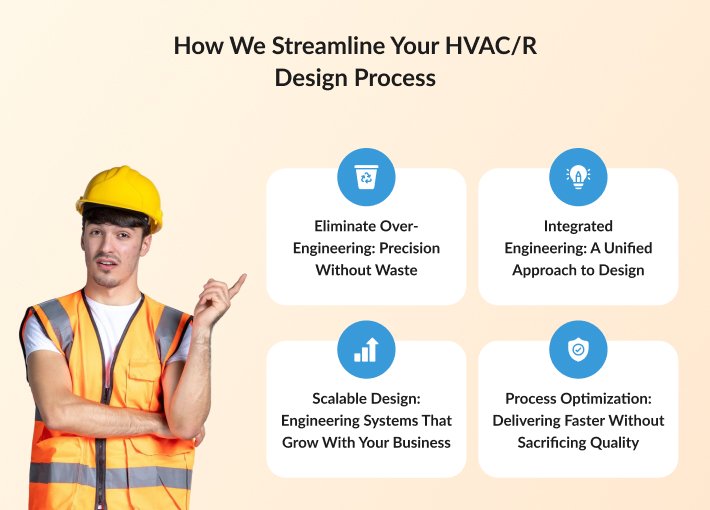
1. Eliminate Over-Engineering
Most HVAC&R systems and equipment are designed with unnecessary redundancies that increase material costs, production time and overall inefficiency.
- Problem: Component selection by habit rather than Engineering intellect, unnecessarily complex layouts, and redundant safety margins inflate costs, minimal thought to maintenance challenges.
- Solution: By leveraging the right resources and tools, we engineer and support design, leaner, high-performance systems without sacrificing durability or compliance.
- Impact: HVAC&R equipment manufacturers decrease material waste, lower energy use, and enhance cost efficiency.
2. Integrated Engineering
The best HVAC&R systems and equipment don’t come from working in silos. Yet, many manufacturers approach mechanical, electrical and automation engineering separately, leading to inefficiencies and misalignment.
- Problem: Poor coordination between design teams leads to last-minute changes, errors in schematics, and compatibility issues in production.
- Solution: A fully integrated design approach that aligns mechanical, electrical and control system teams from day one.
- Impact: HVAC&R systems and equipment that work seamlessly together, reducing delays, rework, and unexpected costs during manufacturing.
3. Scalable Design
What is one of the biggest inefficiencies in System and Equipment manufacturing that the community faces today? Designing one-off systems instead of creating modular, scalable designs that can be adapted across multiple models.
- Problem: Repeating the same design process for every new project increases engineering costs and slows down production.
- Solution: Implementing scalable design principles that allow HVAC&R System and Equipment manufacturers to reuse design elements, optimize bill of materials (BOMs), and develop product families instead of single units.
- Impact: Faster iterations, reduced engineering overhead, and a competitive edge in launching new products quickly.
4. Process Optimization
Most HVAC&R manufacturers rely on manual processes to maintain quality and precision. But inefficiencies creep in when workflows aren’t structured for speed and accuracy.
- Problem: Disjointed workflows lead to repetitive tasks, delays in approvals, and inefficiencies in collaboration.
- Solution: Process optimization—streamlining design validation, approvals, and documentation workflows to cut inefficiencies without changing the way teams work.
- Impact: HVAC&R manufacturers get faster turnaround times, fewer revisions, and a more structured path from concept to production.
Technical Drafting Excellence
CAD/BIM Expertise: Our team leverages industry-leading platforms including AutoCAD, Revit, and SolidWorks to deliver both 2D and 3D models with exceptional precision. The commitment to HVAC CAD drafting ensures compliance and production-readiness.
Our QC Process
Our quality control process combines multi-stage reviews during every project.
1.Multi-Stage Reviews: Each design undergoes a structured review beginning with a meeting involving team members not part of the initial drafting process. This is followed by engineering checks at each critical stage and concludes with a comprehensive final review by senior staff.
2.Standardized Checklists: We incorporate equipment-specific checklists that covers critical elements including dimensional accuracy, material specifications, component clearances, compliance standards and manufacturing feasibility. These checklists serve as systematic guides, ensuring consistent quality regardless of project complexity or timeline pressures.
This methodical approach significantly reduces errors and rework, translating directly to more reliable equipment and faster production cycles for our OEM clients.
Visualization Services
While not our core service, we can create realistic renderings and visualizations that help clients visualize the final product before manufacturing begins. These visualizations provide value for both internal design reviews and external marketing materials, helping communicate complex HVAC equipment design services to both technical and non-technical stakeholders.
Technology & Innovation
Our technology stack is carefully selected to enhance precision and reduce errors throughout the design and drafting process:
- SolidWorks/Autodesk/Revit
- Creo/CATIA
- Rockwell Software/Factory Talk
- SIMA S7
This technology stack enables us to function with enhanced precision by automating calculations, maintaining dimensional relationships, detecting interferences, and enabling virtual testing before physical production begins.
While we don’t have in-house experts for energy-efficient and sustainable designs, we maintain contractual partnerships with specialists who can provide this expertise when projects require it.
Industry Specializations
Commercial HVAC Systems:
We have extensive experience designing supermarket cooling systems, addressing the complex challenges these environments present. Our designs accommodate variable loads caused by fluctuating customer traffic and merchandise density. Ensuring consistent temperature control across different store zones. We excel at maximizing cooling efficiency within tight spatial constraints, particularly in crowded ceiling plenums and compact equipment rooms typical in retail settings. Our solutions balance energy efficiency with performance requirements, incorporating strategic component selection and optimized refrigerant cycles that reduce operational costs while maintaining the critical temperature stability needed for food preservation and shopper comfort.
Industrial Refrigeration:
Our specialized knowledge extends to industrial cooling systems, particularly those using ammonia and CO2 as refrigerants. We understand the compliance requirements for these systems and design with safety, efficiency, and reliability as priorities.
Our Collaborative Process
Discovery & Requirements
Our initial consultation with clients involves comprehensive technical discussions to understand project objectives and performance requirements. We meticulously review all specifications and identify critical constraints including space limitations, budget parameters, and regulatory requirements. For customers with complex requirements, we offer selective Proof of Concept (POC) development based on their interest and engagement level, allowing for early validation of critical design elements before committing to full implementation. Every requirement is documented using detailed specification sheets that capture performance criteria, dimensional constraints, and material specifications. This thorough documentation process ensures complete alignment between all stakeholders before any work begins.
Design Development Cycle: Our iterative design process typically follows these steps:
- Initial concept development based on client requirements
- Preliminary design review with client stakeholders
- Detailed design development incorporating feedback
- Final review and approval before documentation
Delivery & Support: We provide comprehensive documentation packages to our clients. If revisions are needed, we address them promptly to maintain project momentum and ensure client satisfaction.
Benefits for OEMs
Enhanced Product Performance: Our designs translate directly to improved equipment performance by ensuring components work together as intended by optimizing flow paths, and maintaining critical tolerances.
Manufacturing Efficiency: Precise drafting significantly reduces the chances of misinterpretation. Clear documentation means less time spent interpreting designs and fewer issues discovered during production.
Faster Time-to-Market: Our efficient processes help OEMs launch products more quickly by streamlining the design phase and minimizing complications that can delay production.
Regional Expertise:
Our team is well-versed in North American standards (ASHRAE), and we ensure our solutions align with the applicable standards in the UK and Canada. This knowledge ensures that designs meet all applicable regulations regardless of where the equipment will be manufactured or installed. Our experience working with these standards means we can navigate regulatory requirements efficiently.
Cross-Border Collaboration
Being based in India while serving clients in North America and the UK, we’ve developed effective approaches to international collaboration. We manage time zones and communication through: –
- overlapping work hours
- scheduled check-ins
- cloud-based project management.
Our team understands the importance of clear communication across borders and cultures.
Why Choose Us
What sets us apart in the HVAC/R design and drafting space is our specialized focus. Unlike general mechanical design firms, we concentrate exclusively on HVAC equipment design, bringing deeper understanding and more relevant experience to every project. Our track record demonstrates our commitment to precision, quality, and client satisfaction. We understand OEM manufacturing needs and design with production in mind.

Take the Next Step with Us
Partnering with us for your design and HVAC CAD drafting service needs means gaining a precision-focused ally committed to your success. We invite you to reach out to discuss your specific requirements and learn how our expertise can benefit your next project. Contact us at +91 9840895134 or sales@asset-eyes.com. We typically respond within 48 hours and look forward to exploring how we can support your design needs!
FAQs
Asset-Eyes acts as an extension of your engineering team, handling 2D and 3D modeling, assembly drawings, detailing and drafting, product documentation, and conversion of legacy drawings into editable digital formats. They manage schematics, wiring diagrams, and P&ID drawings so your in-house teams can focus on core engineering while maintaining the precision and compliance required for complex industrial and commercial HVAC/R projects.
Asset-Eyes reduces over-engineering by challenging component selection driven by habit rather than engineering intellect, removing unnecessarily complex layouts and redundant safety margins. Using the right resources and tools, they engineer leaner, high-performance systems without sacrificing durability or compliance. This approach helps HVAC/R equipment manufacturers reduce material waste, lower energy consumption, and improve overall cost efficiency.
Integrated engineering means aligning mechanical, electrical, and automation disciplines from day one rather than working in silos. Asset-Eyes coordinates these teams early to avoid last-minute changes, schematic errors, and compatibility issues during production. This approach results in HVAC/R systems and equipment that work seamlessly together, reducing delays, rework, and unexpected manufacturing costs for OEMs.
Asset-Eyes helps OEMs move from designing one-off systems to creating modular, scalable designs that can be adapted across multiple models. They implement design principles that allow manufacturers to reuse design elements, optimize bills of materials, and develop product families instead of starting from scratch each time. This leads to faster iterations, reduced engineering overhead, and competitive advantages in launching new products quickly.
Asset-Eyes uses a multi-stage QC process combining reviews by team members not involved in initial drafting, engineering checks at critical stages, and comprehensive final reviews by senior staff. They employ standardized, equipment-specific checklists covering dimensional accuracy, material specifications, component clearances, compliance standards, and manufacturing feasibility. This methodical approach significantly reduces errors and rework, improving equipment reliability and accelerating production cycles.
Asset-Eyes leverages industry-leading platforms including AutoCAD, Revit, SolidWorks, Creo, CATIA, Rockwell Software, FactoryTalk, and SIMA S7. This technology stack enables enhanced precision by automating calculations, maintaining dimensional relationships, detecting interferences, and enabling virtual testing before physical production begins. For energy-efficient and sustainable designs, they maintain contractual partnerships with specialists when projects require this expertise.
Asset-Eyes designs supermarket cooling systems that manage variable loads from fluctuating customer traffic and merchandise density while ensuring consistent temperature control across different store zones. They excel at maximizing cooling efficiency within tight spatial constraints, particularly in crowded ceiling plenums and compact equipment rooms. Their solutions balance energy efficiency with performance requirements while maintaining critical temperature stability needed for food preservation and shopper comfort.
Asset-Eyes specializes in industrial cooling systems using ammonia and CO2 refrigerants, understanding the specific compliance requirements for these systems. They design with safety, efficiency, and reliability as priorities, ensuring all regulatory requirements are met. Their specialized knowledge extends to the unique challenges these refrigerants present, focusing on proper safety protocols and system optimization for industrial applications.
Based in India, Asset-Eyes manages international collaboration through overlapping work hours, scheduled check-ins, and cloud-based project management. They’re well-versed in North American ASHRAE standards and applicable UK and Canadian regulations, ensuring designs meet all requirements regardless of manufacturing or installation location. Their process includes comprehensive technical discovery, detailed specification documentation, and iterative design reviews to maintain clear communication across time zones and cultures.
Asset-Eyes stands out through exclusive specialization in HVAC/R equipment design and drafting, bringing decades of combined experience in mechanical, electrical, and automation engineering specific to this industry. Unlike general mechanical firms, they understand OEM manufacturing needs and design with production in mind. Their processes are tailored for HVAC/R applications, emphasizing production-ready documentation, modular design principles, and rigorous quality control that delivers more relevant and manufacturable designs.