
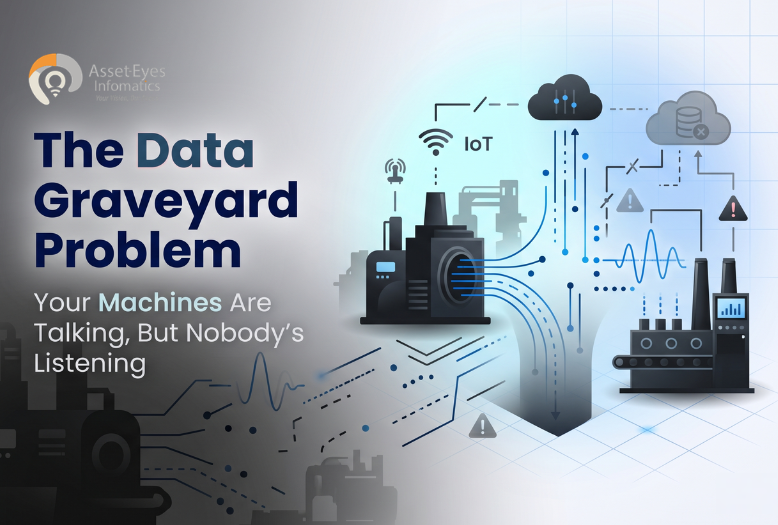
Picture walking into a factory where every machine is equipped with the latest sensors, PLCs are humming with activity, and SCADA screens display thousands of data graveyard points in real-time. The facility looks impressively modern and “smart.” Yet when the plant manager asks a simple question“Why did our main production line’s efficiency drop 12% last week?”nobody can provide a clear answer.
Welcome to the data graveyard, where millions of data points go to be buried rather than analyzed.
This scenario plays out in manufacturing facilities worldwide. Companies invest heavily in sensors and data collection systems, creating an illusion of digital sophistication. But there’s a critical difference between collecting data and building an information system that actually helps you make better decisions.
In this article, we’ll explore why “smart” factories often generate more confusion than clarity, and how to design purposeful data strategies that transform your machines from data generators into intelligence assets.
1. Data Collection vs. Information Systems: Understanding the Critical Difference
Embracing the “collect everything, just in case” mentality seems logical because storage is cheap, sensors are affordable, and more data should lead to better insights, right? Unfortunately, this approach creates expensive digital landfills rather than competitive advantages.
Data collection answers the question: “What can we measure and store?”
This leads teams to add sensors everywhere, log every parameter at maximum resolution, and push everything to historians or cloud databases. The result is massive volumes of raw numbers with no clear purpose or context.
Information systems answer the question: “What decisions do we need to make, and what data supports those decisions?”
This approach starts with specific business questions like “Which components cause the most unplanned downtime?” or “What operating parameters predict quality issues?” Only then do you design the data collection architecture to answer these questions efficiently.
The difference isn’t just philosophical, it’s financial. Data graveyard consume network bandwidth, storage resources, and IT support while providing minimal value. Information systems generate measurable ROI through improved decision-making, reduced downtime, and optimized operations.
Let’s consider a typical HVAC equipment design project. A data collection approach might monitor dozens of parameters across every component, generating terabytes of information annually. An information system approach would focus on the specific metrics that matter: energy efficiency trends, predictive maintenance indicators, and performance benchmarks that help customers justify their equipment investment.
2. How Data Graveyard Develop in Real Manufacturing Environments
Understanding why data graveyard form helps prevent them. Three common patterns emerge repeatedly across different industries and company sizes.
Pattern 1: “We’ll Figure It Out Later” Engineering
During machine design phases, data logging often becomes an afterthought. Engineers focus primarily on making equipment run reliably, which is appropriate, but treat data collection as a simple checkbox item. They add available sensors, map existing PLC tags to historians, and assume someone else will extract value from the information later.
This approach creates fundamental problems. There’s no clear mapping between collected data and business decisions. Critical context gets lost because nobody defines what questions the data should answer. Gaps appear in essential information while irrelevant details consume storage space.
By choosing not to integrate data strategy into the initial engineering process, you inherit these problems permanently. Retrofitting purposeful data architecture into existing equipment is exponentially more expensive than designing it correctly from the start.
Pattern 2: The “Storage is Cheap” Fallacy
While storage costs have decreased dramatically, the total cost of data isn’t just about disk space. High-frequency logging creates network congestion, slows database performance, and overwhelms analysis tools. More importantly, it creates cognitive overload for the humans who need to extract insights.
When engineers face databases containing millions of undifferentiated data points, they often abandon systematic analysis entirely. Instead, they fall back on manual spot-checks and intuitive decision-making essentially ignoring the expensive monitoring infrastructure they’ve installed.
Pattern 3: Disconnected Technical Disciplines
Perhaps the most damaging pattern involves treating mechanical design, electrical control panel design, and automation programming as separate activities. When these disciplines work in isolation, data collection becomes an afterthought rather than an integrated capability.
Mechanical engineers design equipment without considering sensor placement for meaningful data collection. Electrical engineers create control panels without structured approaches to signal conditioning and data transmission. Automation specialists add data logging without understanding the business context their information should support.
This fragmented approach guarantees suboptimal results. Sensors end up in locations that provide poor data quality. Signal conditioning creates noise rather than clarity. PLC programming focuses on machine operation while ignoring data structure requirements.
3. Designing Purposeful Data Architecture: A Strategic Framework
Effective industrial data systems share a common characteristic: they’re designed from business questions backward to sensor selection. This inverted approach ensures every data point serves a specific purpose and contributes to actual decision-making.
Step 1: Define Your Decision Framework
Start by identifying the specific decisions your data should support. For equipment manufacturers, these typically fall into several categories:
Performance optimization decisions: “Which operating parameters maximize energy efficiency?” or “What settings minimize cycle time while maintaining quality standards?”
Maintenance planning decisions: “Which components require attention before they fail?” or “When should we schedule preventive maintenance to minimize production disruption?”
Customer support decisions: “What caused this equipment malfunction?” or “How can we optimize this installation for better performance?”
Each decision category requires different data types, collection frequencies, and analysis approaches. By mapping these requirements explicitly, you avoid the trap of collecting everything and hoping for insights.
Step 2: Design I/O Architecture for Intelligence
Your Input/Output listings become strategic documents rather than simple wiring guides when you approach them with data intelligence in mind. Instead of listing every available signal, focus on the information required to support your decision framework.
Critical operational data includes sensors directly required for equipment control and safety. These data points must be collected because the equipment can’t function safely without them.
Performance monitoring data includes sensors that answer specific performance questions. For HVAC&R equipment design, this might encompass supply and return air temperatures, airflow measurements, and power consumption but only if someone has identified specific performance metrics they need to track.
Diagnostic data includes sensors that enable troubleshooting and predictive maintenance. Vibration sensors on rotating equipment, thermal monitoring on electrical connections, and runtime counters on consumable components fall into this category.
Rather than wiring every conceivable sensor immediately, design your electrical control panel design with structured expansion capacity. This provides flexibility without committing to data collection that may never prove valuable.
Step 3: Structure Control Logic for Context
Control logic development should transform raw sensor data into meaningful information rather than simply passing values to databases. Your PLC programming becomes a critical filter that converts measurements into insights.
For example, instead of logging individual motor amperage readings, calculate total system power consumption, compare it to baseline specifications, and flag deviations beyond acceptable ranges. Rather than storing raw temperature values, track thermal trends and generate alerts when patterns suggest impending component failures.
This approach requires solidworks design integrated with automation thinking from the earliest project phases. Mechanical configurations must support sensor placement that provides representative data. Electrical systems must condition signals appropriately for meaningful analysis. Control logic must package information in formats that support human decision-making.
4. Common Implementation Mistakes That Create Data Graveyard
Even manufacturers who understand these principles can stumble during execution. Recognizing these common mistakes helps avoid expensive implementation problems.
Mistake 1: Maximum Resolution Logging
Just because sensors can report every 100 milliseconds doesn’t mean you should log at that frequency. High-resolution data is expensive to store and transmit.
A temperature sensor monitoring performance doesn’t need sub-second resolution; one-minute intervals provide adequate trending information while reducing data volume by 600 times. Reserve high-resolution logging for specific diagnostic scenarios, not continuous operation.
Mistake 2: Treating All Data Equally
Not every sensor reading deserves the same storage, transmission, and analysis resources. Critical safety data requires redundancy, immediate alerting, and long-term archival. Routine performance metrics might only need daily summaries after initial commissioning periods.
Implement data tiering strategies that match infrastructure resources to actual information value. This dramatically reduces costs while ensuring critical information receives appropriate attention.
Mistake 3: Ignoring Data Lifecycle Management
Many manufacturers never define retention policies for different data types. This leads to databases that grow indefinitely, consuming increasing storage and degrading query performance.
Define retention policies during system design, not after database performance becomes problematic. Regulatory requirements might dictate some retention periods, but most operational data doesn’t need permanent storage.
Mistake 4: Separating Data Strategy from Core Engineering
The most fundamental mistake involves treating data architecture as an add-on rather than an integral design consideration. When mechanical engineers, electrical engineers, and automation specialists work without coordinated data strategy, disconnected systems are inevitable.
5. How Asset-Eyes Prevents Data Graveyard Through Integrated Design
At Asset-Eyes, our multidisciplinary approach to cad drafting service and automation integration allows us to design systems where data intelligence is built in from the concept phase, not retrofitted afterward.
When we develop I/O listings for your equipment, we start by understanding the business questions your customers need answered. What performance metrics influence their purchasing decisions? Information do their maintenance teams require? What data points would help your service organization provide superior support?
Only after mapping these requirements do we specify sensors and design control logic. Our automation team collaborates directly with mechanical designers to ensure sensor placement provides accurate readings without compromising equipment serviceability. We work with electrical engineers to structure electrical control panel design layouts that support both current data requirements and future expansion needs.
Our control logic development focuses on transforming raw sensor data into actionable information. We program PLCs to perform calculations, recognize patterns, and generate alerts based on your specific operational requirements. This means your customers receive decision support tools rather than data dumps.
For industrial automation projects, this integrated approach ensures mechanical configuration, electrical systems, and automation logic work together seamlessly. Temperature sensors are positioned where they provide representative readings. Power monitoring is structured to answer energy efficiency questions. Runtime tracking supports predictive maintenance strategies.
The result is equipment that generates valuable insights rather than expensive storage problems. Your customers can actually use the data your machines produce because it’s purposefully designed to answer their specific questions.
Our 50-hour pilot program provides a risk-free opportunity to experience this difference. We can review your current data collection approach, identify gaps between the information you’re capturing and the questions you need answered, and design improved architecture that transforms your machines from data generators into intelligence assets.
6. Transforming Your Approach: From Collection to Intelligence
The difference between manufacturers who gain competitive advantage from IIoT and those who build data graveyard comes down to intentional design. Technology alone doesn’t create value. A purposeful architecture that connects data collection to business decisions creates value.
If your current equipment generates data that nobody uses, you’re not alone. Most manufacturers have made this mistake because the industry has focused on sensor technology rather than information architecture. The good news is that this problem is fixable with better design thinking.
Start by identifying the three most important questions your customers need answered about equipment performance. Then work backward to design data collection, analysis, and presentation systems that answer those questions clearly and automatically. Resist the temptation to collect everything “just in case” that’s exactly how data graveyard are built.

Focus on creating information systems rather than data collection systems. Your PLCs should perform meaningful calculations, not just pass raw values to databases. Your control panels should structure signals for analysis, not just equipment operation. The mechanical designs should optimize sensor placement for data quality, not just manufacturing convenience.
When you’re ready to design equipment that generates intelligence rather than just data, we’re here to help. Our integrated approach to mechanical engineering, electrical systems, and automation architecture ensures your next product delivers insights your customers will actually use.
Contact Us Now:
📞 +91 9840895134
FAQs
The data graveyard problem occurs when manufacturers invest heavily in sensors, PLCs, and data collection infrastructure that generates millions of data points nobody actually analyzes or uses for decision-making. These facilities appear impressively modern with SCADA screens displaying thousands of real-time parameters, yet management cannot answer simple operational questions like “Why did production efficiency drop 12% last week?” The core issue is confusing data collection with information systems collecting everything creates expensive digital landfills that consume network bandwidth, storage resources, and IT support while providing minimal measurable business value, ultimately overwhelming engineers who abandon systematic analysis in favor of manual decision-making.
Data collection asks “What can we measure and store?” leading teams to add sensors everywhere, log every parameter at maximum resolution, and create massive volumes of raw numbers without context or purpose. Information systems ask “What decisions do we need to make, and what data supports those decisions?” This approach starts with specific business questions like “Which components cause unplanned downtime?” or “What parameters predict quality issues?” and then designs collection architecture to answer those questions efficiently. The difference is financial data graveyard consume resources while information systems generate measurable ROI through improved decision-making, reduced downtime, and optimized operations.
Data graveyards form through three predictable patterns. First, “we’ll figure it out later” engineering treats data logging as an afterthought during machine design, adding available sensors without defining what questions the data should answer. Second, the “storage is cheap” fallacy ignores that high-frequency logging creates network congestion, database performance issues, and cognitive overload for humans who must extract insights. Third, disconnected technical disciplines work in isolation—mechanical engineers design without considering sensor placement, electrical engineers create control panels without structured signal conditioning approaches, and automation specialists add logging without understanding business context, guaranteeing suboptimal results that are exponentially expensive to retrofit later.
While storage costs have decreased dramatically, the total cost of undifferentiated data extends far beyond disk space. High-frequency logging creates network congestion, slows database performance, and overwhelms analysis tools with millions of undifferentiated data points. More critically, it creates cognitive overload for engineers who must extract insights, causing them to abandon systematic analysis entirely and fall back on manual spot-checks and intuitive decision-making essentially ignoring expensive monitoring infrastructure. This approach floods systems with noise rather than signal, making teams revert to gut-based decisions despite having invested heavily in sophisticated data collection capabilities.
Strategic I/O architecture starts by mapping specific decisions the data must support, then categorizing signals into three purposeful tiers. Critical operational data includes sensors required for equipment control and safety that must be collected for functional operation. Performance monitoring data answers specific efficiency questions like energy consumption trends or throughput optimization. Diagnostic data enables predictive maintenance through vibration sensors, thermal monitoring, and runtime counters on consumable components. Rather than wiring every conceivable sensor immediately, electrical control panel design should include structured expansion capacity providing flexibility without committing to potentially valueless data collection, ensuring every sensor serves a documented decision-making purpose.
Control logic should act as an intelligent filter that converts measurements into meaningful information rather than simply passing raw values to databases. Instead of logging individual motor amperage readings, PLCs should calculate total system power consumption, compare it against baseline specifications, and flag deviations beyond acceptable ranges. Rather than storing raw temperature values, control systems should track thermal trends and generate alerts when patterns suggest impending component failures. This approach transforms PLCs from data conduits into analytical tools that package information in decision-ready formats, enabling operators to act on insights rather than interpret streams of undifferentiated numbers.
Four critical mistakes create data graveyards despite good intentions. Maximum resolution logging wastes resources temperature sensors monitoring performance need one-minute intervals rather than 100-millisecond logging, reducing data volume by 600 times without losing analytical value. Treating all data equally misallocates infrastructure when critical safety data deserves redundancy while routine metrics need only daily summaries. Ignoring data lifecycle management causes indefinitely growing databases that degrade query performance over time. Most fundamentally, separating data strategy from core engineering ensures disconnected systems where sensor placement, signal conditioning, and PLC programming cannot efficiently support the business intelligence manufacturers actually need.
Manufacturers should first define specific decisions they must support, typically falling into performance optimization categories like “What parameters maximize energy efficiency?”, maintenance planning categories like “Which components require attention before failure?”, and customer support categories like “What caused this malfunction?” Each category requires different data types, collection frequencies, and analysis approaches. Only after mapping these requirements should teams choose sensors, design I/O listings, and structure PLC logic. This backward design methodology eliminates the trap of collecting everything hoping for insights while ensuring infrastructure investments directly support measurable business outcomes rather than creating impressive but analytically useless data accumulation.
Retrofitting data architecture is exponentially more expensive because sensor placement decisions made during mechanical design phases are extremely difficult to change without significant equipment modification. Sensors installed in suboptimal locations for manufacturing convenience rather than data quality provide poor readings requiring expensive signal conditioning or complete replacement. Control panel modifications to add structured data transmission capabilities require rewiring and potential safety recertification. Most critically, PLC programming built around equipment operation rather than information architecture requires fundamental restructuring rather than incremental improvement, making the “we’ll figure it out later” approach permanently costly compared to integrated initial design that considers data intelligence from the concept phase.
Asset-Eyes prevents data graveyards by integrating data intelligence into the concept phase rather than treating it as an afterthought. Their process begins by mapping specific business questions customers need answered performance metrics influencing purchasing decisions, maintenance team requirements, and service organization support needs before specifying sensors or designing control logic. Automation teams collaborate directly with mechanical designers ensuring sensor placement provides accurate readings without compromising serviceability, while electrical engineers structure motor control panel layouts supporting both current requirements and future expansion. Their control logic development transforms raw sensor data into actionable information through meaningful calculations and pattern recognition. Asset-Eyes’ 50-hour pilot program provides a risk-free opportunity to review current data collection approaches, identify gaps between captured information and needed decisions, and design improved architecture that transforms machines from data generators into genuine intelligence assets that deliver decision support rather than storage problems.