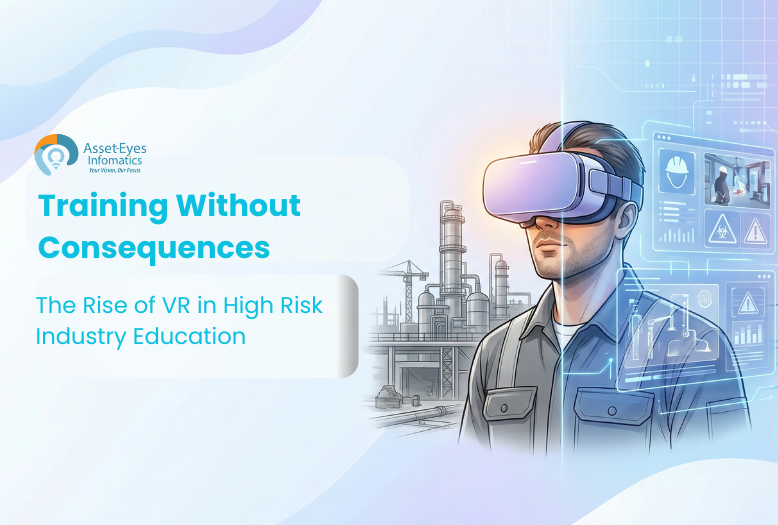
Picture this scenario: You need to train a new chemical plant operator on emergency shutdown procedures, but you can’t actually create a chemical emergency for practice. A construction worker must learn fall protection protocols, but you can’t let them fall to understand the consequences. A manufacturing technician needs to master lockout/tagout procedures on complex machinery, but you can’t risk equipment damage or injury during training. This is exactly where the growth of VR in high risk industry education is making a powerful impact. Virtual Reality (VR) allows businesses to create realistic. Immersive training environments where employees can safely experience dangerous situations without any real-world consequences.
This is the paradox that’s plagued industrial safety training for decades: You can’t truly prepare workers for dangerous situations without exposing them to danger. Until now.
Virtual Reality is fundamentally solving this catch-22, allowing workers to experience realistic, high-stakes scenarios complete with consequences without any actual risk. This isn’t just an improvement in training methods; it’s a complete reimagining of how we prepare people for hazardous work environments.
1. The Training Paradox: Why Traditional Safety Methods Fall Short
Let’s be honest about conventional safety training. Most of it involves sitting in conference rooms, watching PowerPoint presentations. And reviewing safety videos that feel disconnected from the actual chaos of industrial environments. Workers nod along, sign completion forms, and then head to job sites where real world conditions look nothing like what they studied.
The problem isn’t that workers don’t care or trainers aren’t trying hard enough. The problem is neurological. Our brains learn dangerous tasks through experience through doing, failing, correcting, and repeating until responses become automatic. When someone faces an actual emergency, they don’t have time to recall bullet points from a slide deck. They need trained reflexes.
VR training can improve knowledge retention by up to 92% compared to traditional methods. Primarily because it engages multiple senses and creates genuine emotional responses. When your brain experiences something in VR even though you consciously know it’s not real your body responds as if it is. Your heart rate increases, your decision-making processes activate under pressure, and muscle memory begins forming.
This physiological response is exactly what makes VR so effective for safety training. You’re not just learning about hazards; you’re learning how to respond to them while experiencing realistic stress levels.
2. How VR Resolves the Safety Training Challenge – Growth of VR
Virtual reality eliminates the impossible choice between thorough preparation and worker safety. Here’s how it works across high-risk industries:
Construction: From Toolbox Talks to Immersive Hazard Recognition
On live construction sites, you don’t want new workers learning about fall protection, scaffold collapse, or crane swing radius by being present when something actually goes wrong. VR lets you simulate pre-task planning and hazard identification on digital twins of actual jobsites.
Workers can practice correct use of PPE and fall arrest systems under realistic conditions, experience step-by-step safe access to height. And learn emergency response procedures when something does fail. Studies in construction safety training show that VR-trained workers recognize significantly more hazards in real environments than those who only received traditional training.
Manufacturing: Lockout/Tagout and Machine Safety
In manufacturing, danger is often fast and unforgiving rotating parts, pinch points, high-pressure lines, and automated systems leave no room for error. VR training allows operators and technicians to practice lockout/tagout procedures for complex machines, safe approaches to clearing jams. And proper setup during line changeovers.
A key advantage here: you can build these VR experiences directly from your existing CAD drawings services, SolidWorks design models, or general assembly drawings of actual machines. This means trainees practice on true-to-life digital versions of your exact equipment, ensuring the steps they learn in VR match what they’ll do on the shop floor.
Chemical Processing: Rare but Critical Scenarios
In chemical processing and related fields, most days are uneventful until they very much aren’t. Many critical scenarios are low probability but high impact, and very difficult to rehearse safely. VR allows process operators and emergency response crews to train for leak detection and response, alarm handling protocols, and startup/shutdown procedures under abnormal conditions.
Research in process safety training shows that immersive simulations help operators build more accurate mental models of system behavior. Especially under fault conditions, compared to reading procedures alone.
3. What Makes VR Safety Training Effective – Growth of VR
Not all VR training delivers results. Based on industry best practices, effective VR safety programs share these characteristics:
Scenario-Based, Not Menu-Based Learning
Effective growth of VR safety training drops learners into realistic situations and asks them to make decisions and take actions. It shows consequences immediately. Think of it as being inside a live drill rather than clicking through slides.
Built on Real Equipment and Procedures
The strongest results come when VR content uses your actual equipment models from SolidWorks models, facility layouts, and documented procedures. This ensures operators recognize what they see in the headset once they’re on site, and safety procedures in VR align with real-world standards.
Measurable, Repeatable Practice
VR excels when you use its data capabilities to track which hazards trainees consistently miss, measure time to complete procedures, and log incorrect steps. Over multiple sessions, you can determine whether a trainee is ready for real world work and identify which topics need more attention across your workforce.
4. Implementation Considerations for Your Organization
If you’re considering VR safety training, here are practical points to consider:
Content Development Strategy
Start by identifying which high-risk tasks cause the most incidents today, which are hardest to train safely in the real world, and where new hires struggle during their first months. These typically make the best initial use cases.
Technical Foundation
You’ll want to organize your 3D models from your CAD models, general assembly drawings, facility photos for texturing, and existing safety documentation. The better your technical inputs, the more realistic and useful your VR environment will be.
Integration with Existing Programs
VR works best as part of your training ecosystem, not a replacement for everything else. Most effective programs pair growth of VR modules with classroom instruction, use VR for both onboarding and refresher training, and integrate completion data into existing learning management systems.
5. How Asset-Eyes Creates Industry-Specific VR Training
This is where Asset-Eyes makes the difference between generic VR experiences and training that actually prepares your workforce.
Instead of cookie-cutter training environments, Asset-Eyes specializes in creating industry-specific VR training modules built from your actual engineering data. We can ingest your existing CAD models, SolidWorks assemblies, and technical drawings to recreate your actual machines, production lines, and layouts as detailed 3D environments.
When Asset-Eyes develops your VR training modules, we add realistic behaviors, animations, and interactions that mirror your real equipment. This means when a trainee reaches for a valve or control panel in VR, it’s the same one they’ll use on your plant floor.
Our machine design company background ensures these modules cover hazard recognition walkthroughs, step-by-step procedural training like lockout/tagout sequences. And emergency response drills that would be impossible or irresponsible to stage in real life.
With Asset-Eyes VR modules, your teams can practice complex or hazardous tasks repeatedly, make mistakes and see consequences without injuries or downtime, and build genuine muscle memory that transfers directly to real-world performance.
The Bottom Line: From Paper Safety to Practiced Safety
High-risk industries don’t need more safety posters; they need workers who’ve already experienced worst-case scenarios before they actually happened.
VR safety training allows you to expose people to realistic danger without real harm, turn your existing CAD models and SolidWorks design data into interactive training environments, and build measurable competence before workers touch real equipment.
Used thoughtfully, VR doesn’t replace your safety program, it brings it to life. The technology has matured, the effectiveness is proven, and the implementation challenges are manageable. The question isn’t whether VR training works, but how quickly your organization will adopt methods that could prevent the next injury or incident.
If you’re ready to transform your existing engineering data and safety procedures into immersive. Practical training experiences, Asset-Eyes can help you map that journey and build the right VR modules for your specific industry and use cases.
Contact Us Now:
📞 +91 9840895134