
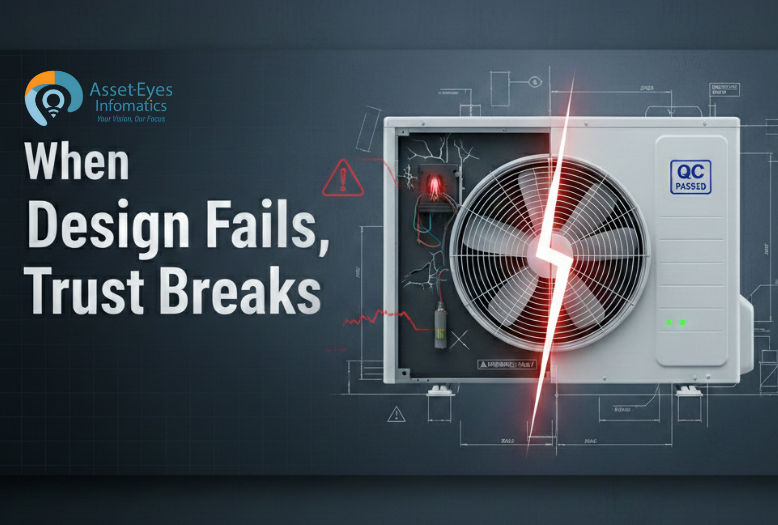
Ever had to explain to a customer why their expensive equipment isn’t working as promised? If you’ve been in that uncomfortable conversation, you know it’s not just about fixing a problem, it’s about rebuilding trust that may never fully return. When design fails, Design quality isn’t just an engineering goal, it’s a fundamental promise to every customer who relies on your equipment for comfort, safety, and peace of mind.
A recent recall involving 1.7 million air conditioning units serves as a stark reminder of what happens when design falls short. Let’s explore how this incident illustrates why exceptional design quality is absolutely non-negotiable for your company’s success and reputation.
Table of Contents
- When Design Lets You Down: The Midea Story
- What Really Went Wrong in the Design
- The Hidden Price of Poor Design
- Why Good Documentation Prevents Bad Design
- How to Build Products That Don’t Design Fails Your Customers
- How Asset-Eyes Helps You Get Design Right
- Your Promise of Quality Starts With Design
1. The Midea Recall: When Design Promises Break Down
According to Health.com, Midea recently recalled approximately 1.7 million U-shaped window air conditioning units across the United States and 45,900 units in Canada. These units, sold under multiple brand names including Midea, Frigidaire, Insignia, and Danby between March 2020 and May 2025, shared a critical design flaw that turned a selling feature into a safety hazard.
The problem centered on the units’ signature U-shaped design. While this configuration was likely intended to provide better window fit and aesthetic appeal, it inadvertently created drainage issues that prevented water from flowing out of the system properly. When condensate water can’t drain effectively, it creates the perfect breeding ground for mold growth inside the unit.
The consequences were serious and far reaching. The recall documentation shows 152 reports of mold growth, with 17 consumers experiencing health symptoms including respiratory infections, allergic reactions, coughing, sneezing, and sore throats. This wasn’t a manufacturing defect or installation error, this was a fundamental design failure where the product’s core configuration created conditions that compromised user health and safety.
2. Why This Represents a Design Fails
This incident clearly illustrates what happens when design teams don’t fully consider the real-world implications of their decisions. The U-shaped configuration that differentiated these units in the marketplace became the very feature that caused their failure. When a product’s physical design prevents basic functions like proper drainage, we’re looking at a design level problem that no amount of quality control or user education can fix.
The scope of this recall affecting multiple brands, various BTU ratings, and spanning five years of production demonstrates how design flaws can have massive, long lasting consequences. Each affected customer now requires either a technician visit, repair kit, or full refund, creating logistical and financial challenges that extend far beyond the initial design oversight. It truly became the worst case scenario.
3. The True Cost of Design Compromises
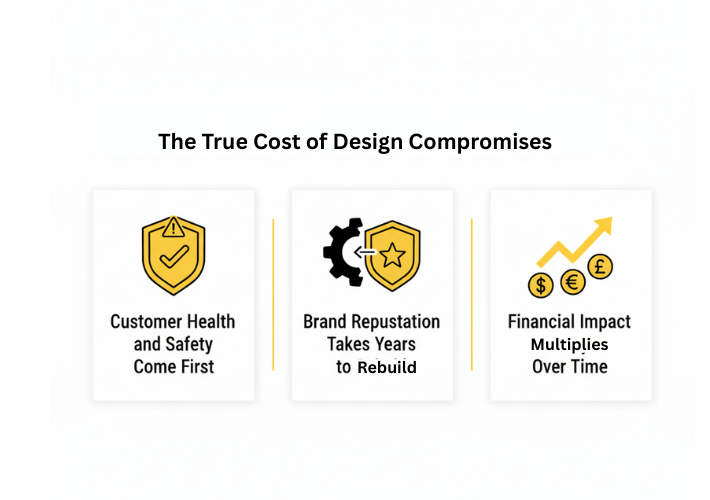
When we talk about design quality, it’s easy to focus on immediate costs like materials or manufacturing complexity. But the ideal situation reveals the hidden costs that emerge when design falls short of customer needs and safety requirements.
Customer Health and Safety Come First: The 17 people who experienced health symptoms remind us that HVAC equipment directly affects indoor air quality and human wellbeing. When design decisions compromise safety, even slightly, the consequences can be severe and personal. Your customers trust you with their comfort and health. That’s a responsibility that must drive every design decision.
Brand Reputation Takes Years to Rebuild: In today’s connected world, product failures don’t stay hidden. Social media, review platforms, and regulatory agencies ensure that design problems become public knowledge quickly, but they also create an environment where even minor issues can be amplified or misrepresented. The companies that thrive are those that get design right the first time, building products that consistently exceed customer expectations for reliability and performance.
Financial Impact Multiplies Over Time: Beyond the immediate recall costs, there’s regulatory scrutiny, competitive disadvantage, and the challenge of rebuilding customer trust. When you’re dealing with millions of units across multiple brand names, the financial impact becomes company defining rather than just a quarterly expense.
4. Building Design Excellence Through Proper Documentation
Here’s where many companies miss a critical opportunity: they focus on the big picture of design innovation while overlooking the foundation that makes reliable design possible, comprehensive, accurate technical documentation that captures every critical interaction and potential failure mode.
The Midea drainage issue might have been prevented with more thorough design documentation that fully explored the implications of the U-shaped configuration under various installation and operating conditions. When drainage pathways aren’t clearly documented and analyzed during development, problems that seem obvious in hindsight can easily slip through even experienced design teams.
Effective HVAC equipment design requires documentation that goes beyond basic component specifications. Modern air conditioning systems involve complex interactions between airflow patterns, condensate management, electrical systems, and structural components. Without comprehensive documentation that maps these interactions, critical failure modes can be missed during development and testing phases.
This is particularly important in HVAC CAD drafting, where precise documentation of moisture pathways, drainage slopes, and component clearances can mean the difference between reliable operation and the kind of systematic failure we saw with the Midea units. When every drainage channel, weep hole, and condensate pathway is clearly documented with proper tolerances and installation requirements, design teams can better predict and prevent moisture related issues.
5. Practical Steps for Design Excellence – When design fails
Learning from the Midea recall, here are key considerations for preventing similar design oversights in your products:
Document Critical Pathways Completely: Whether it’s condensate drainage, airflow paths, or electrical routing, ensure that every critical system pathway is fully documented with section views, dimensional requirements, and performance specifications. If water needs to flow from point A to point B, document every component and surface that affects that flow.
Consider Real-World Installation Variations: Design validation must account for how products perform not just in ideal test conditions, but under the range of installation scenarios customers will actually encounter. Window variations, installation angles, and environmental factors all affect system performance.
Establish Cross-Functional Review Processes: Issues like drainage problems often occur at the intersection of multiple engineering disciplines. Mechanical design, materials science, and environmental engineering teams need structured opportunities to review and challenge each other’s assumptions during development.
Prioritize Long-Term Performance: The mold growth in Midea units didn’t appear immediately; it developed over time as water accumulated in areas where drainage was inadequate. Your validation processes need to simulate extended operation under various conditions, not just initial functionality testing.
6. How Asset-Eyes Supports Design Excellence – When design fails
At Asset-Eyes, our cad drafting service focuses on creating the comprehensive technical documentation that forms the foundation of reliable HVAC equipment design. We understand that preventing issues like the Midea recall starts with precise, thorough documentation that captures every critical design consideration.
Our HVAC CAD drafting team specializes in creating general assembly drawings packages that make moisture management systems, critical clearances, and installation requirements unmistakably clear. Through our solidworks drafting services, we ensure that complex drainage pathways, airflow channels, and component interactions are documented with the precision needed to prevent design oversights.
We don’t redesign your products or make engineering decisions, that’s your expertise. Our role is ensuring that your design intent is captured and communicated with absolute clarity so potential issues are easier to identify and address before they reach production. When drainage slopes, weep hole locations, and condensate pathways are documented with proper tolerances and clear installation notes, manufacturing teams and field installers can execute your design vision reliably.

Your Design Quality Promise – When design fails
The Midea recall serves as a powerful reminder that in HVAC manufacturing, there’s no such thing as a minor design detail. Every component interaction, every drainage consideration, every clearance requirement needs to be thoroughly analyzed and properly documented. When you’re creating products that directly affect people’s comfort, health, and safety, excellence isn’t optional, it’s essential.
Your customers choose your equipment because they trust it to perform reliably day after day, year after year. That trust is built on a foundation of design excellence that starts with thorough analysis and comprehensive documentation, extending through every aspect of your development and manufacturing process. Don’t let a preventable design oversight become your company’s defining moment.
Contact Us Now:
📞 +91 9840895134
FAQs
The Midea recall involved 1.7 million U-shaped window air conditioning units in the U.S. and 45,900 in Canada due to a fundamental design flaw. The signature U-shaped configuration created drainage issues that prevented condensate water from flowing out properly, creating ideal conditions for mold growth. This resulted in 152 reported mold cases and 17 consumers experiencing health symptoms including respiratory infections, allergic reactions, coughing, and sore throats.
The Midea situation represents a design failure because the product’s core physical configuration—not manufacturing errors or installation mistakes—created systematic problems. The U-shaped design that differentiated these units became the feature causing failure across multiple brands, various BTU ratings, and five years of production. No amount of quality control or user education could fix a problem embedded in the fundamental product architecture.
Design failures create costs far beyond immediate recall expenses. The Midea case shows direct costs including technician visits, repair kits, and refunds, plus regulatory scrutiny and brand reputation damage. Human costs included 17 cases of respiratory symptoms from mold exposure. Across millions of units and multiple brands, these impacts become company-defining challenges affecting competitive position, customer trust rebuilding, and long-term market credibility rather than manageable quarterly expenses.
Comprehensive design documentation that fully explored the U-shaped configuration’s implications under various installation and operating conditions might have identified drainage issues before production. When drainage pathways, slopes, and condensate management systems aren’t clearly documented and analyzed during development, problems obvious in hindsight slip through experienced design teams. Precise documentation enables systematic prediction and prevention of moisture-related failures before they reach customers.
HVAC manufacturers should completely document critical pathways including every component affecting condensate drainage with section views and dimensional requirements, account for real-world installation variations beyond ideal test conditions, establish cross-functional review processes where multiple engineering disciplines challenge assumptions, and prioritize long-term performance validation simulating extended operation. The Midea mold problem developed gradually, demonstrating why validation must extend beyond initial functionality testing.
Cross-functional review is essential because HVAC design failures often occur at intersections of multiple engineering disciplines. The Midea drainage issue involved complex interactions between airflow patterns, condensate management, structural components, and installation variables that no single discipline could fully anticipate. Structured opportunities for mechanical design, materials science, and environmental engineering teams to review and challenge each other’s assumptions creates collaborative oversight necessary for identifying failure modes.
Proper HVAC CAD drafting prevents moisture-related failures by documenting every drainage channel, weep hole, condensate pathway, and component clearance with precise tolerances and installation requirements. When moisture management systems are documented with comprehensive section views and dimensional specifications, design teams can predict drainage behavior under various conditions. Clear documentation of drainage slopes ensures manufacturing teams and field installers execute design intent reliably, preventing accumulation issues.
Long-term performance validation simulates extended operation under various real-world conditions, while standard testing only confirms initial functionality. The Midea mold problem demonstrates this distinction—units functioned normally initially but developed serious problems as water accumulated over time. Effective validation must account for window installation variations, different angles, environmental factors, and cumulative moisture effects manifesting only after extended operational periods under diverse customer scenarios.
Asset-Eyes creates comprehensive technical documentation forming the foundation of reliable HVAC equipment design. Their HVAC CAD drafting team specializes in general assembly drawing packages making moisture management systems, critical clearances, and installation requirements unmistakably clear. Through SolidWorks drafting services, complex drainage pathways and component interactions are documented with precision needed to prevent oversights. Asset-Eyes ensures design intent is captured clearly without making engineering decisions or redesigning products.
The Midea recall demonstrates that in HVAC manufacturing, no design detail is minor—every component interaction, drainage consideration, and clearance requirement needs thorough analysis and proper documentation. Products directly affecting people’s comfort, health, and safety require design excellence as a non-negotiable standard. A single overlooked design interaction affecting 1.7 million units across multiple brands proves that preventable oversights can create company-defining consequences damaging customer trust, brand reputation, and financial stability simultaneously.