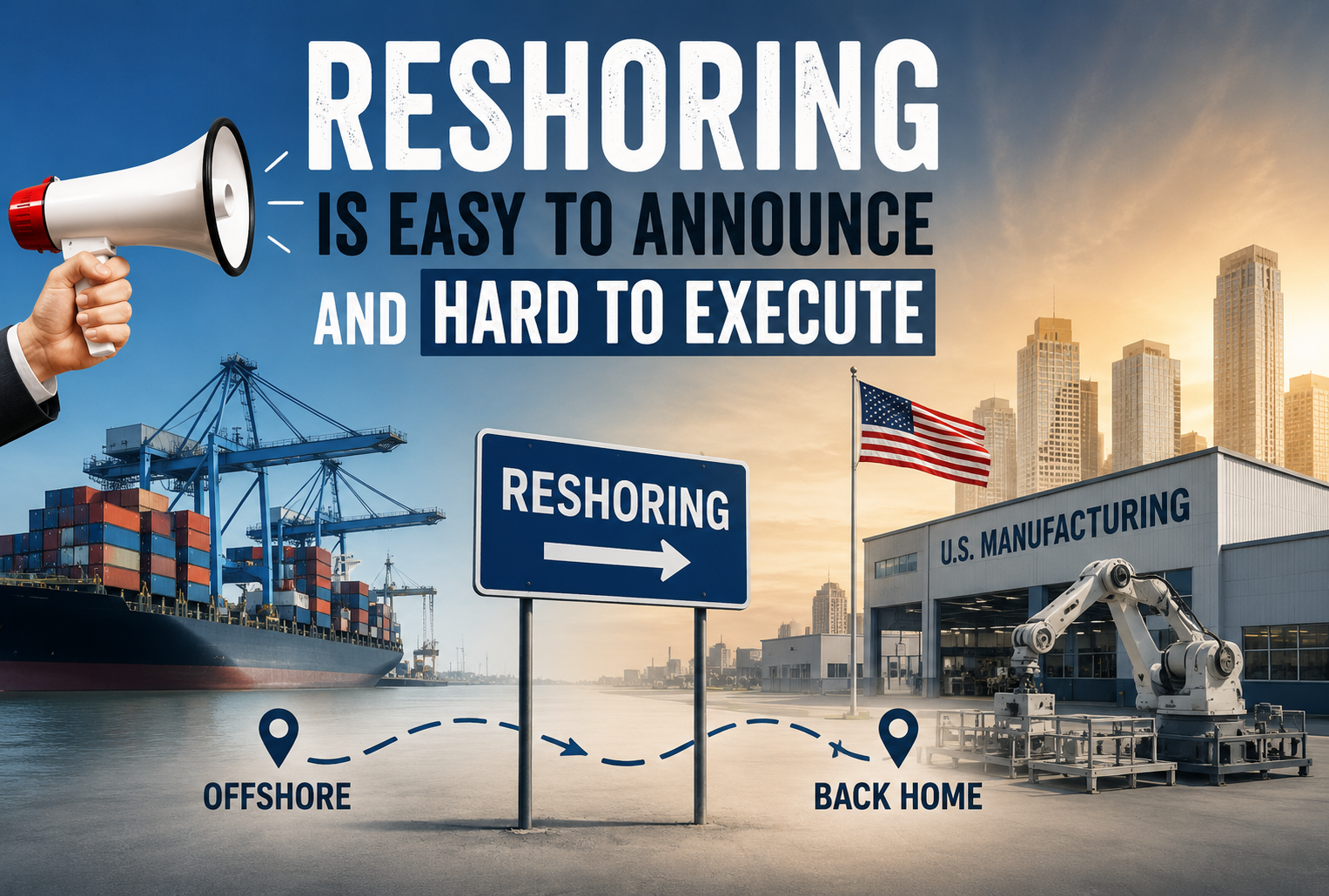
Open any manufacturing trade publication right now and you’ll find the same story on repeat: another company announcing plans to bring production back to the US. Press releases go out. Executives talk about supply chain resilience. Ground gets broken on new facilities. On paper, reshoring looks like a done deal the moment it’s announced.
But walk the floor of a plant six months after one of these announcements, and the picture often looks very different from the press release. The intent is real. The capital is often real too. So why isn’t the actual output new lines running, new facilities producing showing up on the same timeline as the announcements?
The answer sits earlier in the process than most people assume, and it has almost nothing to do with willingness or budget. It sits at the engineering design services stage the unglamorous work of designing and documenting a line before a single machine can run. This article unpacks where reshoring efforts actually stall, why today’s talent market is making that stall worse, and what closes the gap between a reshoring decision and an operational line.
The Bottleneck Isn’t Capital or Willpower — It’s Engineering Execution Capacity
Before a new line runs — before equipment gets ordered, before a contractor breaks ground — someone has to figure out exactly how that line will work. That means:
- Machine and equipment design: new or modified equipment, safety and maintainability built into the design, integration with the rest of the process
- Plant and facility layout planning: where the line sits in the building, how material flows through it, how utilities get routed to it
- Electrical and controls design: power distribution, control panel design, and how the new equipment integrates with existing systems
None of this is optional, and none of it is fast. Without it fully documented, vendors can’t quote accurately, contractors can’t schedule their work, and internal safety and compliance reviews have nothing solid to review.
Here’s what typically happens instead: leadership approves the reshoring initiative, and the assumption is that “engineering will figure it out.” But the same engineers who’d need to design and document the new line are usually the ones already keeping the current operation running — troubleshooting equipment, handling change orders, managing audits. Asking them to stand up a new line on top of that is a bit like asking your one available contractor to build an addition on your house while they’re still patching the roof and unclogging the plumbing elsewhere. Something has to wait, and it’s rarely the plumbing.
Why This Stage Gets Missed on the Timeline
Part of the problem is that “reshoring” sounds simpler from the outside than it is from the inside. Saying “we’ll duplicate the line we already run overseas” is one sentence. Turning that into a fully engineered, documented solution for a different building, different codes, and different suppliers is a much longer project.
There’s also a visibility problem. You can walk a nearly finished building or point to a machine sitting on a delivery truck — those milestones are tangible. A finalized layout drawing or a completed controls package doesn’t photograph the same way, so it’s easy for organizations to under-resource the exact stage where the real risk is concentrated.
The Talent Squeeze Nobody Priced Into the Plan
Even manufacturers who recognize this gap and try to solve it by hiring are running into a labor market that has shifted underneath them. The AI and data center infrastructure boom isn’t a background trend anymore it’s actively pulling from the same talent pool manufacturers need for reshoring.
Data center developers and their build-out contractors are recruiting electricians, HVAC technicians, controls specialists, and project engineers at scale the exact people manufacturers need to electrify new lines, retrofit facilities, and keep uptime intact during the transition. You’re not just competing with the manufacturer down the road for that talent anymore; you’re competing with hyperscale construction budgets that can move faster and pay more.
The net effect is that even well-funded, well-intentioned reshoring commitments can sit idle for months — not because construction is behind schedule, but because the engineering documentation that construction depends on was never finished in the first place.
What “Engineering Execution” Actually Involves
It’s worth being specific about what this stage actually requires, because the scope is easy to underestimate if you haven’t run through it before. Standing up a reshored line typically means working through several things in parallel:
- Facility and plant layout design: positioning equipment, workstations, and material flow paths while accounting for safety clearances, maintenance access, and future flexibility
- Machine and equipment design: adapting existing designs or engineering new equipment to fit domestic suppliers, codes, and building constraints
- Electrical and controls design: power load planning, control panel design, and integration with existing systems
- Documentation: the drawings, specifications, and bills of materials that let vendors quote accurately and contractors schedule their work
Each of these needs dedicated engineering hours, and in a typical reshoring project, they all need to move at roughly the same time to hit any realistic date.
Why Hiring Your Way Out Rarely Works on Reshoring Timelines
The instinct to solve a capacity problem by hiring is understandable, but the math rarely lines up with reshoring urgency. A realistic hiring cycle for a specialized engineer today runs 60 to 90 days before you factor in onboarding and that clock only starts once a role is approved and posted, assuming the right candidate exists at all in a market where data center projects are also bidding for them.
There’s a second mismatch too: reshoring engineering work tends to spike for a defined window — typically the 12 to 18 months it takes to get a line fully documented and installed — and then tapers off. Hiring full-time to meet a temporary peak often leaves manufacturers carrying overhead they don’t need once the project is done.
Several industry surveys over the past few years have pointed to a consistent gap between the share of manufacturing leaders who say they intend to reshore and the share of projects that have actually reached full production. That pattern lines up with what shows up on the ground floor: intent and capital are rarely the constraint. Available engineering hours are.
Closing the Gap Between Decision and Operational Line
This is precisely the phase where flexible, external engineering support can close the distance between a reshoring decision and a reshoring reality. As a machine design company that also delivers engineering design services, Asset-Eyes works with manufacturers at exactly the point where internal teams are stretched thinnest and the clock is already running.
That work spans plant and facility layout design, machine design for new or adapted equipment, and electrical control panel design for the lines being stood up not as a checklist of services, but as the connected engineering work that has to happen before anything gets installed. The goal isn’t to replace an internal engineering team; it’s to add capacity at the exact stage where reshoring projects most often lose momentum, without adding a 60-to-90-day hiring cycle to the front of an already time-sensitive commitment.
For manufacturers serious about reshoring, the real question isn’t whether the engineering will eventually get done it’s whether it gets done fast enough to protect the timeline that’s already been communicated to customers, investors, and leadership.
The Real Reshoring Question
The gap between a reshoring announcement and an operational line rarely comes down to willingness or funding. It comes down to whether there’s enough engineering bandwidth to design the line, plan the layout, engineer the power and controls, and document all of it before construction and installation can even start. Ambition was never the missing piece — capacity at the engineering stage usually is.