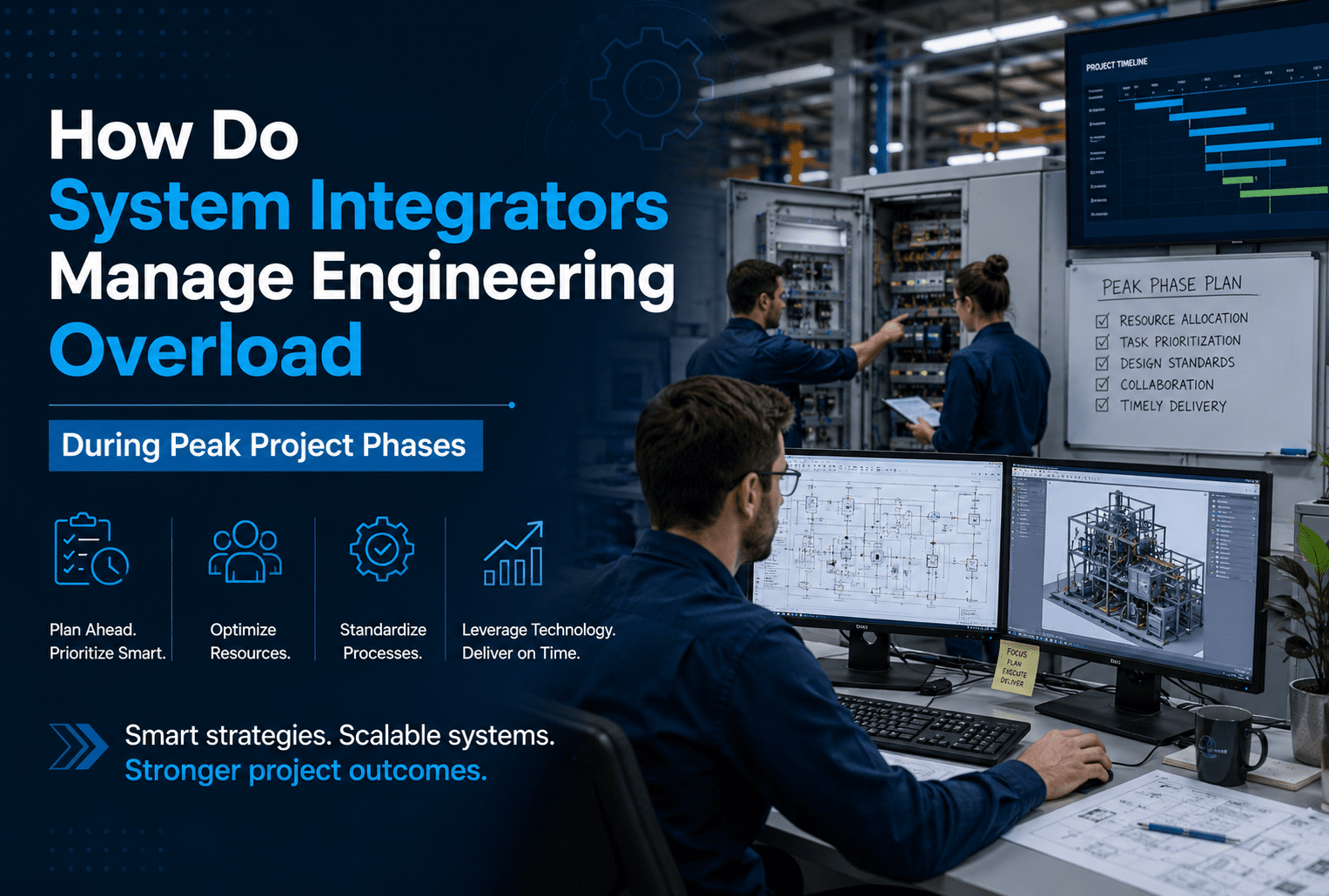
System integrators manage engineering overload by separating high-value design judgment from execution-heavy drafting, standardizing templates and component libraries so work can actually be delegated, and using an elastic bench of external engineering capacity to absorb surges instead of forcing overtime on the same two or three overloaded people. Trying to survive peak phases purely through internal overtime leads to burnout, drafting errors, and commissioning delays; the integrators who protect their margins treat capacity as something that flexes with the project pipeline, not something fixed to headcount.
Why Integration Workloads Spike So Violently
System integration is inherently boom-and-bust. You might spend six months bidding a major facility automation project, only to have it awarded at the same time as two smaller upgrades and suddenly your engineering team faces an impossible backlog of hardware design, panel layout, and PLC programming simultaneously. Hire full-time staff to cover that peak and your overhead erodes margin the moment the workload normalizes. Don’t add capacity, and you miss deadlines and damage the client relationship you just won the bid to protect. Three structural factors make these peaks especially punishing: the same senior people are critical to multiple projects at once, customers push late-stage changes that ripple through drawings already in progress, and documentation — as-built updates, wiring markups, final drawing packages gets pushed to nights and weekends because it’s the easiest thing to defer.
The Overload Diagnostic Framework
Before deciding how to respond to a peak, run your situation through these four questions.
1. Is your bottleneck design judgment or execution drafting?
Audit where the hours are actually going. If senior controls engineers are spending a significant share of their week generating I/O lists, terminal layouts, or wiring schematics rather than architecture decisions and commissioning, your bottleneck is execution — not a shortage of engineering judgment. That distinction determines whether the fix is more expertise or more hands.
2. Is this peak structural and recurring, or a one-time spike?
A single unusually large project creates a temporary crunch that may not justify building a standing external relationship. A pattern of peaks quarter after quarter, tied to your typical project cycle is a structural feature of your business model that deserves a structural answer.
3. How standardized are your templates and component libraries?
You can’t hand off work to a junior hire or an external partner if your designs depend on tribal knowledge. Delegation requires standardized templates, macro libraries, and a clean, structured component database that lets a peak-phase project pull a pre-configured motor starter circuit or standard PLC rack layout instead of designing it from scratch every time.
4. What’s the real cost of your current approach?
Add up the overtime premium, the missed or declined bids because sales doesn’t trust engineering’s bandwidth, and the schedule risk created by having one person as a single point of failure across every active project. That number is almost always larger than the cost of a flexible external bench — it’s just less visible because it’s spread across payroll and lost opportunity rather than a single invoice.
Signs It’s Time to Add External Capacity
Your programmers are drafting instead of programming: Engineers responsible for PLC and HMI logic are delayed because they’re stuck generating terminal strip diagrams and updating schematics.
Overtime has become a permanent strategy, not a sprint: Your team works evenings and weekends for months at a time just to keep pace with the drafting backlog, not just during a single commissioning week.
You’re declining profitable bids: Sales hesitates to pursue new integration work because engineering can’t credibly commit to producing the drawing packages on time.
A single designer is your critical path: One person handles all electrical schematic and layout work across every active project, and their availability determines your delivery schedule for the whole business.
Signs You Need Process Improvements First
Every project is a custom snowflake: Your team designs every control panel from scratch and won’t use standardized macros or templates. External capacity can’t help if there’s no established framework to follow.
Your component database is a mess: If your CAD environment relies on manual text entry rather than a structured manufacturer part database, adding more drafters just multiplies BOM errors instead of fixing the underlying problem.
Handoffs are undocumented: If explaining design intent requires a two-hour whiteboard session with the lead engineer every time, your internal process is too fragile to hand off to anyone internal or external until it’s tightened up.
What to Expect from a Professional Engineering Partner During Peak Phases
A partner worth using during a peak should function as an extension of your team, not a disconnected vendor executing instructions. Look for:
- Fluency in your electrical CAD platform (EPLAN, AutoCAD Electrical, SolidWorks Electrical) and the component libraries you already rely on
- The ability to scale a team up quickly when a project lands and scale back down to zero once panels ship, without contract friction
- Established handoff protocols — once I/O and device lists are defined, drafting proceeds in parallel with your engineers’ design work rather than queuing behind it
- Clear escalation paths for ambiguous inputs, so drafting doesn’t stall waiting on a clarification that could have been resolved same-day
- A track record with standards-driven, execution-heavy work specifically schematics, panel layouts, wire lists, terminal plans, and as-built updates rather than a generalist claim to “do engineering”
How Asset-Eyes Supports Integrators During Peak Phases Asset-Eyes acts as an elastic drafting and documentation bench for system integrators facing peak project phases. We work inside your standards and component libraries, turning your team’s architecture decisions into complete, production-ready electrical drawing packages schematics, panel layouts, wire lists, terminal plans, and as-built updates so your controls engineers stay focused on PLC/HMI logic, safety functions, and commissioning instead of drafting execution. You keep ownership of design intent and customer relationships; we absorb the documentation volume that turns a manageable peak into an unmanageable one.