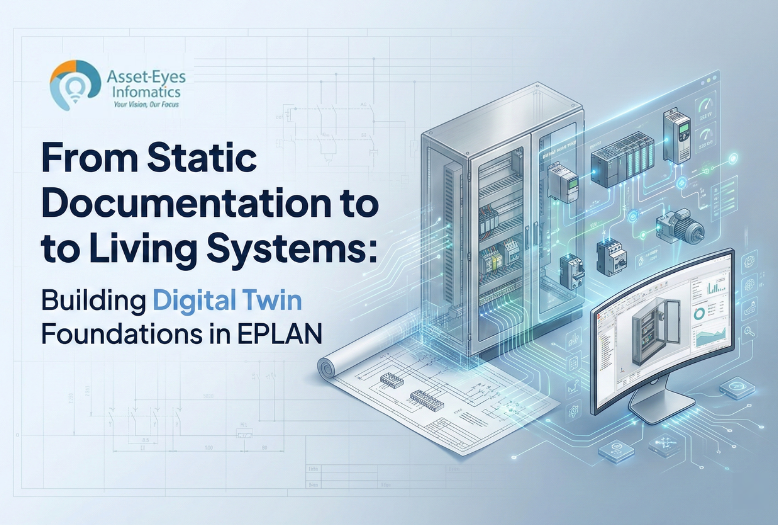
For engineers already deep in EPLAN Electric P8 and Pro Panel, the real opportunity isn’t another dashboard showing live sensor readings. It’s using the structured data you already create as a foundation for IIoT systems that connect design intent with real world operation. The question isn’t whether digital twins are worth pursuing, it’s whether your EPLAN projects are structured to support them.
1. The Data Fragmentation Problem
Controls engineers will be familiar with this scenario : your EPLAN project meticulously documents every device as “M1_VFD_SupplyFan,” the PLC programmer tags it “AHU01_SF_Drive,” and the SCADA system displays it as “Supply Fan VFD Unit 1.” When operations need to correlate energy consumption trends with design specifications, these naming inconsistencies become painful headaches.
The digital twin doesn’t fail because of sensor technology or analytics algorithms. It fails because the foundational engineering data exists in disconnected silos, each using different naming conventions, different levels of detail, and different organizational paradigms. Your EPLAN database contains extraordinarily rich device data, but most of it remains trapped in a format that downstream systems can’t consume intelligently.
The problem isn’t understanding that EPLAN can act as a master data source, it’s that most teams don’t structure their projects to actually use it that way from day one.
2. Tag Architecture: The Foundation Everything Depends On
Device tagging represents the single point of failure or success for digital twin implementations. For experienced EPLAN users, this isn’t about learning new tagging conventions; it’s about understanding how your existing choices ripple through every downstream system.
2.1 Structured Naming for System Integration
Your tag architecture must simultaneously satisfy
- Electrical documentation requirements
- PLC addressing conventions
- SCADA display hierarchies
- Analytics platform data models
The problem gets worse as systems grow; flat naming breaks down, while overly complex hierarchies clash with platform character limits. Successful implementations typically employ structured naming that embeds location, function, and device type within the tag itself.
For example, CH01_COMP_A_OilPressure clearly shows the chiller, compressor, and signal type at a glance. The same tag works consistently across EPLAN drawings, PLC programs, SCADA screens, and analytics systems.
2.2 IEC 81346 Compliance for Global Consistency
For organizations operating internationally, rigorous enforcement of IEC 81346 standards (Function, Location, Product) becomes critical. The same device identifier used in EPLAN must be carried through every connected system. When data is exchanged with PLC tools like TIA Portal or Studio 5000, this consistency ensures the digital model accurately reflects the real hardware.
At Asset-Eyes, we’ve found that establishing these conventions during initial project setup prevents months of downstream reconciliation work. We configure EPLAN templates and device libraries with standardized tagging schemes that maintain consistency across electrical documentation, PLC programming, and IIoT platforms.
3. Device Intelligence Beyond Basic Properties
EPLAN’s component database capabilities extend far beyond part numbers and terminal configurations. When it comes to digital twins, every device you specify should carry operational metadata that analytics platforms will reference throughout the system’s lifecycle.
3.1 Operational Specifications as Structured Data
When you specify a pressure transmitter, the standard approach captures manufacturer, model number, and electrical connections.
For digital twin use, you also need to capture operational details such as measurement range, accuracy, calibration intervals, and alarm thresholds. Rather than being scattered across specification documents, this data is embedded directly into the EPLAN database and reused downstream.
Implementation involves creating custom component properties that capture operational metadata alongside electrical specifications. These properties then export to structured formats (XML, CSV, JSON) that analytics platforms consume directly. When your digital twin needs to determine “normal” operation for a specific device, it references design specifications embedded in the EPLAN project rather than requiring manual data entry into separate systems.
3.2 Relationship Mapping for System Context
Take a VFD controlling a supply fan. EPLAN captures the wiring and control signals, but a digital twin only works when it can relate speed commands to motor current, temperatures, and airflow data. That’s only possible if all related devices are tagged consistently and their relationships are clearly defined.
In practice, this means deliberately linking components during project setup. Motors, starters, overloads, and relevant sensors must be connected in the model and not just on drawings. This is so downstream systems can understand how the equipment actually behaves.
4. Integration Architecture: From EPLAN to Operations
Moving from EPLAN documentation to operational insights requires passing data through several systems, where inconsistencies can easily creep in. Understanding these handoff points helps you structure EPLAN projects in a way that reduces rework and data loss.
4.1 SCADA Integration Strategy
SCADA systems organize by operations (process control, alarms, monitoring), while EPLAN organizes by electrical function (circuits, power, instrumentation). A digital twin needs both views, so data must flow carefully between systems.
In practice, you export structured device lists from EPLAN that include not just tags and I/O addresses, but also display groups, alarm settings, and trending info. For example, a temperature sensor “TT-201” in EPLAN also needs to be assigned to the “Condenser Section” in SCADA, trend every second, and trigger high priority alarms above 180°F.
The best approach uses an intermediate translation step. Export EPLAN data to a standard format, then use scripts to convert it into SCADA ready formats. This lets you add operational details and apply business rules without altering the original EPLAN project.
4.2 Time-Series Database Preparation
Modern digital twins use time series databases to track device data for trends, maintenance, and performance. Every sensor or meter in EPLAN can generate this data, but connecting it to analytics requires planning.
Your analytics system needs consistent device tags, measurement units, normal ranges, and ideally location, maintenance schedules, and relationships to other equipment. This metadata lets you analyze trends, predict failures, and optimize energy use effectively.
5. Pro Panel as Spatial Intelligence
For IIoT implementations involving thermal monitoring, augmented reality maintenance, or automated diagnostics, 2D schematics prove insufficient. EPLAN Pro Panel becomes the spatial database that provides XYZ coordinates for every component, enabling location aware analytics and visualization.
5.1 3D Context for Analytics
By exporting Pro Panel enclosure models via STEP files or AutomationML, you provide digital twins with precise component positioning. When a cabinet temperature sensor alerts to a hotspot, the digital twin uses Pro Panel data to visualize exactly which components occupy that zone and calculates theoretical heat dissipation based on active load conditions.
This spatial intelligence also enables augmented reality applications where technicians viewing panels through AR tablets see overlay data identifying which breaker controls which remote motor pulled directly from EPLAN device tags and 3D positioning information.
5.2 Manufacturing Integration
Pro Panel’s 3D validation capabilities extend into digital twin commissioning validation. Export your component placement data and compare against what installation teams actually build. Discrepancies indicate either installation errors or documentation problems, both of which you want to identify before declaring systems operational.
At Asset-Eyes, we leverage Pro Panel not just for panel layout verification, but as a source of spatial data that supports the entire system lifecycle. Our approach ensures that 3D models contain the metadata and relationship information that downstream digital twin platforms require.
6. Multi-Vendor Integration Reality
Because real world industrial systems rarely consist of components from a single manufacturer, your project might include Siemens VFDs, Allen Bradley PLCs, Schneider Electric contactors, and instrumentation from a dozen different vendors. Each manufacturer provides device data in different formats with varying levels of detail, creating integration challenges for digital twin implementations.
The solution requires establishing internal data standards that supersede manufacturer provided information. When adding components to EPLAN libraries, don’t just accept manufacturer data as-is. Augment it with standardized properties that your digital twin architecture requires: consistent parameter naming, normalized units of measurement, and structured relationship definitions.
This standardization effort pays dividends throughout the system lifecycle. When you need to replace a failed sensor with a different manufacturer’s equivalent, your digital twin continues functioning because the replacement device inherits the same standardized properties and relationships. The specific manufacturer becomes an implementation detail rather than a system architecture dependency.
7. Version Control and Change Management
Industrial systems change over time equipment is upgraded, controls are adjusted, and new sensors are added. A digital twin must reflect not only the current setup, but also how and why the system has changed. EPLAN’s revision tools help, but digital twins need clearer, more structured change tracking.
Any update in EPLAN can affect how the digital twin interprets system behavior. Adding a sensor changes operating limits, and replacing a VFD means performance baselines must be reset. What matters is recording not just the change, but the reason for it and the expected impact.
In practice, EPLAN projects should be treated as living documents. Key updates are regularly exported to the digital twin so design data and real world operation stay aligned over the entire lifecycle, not just at commissioning.
8. Asset-Eyes’ Integrated Approach – EPLAN
At Asset-Eyes, we recognize that electrical documentation serves purposes far beyond panel fabrication and field installation. Our EPLAN expertise extends into structuring projects as foundational databases for digital twin implementations, ensuring device data, tag architectures, and relationship mappings support both immediate manufacturing needs and long term operational intelligence requirements.
We combine deep EPLAN proficiency with emerging IIoT capabilities, understanding how electrical design data flows into SCADA systems, historians, and analytics platforms. Our approach involves establishing consistent tagging conventions, populating comprehensive device metadata, and documenting system relationships in machine interpretable formats.
Through our integrated service model spanning electrical design, automation systems, and now AR/VR visualization capabilities, we ensure EPLAN projects become true digital assets supporting the entire system lifecycle. We handle the complex, time intensive work of building data foundations so your internal engineers can focus on control logic and system architecture.
Whether you’re in renewable energy, semiconductor manufacturing, pharmaceutical production, or industrial automation, we understand the practical challenges of multi vendor environments, evolving standards, and balancing immediate documentation requirements with future digital twin capabilities.
Implementation Strategy: Starting Smart EPLAN
The convergence of electrical design documentation and operational intelligence platforms isn’t a distant future scenario, it’s happening now. Organizations that structure EPLAN projects with digital twin applications in mind gain significant competitive advantages through predictive maintenance, performance optimization, and rapid troubleshooting capabilities.
Practical First Steps
Start with your next EPLAN project and implement consistent tagging conventions. Populate device properties with operational metadata. Document relationships between related components. Export structured device lists and test importing them into your SCADA system or analytics platform. Learn what works, refine your approach, and gradually build expertise and templates that make digital twin ready documentation your standard practice.
The electrical systems you’re documenting today will operate for decades. Investing effort now to structure documentation for digital twin applications pays dividends throughout the entire system lifecycle from commissioning validation through performance optimization to eventual replacement planning.
How Asset-Eyes Builds Digital Twin–Ready CAD Foundations
Digital twins do not begin with IIoT platforms or analytics dashboards; they begin with engineering data. At Asset-Eyes, our CAD drafting service is structured around this reality. We treat every EPLAN project, panel layout, and device database not simply as documentation, but as a long term digital asset designed to support integration, automation, and operational intelligence.
Our approach goes beyond producing accurate drawings. We focus on building clean, structured, machine readable engineering data that seamlessly connects electrical design, PLC programming, SCADA systems, and analytics platforms.
Digital Twin–Focused CAD Structuring
We design EPLAN Electric P8 and Pro Panel projects using standardized tag architectures, consistent device naming, and structured component properties. This ensures your engineering data remains usable across historians, SCADA environments, and IIoT systems without requiring costly reconciliation later.
Operational Metadata Integration
Asset-Eyes embeds intelligence directly into CAD models. Devices are enriched with operational specifications such as ranges, alarm limits, calibration intervals, and functional relationships. This transforms assembly drawings into data sources that digital twin platforms can interpret automatically.
Multi-System Compatibility
Our CAD deliverables are prepared for downstream integration. Whether exporting to PLC environments, SCADA databases, or time series analytics systems, we ensure device lists, I/O mappings, and component attributes remain consistent and interoperable.
Spatial Intelligence with Pro Panel
For advanced applications such as thermal analysis, AR based maintenance, or diagnostics visualization, we leverage Pro Panel’s 3D capabilities to create spatially aware digital models that extend far beyond traditional schematics.

Future-Ready Documentation Strategy
Industrial systems evolve. Our drafting methodology supports version control, structured updates, and lifecycle continuity so your documentation remains aligned with real world system behavior over time.
At Asset-Eyes, CAD drafting is not a finishing step, it is the foundation of your digital infrastructure. By establishing structured engineering data from the start, we enable smoother automation integration, faster commissioning, and scalable digital twin deployment.
Contact Us Now:
📞 +91 9840895134
FAQs
Digital twin projects fail primarily because foundational engineering data exists in disconnected silos using different naming conventions and organizational paradigms. When EPLAN documents a device as “M1_VFD_SupplyFan,” PLC programming tags it “AHU01_SF_Drive,” and SCADA displays “Supply Fan VFD Unit 1,” operations cannot correlate design specifications with real-world data. The failure isn’t technological—it’s that EPLAN projects aren’t structured from day one to serve as master data sources for downstream systems.
Effective tag architecture must simultaneously satisfy electrical documentation requirements, PLC addressing conventions, SCADA display hierarchies, and analytics platform data models. Structured naming should embed location, function, and device type within each tag—for example, “CH01_COMP_A_OilPressure” clearly identifies the chiller, compressor, and signal type. This single consistent identifier works across EPLAN drawings, PLC programs, SCADA screens, and analytics systems, eliminating downstream reconciliation work and preventing data fragmentation that breaks digital twin functionality.
IEC 81346 provides international standards for Function, Location, and Product identification, ensuring the same device identifier used in EPLAN carries through every connected system globally. For organizations operating internationally, rigorous enforcement becomes critical when exchanging data with PLC tools like TIA Portal or Studio 5000. Asset-Eyes configures EPLAN templates with standardized tagging schemes during initial project setup, preventing months of downstream reconciliation work across electrical documentation, PLC programming, and IIoT platforms in different facilities and regions.
Beyond standard manufacturer information and electrical connections, digital twin-ready EPLAN specifications must capture measurement ranges, accuracy specifications, calibration intervals, and alarm thresholds for instrumentation devices. This operational metadata gets embedded directly into the EPLAN database using custom component properties, then exported to structured formats including XML, CSV, and JSON that analytics platforms consume directly. When digital twins need to determine normal operation parameters, they reference design specifications embedded in EPLAN rather than requiring separate manual data entry into downstream systems.
EPLAN Pro Panel provides XYZ coordinates for every component, enabling location-aware analytics and visualization that 2D schematics cannot support. By exporting Pro Panel enclosure models via STEP files or AutomationML, digital twins receive precise component positioning data. When cabinet temperature sensors detect hotspots, the digital twin visualizes exactly which components occupy that zone and calculates theoretical heat dissipation based on active loads. This spatial intelligence also enables augmented reality maintenance applications where technicians see overlay information pulled directly from EPLAN device tags and positioning data.
Effective SCADA integration requires understanding that EPLAN organizes by electrical function while SCADA organizes by operational processes. The best approach uses an intermediate translation step: export structured device lists from EPLAN containing tags, I/O addresses, display groups, alarm settings, and trending information, then use scripts to convert data into SCADA-ready formats. For example, temperature sensor “TT-201” needs assignment to the “Condenser Section” in SCADA with specific trending intervals and alarm thresholds—details added during translation without altering the original EPLAN project.
Multi-vendor environments require establishing internal data standards that supersede varying manufacturer-provided information formats. When adding components from Siemens, Allen-Bradley, Schneider Electric, or other vendors to EPLAN libraries, engineers must augment manufacturer data with standardized properties including consistent parameter naming, normalized measurement units, and structured relationship definitions. This standardization ensures digital twins continue functioning when failed sensors are replaced with different manufacturers’ equivalents, because replacement devices inherit standardized properties rather than creating architecture dependencies on specific vendor data formats.
Industrial systems continuously evolve through equipment upgrades, control adjustments, and sensor additions that affect digital twin accuracy. Adding a sensor changes operating limits, while replacing a VFD requires resetting performance baselines in analytics systems. EPLAN projects must be regularly exported to digital twins to maintain alignment between design data and real-world operation throughout decades of system lifecycle, not just at commissioning. Effective change management records not just what changed, but the reason for changes and expected operational impacts, ensuring digital twin analytics use correct baselines.
Relationship mapping enables digital twins to understand how equipment actually behaves as integrated systems rather than just documenting individual components. A VFD controlling a supply fan only provides meaningful analytics when speed commands can be correlated with motor current, temperatures, and airflow data simultaneously. This requires deliberately linking motors, starters, overloads, and relevant sensors in the EPLAN model during project setup. Without these documented relationships, downstream analytics platforms cannot understand system interdependencies or generate accurate predictive maintenance insights from operational data.
Asset-Eyes structures EPLAN projects as foundational databases supporting complete system lifecycles by establishing consistent tagging conventions, populating comprehensive device metadata, and documenting system relationships in machine-interpretable formats. Their integrated service model spans electrical design, automation systems, and AR/VR visualization, ensuring EPLAN projects become true digital assets feeding SCADA, historians, and analytics platforms. Asset-Eyes handles complex data foundation work so internal engineers can focus on control logic and system architecture, serving industries including renewable energy, semiconductor manufacturing, pharmaceutical production, and industrial automation with digital twin-ready documentation.