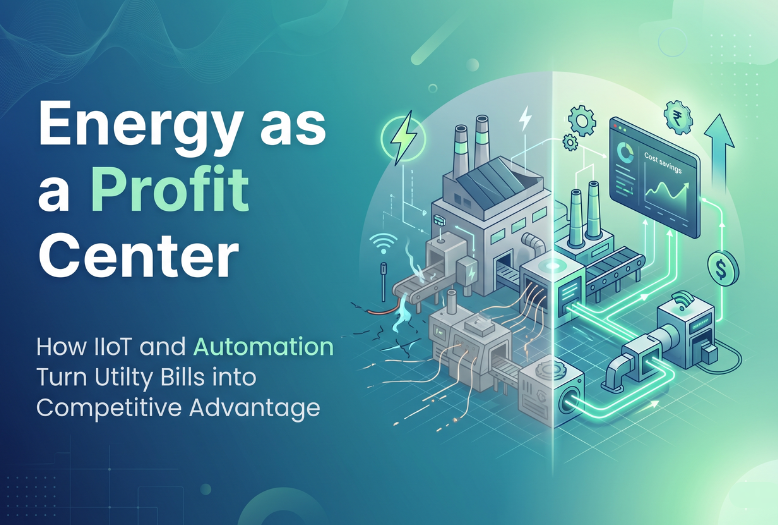
Picture this: You’re reviewing your facility’s monthly expenses, and there it is again that hefty utility bill that seems to grow every quarter. Most manufacturers look at this number and see a painful, fixed cost of doing business. But what if that same expense could be transformed into a Profit Center, generating measurable savings and strategic value instead of just draining resources?
But what if that bill was actually a detailed report card on your operational efficiency? What if those numbers revealed exactly where you’re losing money and how to turn those losses into competitive advantages?
The reality is that energy doesn’t have to be a fixed cost. With the right IIOT monitoring strategy, energy transforms from “just overhead” into a measurable, controllable, and optimizable resource. Unlike many digital initiatives with uncertain payoffs like comprehensive digital twin projects that take years to develop or predictive analytics platforms that require extensive data training before delivering insights, energy monitoring delivers immediate ROI that shows up in your next utility bill.
In this blog, we’ll explore how energy monitoring can deliver 15-30% cost reductions through three high-impact strategies: peak demand management, power factor optimization, and equipment efficiency benchmarking. We’ll also show how proper electrical control panel design creates the foundation for turning energy from a monthly expense into a managed asset.
1. Why Energy Monitoring Delivers Immediate ROI – Profit Center
When most manufacturers track key metrics like raw materials, labor costs, and production output, energy often gets lumped into a single line item on the P&L statement. That’s a massive missed opportunity.
Energy consumption is actually a real-time signal of how your entire facility is performing. It’s a proxy for equipment health, process efficiency, and operational patterns. With IIoT-enabled monitoring, instead of getting a single monthly bill, you gain visibility into:
- Per-equipment and per-line energy consumption
- Time-based trends across shifts, batches, and products
- Real-time alerts on abnormal spikes or inefficiencies
- Actionable data that drives immediate cost reduction
The key difference is moving from reactive bill-paying to proactive energy management.
2. Three High-Impact Areas for Immediate Savings
Let’s focus on the three practical levers where manufacturers consistently see 15-30% energy cost reductions when they implement proper monitoring and control systems.
2.1 Peak Demand Management: Taming the Spikes That Drive Your Bill – Profit Center
Your utility bill isn’t just based on how much energy you use, it’s heavily influenced by your peak demand(The highest amount of power you draw during any 15-minute window in a billing cycle).
Think of it like a speeding ticket. You might drive the speed limit for 29 days of the month, but if you hit 100 mph for just 15 minutes, you pay a penalty for the entire month.
Many facilities unknowingly create costly demand spikes when multiple high-power systems start simultaneously. A compressor kicks on while the HVAC system design ramps up, and suddenly you’ve set a new peak that determines your demand charges for weeks.
How IIoT monitoring helps:
- Identifies exactly when and where demand spikes occur
- Correlates spikes to specific equipment, processes, or shifts
- Provides alerts before thresholds are breached
- Enables automated load-shedding strategies
Practical strategies include:
- Staggered equipment startup sequences instead of simultaneous starts
- Automatic shedding of non-critical loads during peak periods
- Shifting energy-intensive processes to off-peak hours with lower rates
The foundation for this control requires thoughtful electrical control panel design with integrated power monitoring, communication infrastructure, and automated switching capabilities.
2.2 Power Factor Optimization: Eliminating the “Foam” in Your Energy Glass
Power factor might sound technical, but it has a straightforward impact on your bills. Here’s the best analogy: imagine energy like a glass of beer. The liquid beer is “real power” (kW) that does useful work running motors, powering drives. The foam is “reactive power” (kVAR) that you need to magnetize motors but doesn’t accomplish any actual work.
If your glass is 50% foam, you’re not getting your money’s worth. Utilities penalize poor power factors because they still have to deliver that “foam” through their infrastructure.
A poor power factor means you’re drawing more current than necessary for the useful power you’re consuming. Many utilities impose penalties of 5-15% for power factor below certain thresholds.
How monitoring enables optimization:
- Identifies which specific circuits or equipment cause poor power factor
- Measures the impact of corrective actions like capacitor banks
- Validates that power factor correction equipment is properly sized and placed
- Ensures you maintain utility requirements over time
Design considerations:
Your motor control panel design needs to include appropriate current transformers, voltage inputs, and provision for power factor correction equipment. This isn’t just about compliance improving power factor reduces losses, heat, and electrical stress throughout your distribution system.
2.3 Equipment Efficiency Benchmarking: Energy as an Early Warning System – Profit Center
Traditional maintenance metrics focus on uptime, mean time between failures, and throughput. Energy monitoring adds a powerful dimension: how efficiently is each machine using energy to produce output?
When you establish baseline energy consumption patterns for individual equipment, deviations become early warning signals. A motor drawing 20% more current than usual might indicate bearing wear, misalignment, or excessive loading. A compressor cycling more frequently could signal pneumatic system leaks.
What benchmarking looks like:
- Track kWh per unit produced on each machine or line
- Compare identical equipment performance against each other
- Detect gradual drift in consumption that indicates wear or process issues
- Use energy data as a predictive maintenance trigger
Without monitoring, these inefficiencies compound silently until they result in unexpected failures or significantly inflated bills. With monitoring, you gain what one of our clients calls “X-ray vision” into equipment health through energy consumption patterns.
3. Building the Foundation: IIoT Infrastructure That Delivers Results – Profit Center
Effective energy monitoring requires more than installing smart meters and hoping for insights. You need a thoughtfully designed system that captures the right data at the right level of detail.
Strategic Metering Placement
The foundation starts with proper sub-metering at circuit, equipment, or process levels. A single facility meter tells you that you’re consuming energy, but it doesn’t reveal where optimization opportunities exist.
Key metering points include:
- Main incomers and major distribution panels
- Large motor control centers and HVAC design services
- Energy-intensive processes like compression, heating, cooling, industrial exhaust system or industrial ventilation systems.
- Individual production lines or critical equipment
Data Integration and Control
Modern power monitoring systems track voltage, current, power factor, harmonics, and other characteristics at high sampling rates. This data needs to flow into centralized systems where it can be analyzed, trended, and transformed into actionable insights.
Integration with existing control systems enables automated responses:
- Automatic load shedding when approaching demand thresholds
- Power factor correction activation based on real time measurements
- Maintenance alerts triggered by efficiency degradation
Implementation Strategy – Profit Center
You don’t need a massive digital transformation to start seeing results. A practical approach includes:
Phase 1: Focus on major energy users and distribution points
Phase 2: Add equipment-level monitoring for critical assets
Phase 3: Integrate energy KPIs into production dashboards and decision-making
The key is designing your electrical infrastructure to support this evolution from day one.
4. Asset-Eyes Approach: Designing Energy Intelligence Into Your Systems – Profit Center
At Asset-Eyes, we understand that effective energy monitoring starts with proper electrical design. Our expertise in electrical control panel design and power distribution systems allows us to create monitoring infrastructure that integrates seamlessly with your operations.
We don’t just draft circuits, we design intelligent systems that provide actionable data. Our EPLAN electrical drawings and EPLAN services create comprehensive documentation that accounts for:
- Current transformer placement and sizing for accurate monitoring
- Communication architecture that reliably delivers data from plant floor to dashboard
- Integration points for automated control and optimization systems
- Future expansion capabilities as your energy management program matures
Whether you’re implementing facility-wide monitoring or starting with targeted sub-metering, our approach ensures your electrical infrastructure transforms energy from a fixed cost into a managed, optimizable resource. We design systems where energy becomes a controllable variable, not just a bill you pay at month’s end.
From Insight to Competitive Advantage – Profit Center
Understanding where and how you consume energy is valuable, but the real competitive advantage comes from acting on that knowledge. Successful energy management programs typically evolve through stages as monitoring capabilities and organizational maturity increase.
The first stage eliminates obvious waste equipment running unnecessarily, systems operating inefficiently, or processes consuming more energy than required. These quick wins often justify further investment.
second stage optimizes operational patterns based on energy profit center, shifting production schedules to leverage time of use rates and implementing sophisticated demand management strategies.
The third stage embeds energy considerations directly into production planning and equipment investment decisions. Energy consumption becomes a factor in process design, equipment selection, and facility layout.

Conclusion: From Overhead to Advantage
Energy will always be a cost, but for manufacturers who implement intelligent monitoring and control, it becomes much more than that. It transforms into a source of measurable savings, a window into equipment health and process performance, and a differentiator that improves margins and competitiveness.
By focusing on peak demand management, power factor optimization, equipment efficiency benchmarking and by integrating monitoring into your electrical design from the beginning you turn energy from a passive expense into an active performance lever.
Don’t let your utility bill dictate your Profits. Take control of your consumption through smarter design and intelligent monitoring systems.
Schedule a Call:
📞 +91 9840895134
FAQs
Energy monitoring delivers immediate ROI because savings appear directly on the next utility bill, consistently achieving 15-30% cost reductions. Unlike comprehensive digital twin projects that take years to develop or predictive analytics platforms requiring extensive data training before delivering insights, IIoT energy monitoring quickly exposes peak demand spikes, poor power factor, and equipment inefficiencies that translate into measurable cost reductions within the first billing cycle.
IIoT transforms energy by providing real-time, granular visibility instead of a single monthly line item on the P&L statement. Manufacturers gain per-equipment and per-line consumption data, time-based trends across shifts and products, and real-time alerts on abnormal spikes. This shifts operations from reactive bill-paying to proactive energy management where consumption becomes a controllable variable that drives immediate cost reduction and competitive advantage.
Peak demand management addresses how utility bills are calculated based on the highest power drawn during any 15-minute window in a billing cycle, not just total consumption. When multiple high-power systems like compressors and HVAC units start simultaneously, they create costly demand spikes that determine charges for the entire month. IIoT monitoring identifies when these spikes occur, correlates them to specific equipment, and enables automated load-shedding and staggered startup strategies.
Poor power factor means drawing more current than necessary for useful work, like a glass of beer that’s half foam. The “foam” represents reactive power needed to magnetize motors but doesn’t accomplish actual work, yet utilities must deliver it through their infrastructure. Many utilities impose penalties of 5-15% for poor power factors. IIoT monitoring identifies which specific circuits cause problems, measures correction impact, and validates that capacitor banks are properly sized and placed.
Equipment benchmarking establishes baseline consumption patterns for individual machines, making deviations early warning signals of mechanical problems. A motor drawing 20% more current than usual may indicate bearing wear or misalignment, while a compressor cycling more frequently could signal pneumatic system leaks. By tracking kilowatt-hours per unit produced and comparing identical equipment performance, manufacturers detect efficiency drift before unexpected failures or inflated utility bills occur.
Effective monitoring requires strategic sub-metering beyond a single facility meter at main incomers, major distribution panels, large motor control centers, HVAC design, energy-intensive processes like compression and heating, and individual production lines. Electrical control panel design must incorporate current transformers, voltage inputs, communication infrastructure, power factor correction provisions, and automated switching capabilities to translate raw data into actionable control responses and optimization strategies.
Manufacturers can implement monitoring through a practical three-phase approach. Phase one focuses on major energy users and primary distribution points to capture immediate savings opportunities. Phase two adds equipment-level monitoring for critical assets enabling predictive maintenance and efficiency benchmarking. Phase three integrates energy KPIs into production dashboards and decision-making. Designing electrical infrastructure with future expansion capabilities allows this evolution without disruptive overhauls.
Energy consumption functions as a real-time proxy for equipment health, process efficiency, and operational patterns across entire facilities. Rather than appearing as a single line item, IIoT monitoring reveals abnormal spikes indicating inefficiencies that traditional uptime and throughput metrics completely miss. One client described gaining “X-ray vision” into equipment health through consumption patterns, detecting issues like bearing wear, system leaks, or process drift before they impact production.
Manufacturers evolve through three maturity stages. Stage one eliminates obvious waste like equipment running unnecessarily or systems operating inefficiently, generating quick wins that justify further investment. Stage two optimizes operational patterns by shifting production schedules to leverage time-of-use rates and implementing sophisticated demand management. Stage three embeds energy considerations directly into production planning, equipment selection, and facility layout decisions, making energy a strategic competitive differentiator.
Asset-Eyes designs energy intelligence directly into electrical infrastructure through comprehensive EPLAN drawings that account for current transformer placement and sizing, communication architecture delivering reliable plant-floor data to dashboards, integration points for automated control systems, and future expansion capabilities as energy management programs mature. This approach ensures electrical infrastructure supports full evolution from basic metering to sophisticated automated optimization, transforming energy into a measurable, controllable operational resource.