
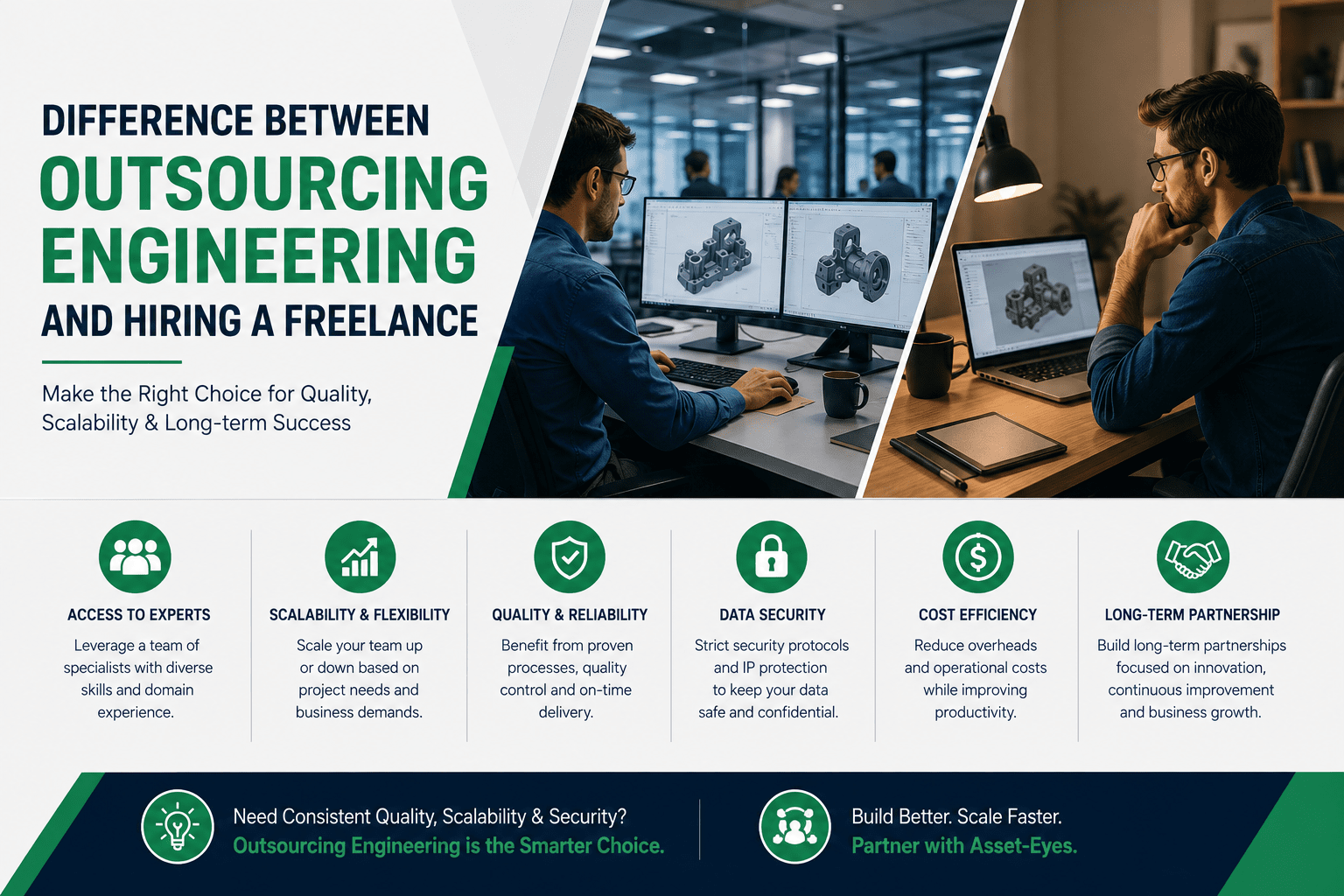
What’s the Difference Between Outsourcing Engineering and Hiring a Freelancer?
Outsourcing engineering to a professional firm means engaging an organization with established quality control, scalable capacity, and accountability that extends beyond any single contributor. Hiring a freelancer means engaging one individual directly — typically at a lower rate, but with single-point-of-failure risk and quality outcomes that depend entirely on that person’s availability and skill. The right choice depends on the scope, duration, and criticality of the work, not just the hourly rate.
Why the Distinction Matters More Than It Seems
Engineering managers often default to freelancers for cost reasons, then discover the model doesn’t scale, doesn’t guarantee consistent quality, and creates management overhead that eats into the savings. Just as often, companies engage a full outsourcing firm for a small, well-defined task where a qualified freelancer would have been faster and cheaper. Understanding the real operational differences — not just the rate card — helps you match the right model to the actual work in front of you.
Six Dimensions That Separate the Two Models
1. Accountability and Quality Management
With a freelancer, quality control is entirely your responsibility — you review, catch issues, and manage revisions yourself. A professional firm maintains internal QA before work reaches you: experienced reviewers check output against your standards and catch problems before they become your problem.
2. Scalability and Capacity Flexibility
A freelancer has a fixed ceiling — typically 20 to 40 hours per week, dependent on other commitments. If a project surges or they’re unavailable, your capacity doesn’t flex with it. A professional partner can add or reduce team members against your account as demand changes, without you managing individual availability.
3. Continuity and Institutional Knowledge
Freelancers are transactional — when the engagement ends, the knowledge they built about your standards and preferences leaves with them, and the next engagement starts from scratch. A professional partner accumulates institutional knowledge over time, making each subsequent engagement more efficient and reducing rework.
4. Process Integration and Workflow Compatibility
Freelancers typically work in their own environment and hand you files to integrate — creating friction with your naming conventions and revision control. A professional partner works inside your systems, using your templates and standards, so output arrives ready to use without translation.
5. Communication and Project Management Overhead
Managing a freelancer means functioning as their project manager — defining scope, tracking progress, resolving ambiguity yourself. A professional partner brings its own project management: defined protocols, proactive status updates, and structured handling of ambiguous inputs, reducing the burden on your internal team.
6. Risk Profile and Business Continuity
A freelancer is a single point of failure — if they’re unavailable, your work stops until you find a replacement. A professional firm reassigns work internally if a team member is unavailable, so your commitment is to the organization, not a single person.
What You’re Actually Paying For
Freelancers typically charge lower hourly rates than professional firms — often $35 to $55 per hour versus $45 to $75 for comparable work from an outsourcing partner. That rate gap is real, but it doesn’t capture the full picture. Once you factor in the time you spend managing the freelancer directly, the rework cost of inconsistent quality, and the risk of a replacement search if they become unavailable, the effective cost gap narrows considerably for ongoing or critical work. For small, fully-scoped, one-off tasks, the freelancer’s rate advantage is more likely to hold up in practice.
When a Freelancer Is the Right Choice
A one-time CAD conversion, a defined drawing package for a single product, or a niche simulation task with a flexible timeline are strong candidates for a freelancer — provided the scope is fully defined up front, the timeline can absorb individual availability constraints, and someone internally has time to manage and review the work closely.
When an Outsourced Engineering Partner Is the Right Choice
Ongoing capacity needs, variable workloads that require scaling up and down, work spanning multiple disciplines (mechanical, electrical, documentation), and situations where delivery consistency directly affects manufacturing or customer commitments all point toward a professional partner rather than an individual contractor. A startup needing a one-off concept render for a pitch deck is a freelancer scenario; a mid-size OEM managing a recurring backlog of manufacturing drawings against hard delivery deadlines needs the reliability a single freelancer structurally cannot guarantee.
The Hybrid Reality: Using Both Strategically
Many OEMs use freelancers for tightly scoped, specialized, or experimental tasks, and a professional partner for core, repeatable engineering and documentation work that must be reliable and scalable. What doesn’t work is relying on a rotating cast of freelancers to solve a structural capacity problem that actually requires process, continuity, and management infrastructure.
How Asset-Eyes Differs From a Freelancer Relationship

Asset-Eyes operates as a structured engineering partner, not a collection of disconnected individuals. You get a lead point of contact who understands your products, a team behind them that flexes across mechanical design, electrical panel design, and documentation, and established QA and revision control that keep output consistent —with the ability to scale capacity up or down without rehiring and retraining each time.