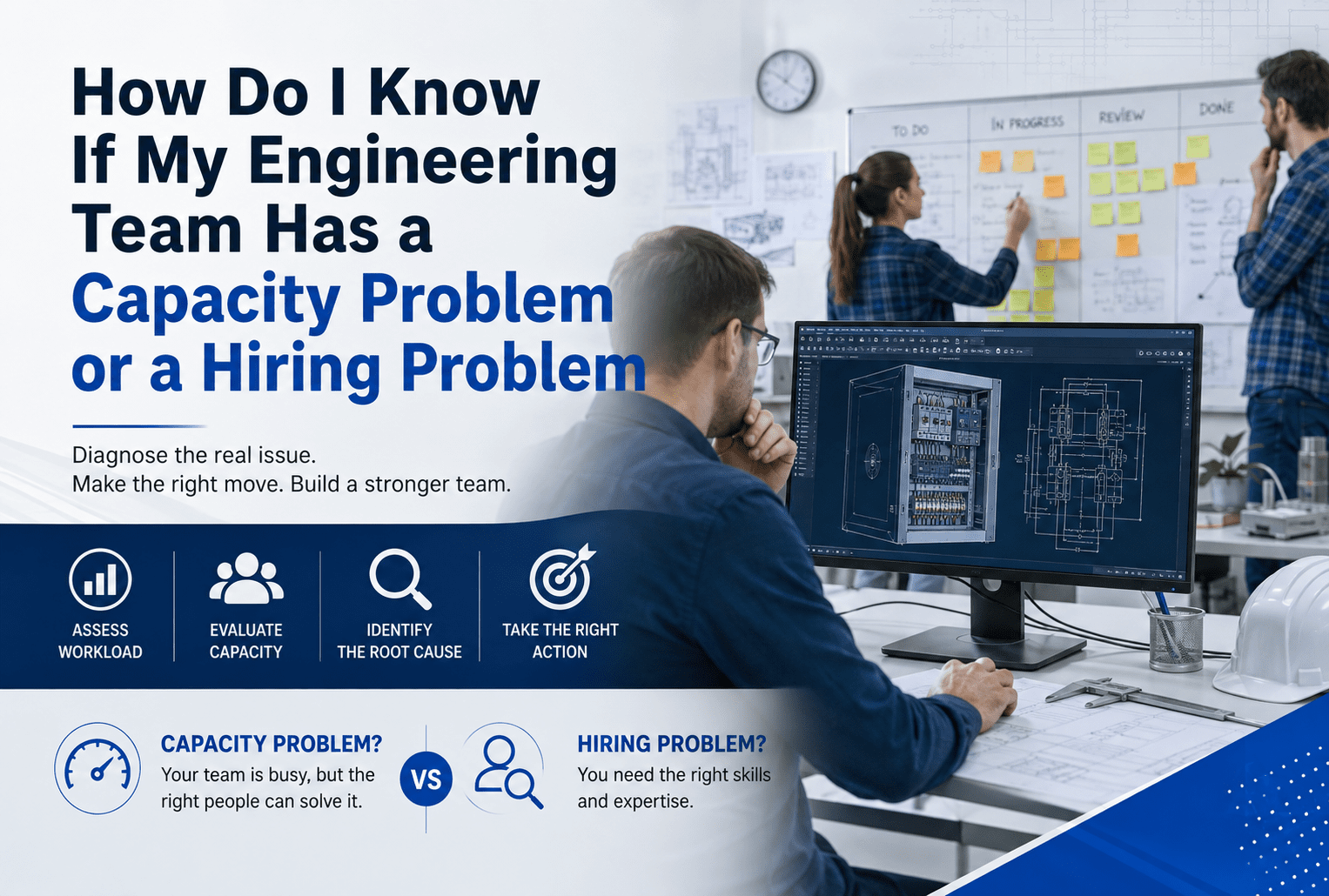
You have a capacity problem if your team possesses the right skills but lacks sufficient time to execute all required work, typically solved through better task allocation or external engineering support. You have a hiring problem if you’re missing essential expertise or if sustainable workload growth requires permanent additional headcount. Misdiagnosing one for the other leads to expensive hiring for temporary spikes or inadequate staffing for genuine growth both costly mistakes that affect project delivery and team morale.
Why This Distinction Matters for Engineering Managers
The default response to engineering bottlenecks is often “we need to hire someone,” but this instinct frequently misses the underlying problem. Hiring takes 60-90 days minimum, costs significantly in recruiting and onboarding, and creates permanent overhead that may not match your actual long-term needs. Meanwhile, capacity problems — where you have the right people spending too much time on execution-heavy work — can often be solved more quickly and cost-effectively through strategic task reallocation or targeted engineering support.
Getting this diagnosis right affects your budget, timeline, team structure, and ability to deliver on customer commitments.
The Diagnostic Framework: Four Critical Dimensions
1. Work Type Analysis: What’s Actually Consuming Your Engineers’ Time?
Strategic engineering work:
- New product design and architecture decisions
- Complex problem-solving and root cause analysis
- Customer-specific technical solutions and specifications
- Strategic technology evaluation and implementation
- Technical leadership and mentoring
Execution-heavy engineering work:
- Design detailing, documentation, and drawing revisions
- Documentation maintenance and revision processing
- Routine calculations and standard configurations
- Data migration and file cleanup
- Administrative project coordination
If your engineers spend more than 30% of their time on execution-heavy work, you likely have a capacity allocation problem, not a hiring problem.
2. Skill Gap Assessment: Missing Expertise vs. Missing Hours
You need more expertise when:
- Projects stall because no one understands the required technology
- You avoid certain types of work due to knowledge gaps
- Customer requirements exceed your team’s technical capabilities
- New market opportunities require competencies you don’t possess
You need more capacity when:
- Your team can do the work but simply lacks sufficient hours
- Bottlenecks occur in execution rather than decision-making
- Engineers work overtime on tasks that don’t require their specific expertise
- Project delays happen at documentation stages, not design stages
3. Timeline Analysis: Urgent vs. Structural Needs
Immediate capacity needs (next 30-60 days):
- Current project deliverables at risk
- Customer commitments in jeopardy
- Temporary surge from large orders or seasonal demand
Structural capacity needs (6+ months):
- Consistent growth in project volume
- Expanding market presence requiring sustained capacity
- New product lines creating permanent workload increases
Hiring cannot solve immediate capacity needs — the timeline doesn’t align. Urgent situations require flexible external support, while structural needs may justify permanent additions.
4. Utilization Pattern: Efficiency vs. Volume
Efficiency problems (often mistaken for capacity problems):
- Engineers wait for decisions, approvals, or information
- Rework cycles due to unclear requirements or poor communication
- Time lost to inefficient tools, processes, or workflows
- Frequent context switching between multiple small projects
True volume problems:
- Engineers work efficiently but consistently exceed sustainable hours
- Clear, well-defined work queues that exceed team capacity
- Predictable workload that justifies additional permanent resources
Signs You Have a Capacity Problem (Consider External Engineering Support)
Task misallocation is the primary issue: Senior engineers spend significant time on execution work that a specialized external team could handle. Project delays occur at documentation stages rather than design decision points.
Workload is variable or project-driven: Busy periods alternate with slower times, making it difficult to justify permanent headcount. Large orders or seasonal demands create temporary capacity crunches.
The team has the right skills but insufficient bandwidth: Engineers can solve the problems they encounter but simply don’t have enough hours to address everything in the queue.
Routine work dominates the backlog: Much of the delayed work involves standardized processes, documentation updates, or repetitive tasks that don’t require senior-level design judgment.
Signs You Have a Hiring Problem
Missing critical expertise: Your team encounters technical challenges they cannot solve, regardless of available time. New market opportunities require competencies that don’t exist internally.
Sustainable growth exceeds current capacity: Even with optimized task allocation, your long-term workload justifies additional permanent headcount.
Leadership or mentoring gaps: You need senior technical leadership to guide junior staff or establish new technical directions.
Core competency expansion: Your business strategy requires building new internal capabilities that will become permanent organizational assets.
The Hybrid Reality: Solving Both Problems Strategically
Many growing OEMs face elements of both problems simultaneously. The most effective approach addresses them on different timelines:
Immediate term (0-90 days): Use external engineering support to handle execution-heavy tasks and create breathing room for your core team. This provides immediate relief while you evaluate long-term needs.
Medium term (3-12 months): With reduced task overload, assess whether hiring is justified by sustained demand and strategic requirements rather than crisis management.
Long term (12+ months): Build permanent capabilities in areas that represent core competitive advantages or structural business needs.
A Practical Self-Assessment Process
Work through these questions with your team:
- If you had 40 additional hours of qualified output starting Monday, would your most pressing delays be resolved? (Capacity problem indicator)
- Could a skilled external partner handle 30-40% of your current backlog with reasonable onboarding? (Feasibility check)
- Are engineers telling you they’re overwhelmed by volume or stuck on problems they can’t solve? (Capacity vs. expertise gap)
- What does your project pipeline look like 12 months from now? (Hiring justification assessment)
- Have previous hiring attempts in this area been successful and retained long-term? (Market reality check)
How Asset-Eyes Addresses Capacity Problems
Asset-Eyes specializes in solving engineering capacity problems by absorbing execution-heavy work that pulls your senior engineers away from design decisions. We handle mechanical design, electrical panel design, and technical documentation across the full engineering scope — allowing your core team to focus on design, innovation, and customer-facing engineering.
This approach provides immediate capacity relief without the timeline and overhead of hiring, while giving you clarity about your true long-term staffing needs.