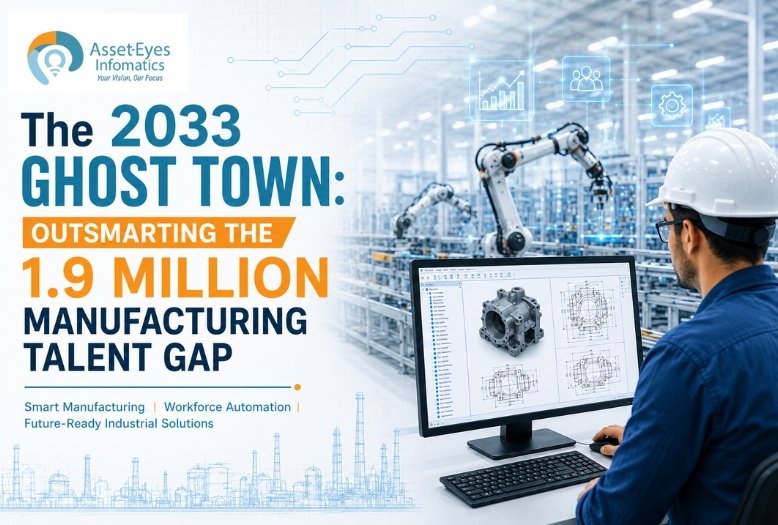
Picture this: you’re walking through your manufacturing facility in 2033. The equipment is humming, orders are flowing in, but half the engineering workstations sit empty. Your CAD drawing backlog stretches for months. Critical projects stall not because of supply chain issues, but because there’s simply no one to design them. This growing Manufacturing Talent Gap is becoming one of the biggest challenges for industrial companies worldwide.
This isn’t science fiction, it’s the mathematical trajectory we’re currently on. The 2024 Deloitte and The Manufacturing Institute Talent Study reveals that while manufacturing is experiencing unprecedented growth. We’re heading straight toward a talent cliff. But here’s the key insight: this case study isn’t a disaster report. It’s your survival guide for building the capacity insurance you’ll need to thrive while your competitors struggle.
1. The Perfect Storm: Boom Meets Bust in the Manufacturing Talent Gap
The numbers tell a fascinating and contradictory story. Manufacturing construction spending has exploded by 183% since 2020, hitting a record 225 billion in January 2024. Employment has surpassed pre-pandemic levels, reaching nearly 13 million workers. The Infrastructure Investment and Jobs Act. The Inflation Reduction Act and CHIPS Act have announced nearly 300 new clean technology and semiconductor facilities. Representing over 430 billion in investment.
Yet beneath this boom lies a structural crisis driven by the growing Manufacturing Talent Gap. The Deloitte study projects that manufacturing will need approximately 3.8 million net new employees between 2024 and 2033. Here’s the sobering reality: nearly half of these positions could remain vacant.

Half of the jobs the industry needs could remain empty. This isn’t just a hiring challenge; it’s a capacity crisis that will determine which companies thrive and which become ghost towns.
2. Where the Manufacturing Talent Gap Hits Hardest
The shortage isn’t evenly distributed. The roles most at risk are precisely the high-skill positions that keep product development and production moving. According to the Bureau of Labor Statistics data cited in the study:
- Mechanical and industrial engineers (currently 370,000 in manufacturing) are projected to grow by approximately 11% by 2032
- Software developers and IT professionals in manufacturing could increase by nearly 13%
- Industrial machinery maintenance technicians may grow by as much as 16%
- Data scientists and statisticians in manufacturing, though currently small at 7,500 workers, could expand by close to 30%
The World Economic Forum’s 2023 Future of Jobs report adds another layer of complexity: 40% of current skill requirements in advanced manufacturing will evolve over the next five years. The Deloitte study found a 75% increase in demand for simulation and simulation software skills alone.
This creates a double bind. Companies need more engineers and designers, but they also need professionals with advanced technical skills that traditional education pipelines are struggling to produce. Associate degree completions for high-skill trades have remained stagnant since 2011, even as demand continues to rise. This widening Manufacturing Talent Gap is already slowing project execution in many industries.
3. The Ecosystem Solution for the Manufacturing Talent Gap: Beyond Traditional Hiring
Here’s what smart manufacturers have already figured out: you can’t hire your way out of a structural shortage. The Deloitte study found that 94% of surveyed manufacturers are forming at least one partnership to improve job attraction and retention. With companies averaging four or more partnerships in their talent ecosystems.
This ecosystem thinking represents a fundamental shift from viewing talent as purely an internal resource to building networks of complementary capabilities.
The most successful manufacturers aren’t just competing for the same shrinking pool of domestic talent. Instead, they’re building flexible and scalable support systems that help them reduce the risks associated with the ongoing Manufacturing Talent Gap.
Offshore Engineering Partnerships as Capacity Insurance
This is where offshore partnerships stop being about cost-cutting and start being about survival. When your general assembly drawing production is bottlenecked because you can’t find qualified CAD designers locally, that’s not just an inconvenience; it’s a serious vulnerability that threatens your competitive edge.
Think of offshore engineering partnerships as disaster-proofing infrastructure. Just as you wouldn’t rely on a single supplier for critical components, building engineering capacity that depends entirely on domestic hiring in a constrained market is a strategic risk.
For manufacturers dealing with complex electrical systems, having reliable offshore electrical control panel design support means your domestic engineers can focus on high-complexity problem-solving rather than getting bottlenecked by documentation. Similarly, for companies with high-volume SolidWorks drafting services needs, it means your design throughput isn’t held hostage by local hiring market fluctuations.
Committing to this integration before you need it is the key. Those who wait until 2030 to explore these partnerships will be scrambling, while their competitors who built these relationships today will have seamless workflows already in place.
4. Future-Proofing Your Operations Against Talent Shortages
The Deloitte study points toward several practical strategies that forward-thinking manufacturers are already implementing to reduce the impact of the Manufacturing Talent Gap.
Skills-Based Workforce Development: Organizations that focus on employee competencies rather than formal qualifications are 107% more likely to place talent effectively and 98% more likely to retain high performers.
Technology as a Talent Multiplier: Manufacturers with high-tech smart factory environments report better retention rates. VR-based training has reduced onboarding time for welders by 50-60% in some cases.
Flexible Capacity Architecture: This means building workflows that can scale up or down based on demand, regardless of local labor market conditions. Offshore design partnerships are a critical component of this flexibility.
5. How Asset-Eyes Fits Your Disaster-Proofing Strategy
Asset-Eyes operates as a specialized extension of your engineering team, providing the exact capabilities where the talent gap is hitting hardest. Whether your bottleneck is in CAD drafting services or electrical control panel design, we function as a scalable engineering capacity that isn’t competing in the same constrained domestic market.
The value proposition is straightforward: your engineering throughput remains consistent regardless of local hiring challenges. Your domestic team focuses on the highest-complexity, relationship-dependent work while we handle the precision drafting and design execution that keeps your projects moving.
We work across automation, mechanical, and electrical design disciplines with the technical precision and workflow integration that make offshore partnership genuinely functional rather than merely theoretical. The goal is simple: your engineering capacity keeps moving, regardless of what the domestic talent market is doing.
The Ghost Town Is Optional
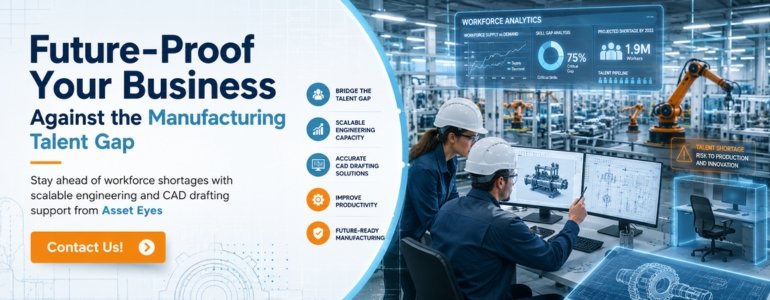
The 2033 workforce shortage is real, structural, and accelerating. However, businesses still have time to adapt. The manufacturers that succeed during this transition will not be the companies that magically discover unlimited domestic engineering talent. They will be the businesses that build resilient operations capable of surviving the ongoing Manufacturing Talent Gap.
The survival guide is clear: build ecosystem partnerships, develop skills-based hiring practices, leverage technology as a multiplier, and create flexible capacity buffers that include offshore engineering relationships. The companies reading this right now have something valuable to act on before the crunch peaks.
The question isn’t whether the talent shortage is coming. The data already confirms that reality. The real question is whether your company will be prepared before the Manufacturing Talent Gap reaches its peak.
Ready to build talent-resilient engineering capacity before the shortage peaks? Let’s discuss how Asset-Eyes can serve as your scalable design team extension.
Schedule a Call:
📞 +91 9840895134
Frequently Asked Questions
The manufacturing talent shortage will be critically severe by 2033. According to the 2024 Deloitte and Manufacturing Institute Talent Study, manufacturing will need approximately 3.8 million net new employees between 2024 and 2033, but nearly 1.9 million of those jobs could remain unfilled. This represents half the industry’s workforce needs going unmet, creating a capacity crisis where engineering workstations sit empty, and CAD drafting backlogs stretch for months.
High-skill engineering roles face the most severe shortages. Mechanical and industrial engineers, currently numbering 370,000 in manufacturing, are projected to grow by 11% by 2032. Software developers and IT professionals could increase by nearly 13%, industrial machinery maintenance technicians by up to 16%, and data scientists by close to 30%. Additionally, the World Economic Forum reports that 40% of current advanced manufacturing skill requirements will evolve within five years.
Manufacturers can’t hire their way out because the shortage is structural, not cyclical. The Deloitte study found that 94% of surveyed manufacturers are already forming partnerships to improve talent attraction, averaging four or more partnerships each. Associate degree completions have remained stagnant since 2011 while demand accelerated, creating a fundamental mismatch between available talent supply and exploding manufacturing construction spending that hit $225 billion in January 2024.
Capacity insurance means building engineering capacity buffers before talent shortages become critical, rather than scrambling reactively when bottlenecks threaten projects. Like not relying on a single supplier for critical components, depending entirely on domestic hiring in a constrained market creates strategic vulnerability. Companies establishing offshore engineering partnerships today will have seamless workflows when shortages peak, while competitors waiting until 2030 will scramble under crisis pressure.
Offshore engineering partnerships provide scalable design capacity outside constrained domestic labor markets, ensuring CAD drafting services and general assembly drawing production continue regardless of local hiring challenges. When qualified designers aren’t locally available, offshore teams handle precision drafting and SolidWorks design execution, allowing domestic engineers to focus on high-complexity problem-solving rather than getting bottlenecked on documentation. This transforms talent shortages from project threats into manageable operational variables.
The 75% increase in simulation software skills demand reflects manufacturing’s evolution toward advanced digital design and smart factory environments. Modern industrial equipment design, HVAC systems, and electrical control panel design increasingly require sophisticated modeling capabilities before physical prototyping. This skills evolution creates a double challenge: companies need more engineers while simultaneously needing engineers with fundamentally different capabilities than traditional education pipelines are producing.
Skills-based hiring is significantly more effective than traditional approaches. According to the Deloitte study, organizations focusing on employee competencies rather than formal qualifications are 107% more likely to place talent effectively and 98% more likely to retain high performers. This approach expands available talent pools by evaluating actual capabilities needed for roles like electrical control panel design and SolidWorks drafting services rather than requiring specific degrees.
Forward-thinking manufacturers implement three key strategies from the Deloitte study: skills-based workforce development focusing on competencies over qualifications, technology deployment as talent multipliers, including VR-based training that reduces onboarding time by 50-60%, and flexible capacity architecture through offshore design partnerships. These approaches ensure engineering throughput remains consistent regardless of local labor market constraints while maximizing existing workforce productivity through advanced training and smart factory environments.
Asset-Eyes operates as a specialized engineering team extension providing scalable capacity precisely where the talent gap hits hardest, including CAD drafting services and electrical control panel design. Working across automation, mechanical, and electrical design disciplines, Asset-Eyes ensures engineering throughput remains consistent regardless of local hiring challenges. Domestic teams focus on the highest-complexity, relationship-dependent work while Asset-Eyes handles precision drafting and design execution that keeps projects moving.
Manufacturers delaying offshore partnerships risk competitive disadvantage when talent shortages peak around 2033. The Deloitte data confirms this shortage is structural and accelerating, not temporary. Companies building ecosystem partnerships now will have integrated, functional workflows while late movers scramble under crisis pressure. Successful manufacturers won’t find secret sources of unlimited domestic talent but will have built resilient operations through flexible capacity architecture that doesn’t depend on constrained local markets.