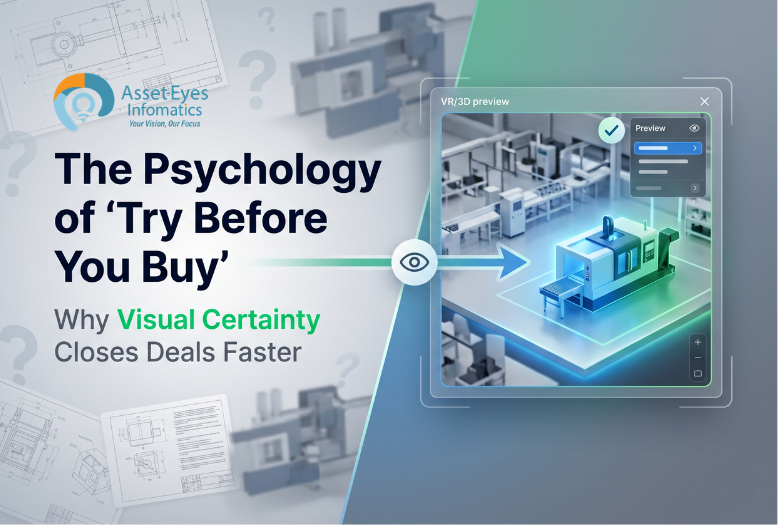
Picture this: You’re about to invest $75,000 in a custom industrial ventilation systems design for your manufacturing facility. The engineering team shows you detailed specifications, performance calculations, and glowing case studies. Everything looks perfect on paper. Yet something holds you back from signing the purchase order. You keep thinking, “But what will it actually look like in my facility? How will operators navigate around it? Will maintenance access really be adequate?” That hesitation isn’t indecision, it’s your brain doing exactly what evolution designed it to do: protecting you from costly mistakes by demanding visual proof before major commitments. This the psychology barrier is the invisible force that stalls deals, extends sales cycles, and frustrates even the most technically sound proposals.
This blog explores why the human brain craves visual certainty before committing to high-ticket purchases, and how immersive visualization experiences can scientifically lower customer barriers to accelerate decision-making processes. We’ll examine the psychology of perceived risk, the cognitive biases that favor tangible evidence, and how Asset-Eyes’ approach transforms abstract technical concepts into decision-driving visual experiences.
Understanding Perceived Risk: The Silent Deal Killer
In high-ticket industrial purchases whether it’s HVAC equipment design, electrical control panel design, or comprehensive machine design company services buyers aren’t just purchasing products. They’re investing in a future state that may only be fully realized months or years later. This creates what the psychology call “perceived risk”: the feeling that if something goes wrong, the cost, disruption, and professional consequences will be enormous.
The anatomy of perceived risk in technical purchases:
When facilities managers evaluate a new motor control panel design or engineers consider EPLAN electrical drawings for a critical system, their minds automatically run worst-case scenarios. They worry about integration issues with existing systems, spatial conflicts that drawings might not reveal, usability problems that could emerge during operation, and hidden costs that surface after installation.
The higher the ticket price and complexity, the stronger this internal resistance becomes. It’s not that buyers don’t trust your technical capabilities, they don’t trust their own ability to accurately predict outcomes based on abstract information.
Why traditional presentations fall short:
Specification sheets, CAD drawing services outputs, and even detailed mechanical general assembly drawings still require a mental leap. Buyers must imagine how everything will look, fit, and function in their specific environment. That imagination gap is where doubt lives and deals stall.
Your prospects’ brains are essentially asking: “Can I see this working before I commit?” When you can’t provide that visual certainty, their risk-averse the Psychology kicks in, leading to extended evaluation periods, requests for more information, and ultimately, delayed decisions.
The Neuroscience of Visual Decision-Making – The Psychology
Human brains process visual information approximately 60,000 times faster than text, but the psychology impact goes far deeper than processing speed. When we can see something, our brain treats it as more real, more trustworthy, and significantly less risky than something we can only read about or imagine.
How visual experiences reshape risk perception:
When prospects interact with immersive visualizations of your SolidWorks design or EPLAN control panel design, something remarkable happens neurologically. Their brains activate the same neural pathways that would fire if they were actually experiencing the completed project. The visualization becomes a “memory of the future,” creating familiarity and comfort with the outcome.
This neurological shift fundamentally changes their emotional relationship with the purchase decision. Instead of feeling like they’re taking a leap of faith based on promises, they feel like they’re making a logical choice based on direct experience.
The cognitive biases working in your favor:
Several well-established the psychology effects favor visual proof over abstract descriptions:
Concreteness Bias drives people to give more weight to tangible, sensory information than abstract claims. A virtual walkthrough of an industrial exhaust system design feels more “real” than a bullet list of specifications, even when both contain identical technical information.
Availability Heuristic means our brains assign more importance to information that’s easy to visualize and recall. Detailed technical documentation might be comprehensive, but it’s difficult to picture and therefore carries less psychological weight than visual representations showing exactly how equipment will look and function.
Loss Aversion makes buyers more motivated to avoid potential problems than to seek gains. Visual certainty reassures them that layouts make sense, access and maintenance are feasible, and clearances have been properly considered, directly addressing their fear of costly mistakes.
The Imagination Gap: Where Deals Get Stuck – The Psychology
Traditional sales materials create what we call the “imagination gap” the cognitive distance between your description of a solution and the prospect’s ability to envision it working in their specific situation. For simple products, this gap is manageable. For complex systems involving HVAC CAD drafting, SolidWorks drafting services, or comprehensive EPLAN services, this gap becomes a chasm.
What you’re actually asking prospects to do:
Consider the mental gymnastics required: Read technical drawings, interpret 2D drafting in SolidWorks outputs, understand assembly sequences from flat representations, and somehow translate all of that into a three-dimensional mental picture of how everything will function in their facility. That’s an enormous cognitive load, and every bit of mental effort required increases perceived risk.
How uncertainty breeds delay:
The longer prospects have to work to visualize your solution, the more time their minds have to imagine things going wrong. Their brains fill the imagination gap with doubts, concerns, and worst-case scenarios. Extended sales cycles aren’t usually caused by budget constraints or competing priorities; they’re caused by prospects needing more time to convince themselves that the solution will actually work.
Most decision delays stem from stakeholders asking themselves:
- Will this integrate smoothly with our existing systems?
- Are we missing something that will cause problems later?
- Can I confidently present this to leadership?
- What if the reality doesn’t match the promises?
Visual certainty eliminates these questions by providing direct answers through experience rather than interpretation.
How Visual Certainty Accelerates Decision-Making – The Psychology
When you provide immersive, realistic visual experiences of your solution, you’re not just showing prospects what they’re buying, you’re fundamentally changing their decision-making process from uncertain evaluation to confident validation.
The decision acceleration effect:
There’s a direct correlation between visual certainty and decision speed. When prospects can see and interact with realistic representations of your Evaporative cooling system design or electrical control panel design, the typical back-and-forth of extended sales cycles compresses dramatically.
This acceleration occurs because you’ve eliminated the primary source of delay: uncertainty. Instead of accumulating abstract information to build confidence over time, prospects achieve certainty immediately through visual exploration.
Stakeholder alignment advantage:
High-ticket purchases typically involve multiple decision-makers with varying technical backgrounds. Getting everyone aligned on abstract concepts is challenging and time-consuming. Getting everyone aligned when they can all experience the same realistic visualization is exponentially easier and faster.
Immersive visual experiences create a shared reference point. Instead of each stakeholder forming different mental pictures based on descriptions, everyone literally sees the same thing. This eliminates miscommunication, reduces conflicting interpretations, and accelerates consensus-building.
From Technical Accuracy to Emotional Confidence
Your existing SolidWorks design capabilities, comprehensive CAD drawing services, detailed EPLAN electrical drawings already demonstrate your commitment to visual clarity for technical teams. These tools clarify component relationships, prevent conflicts, and support accurate fabrication and installation.
However, there’s often a communication gap when presenting to non-technical decision-makers. CFOs, plant directors, and facility owners may find technical drawings intimidating or abstract, even when they’re perfectly accurate from an engineering perspective.
The translation challenge:
Engineering teams might be completely clear on a design while leadership remains uneasy about approval. This isn’t a technical problem, it’s a communication problem. You’re technically accurate but not yet emotionally reassuring to all stakeholders involved in the decision.
Visual certainty for these stakeholders isn’t “I understand the drawing.” It’s “I can place myself inside the finished project and understand it intuitively.” This emotional comfort level is what transforms hesitant evaluators into confident approvers.
Asset-Eyes: Transforming Technical Excellence into Decision Confidence
This is where Asset-Eyes fundamentally changes the equation. Instead of asking prospects to imagine how your CAD drafting services or SolidWorks design will translate into reality, we create immersive visual experiences that eliminate the imagination gap entirely.
Converting existing assets into decision tools:
Asset-Eyes specializes in transforming your existing technical design data CAD models, SolidWorks assemblies, EPLAN control panel designs, general assembly drawings into immersive experiences that stakeholders can walk through and interact with. We’re not adding complexity to your process; we’re repurposing work you’re already producing into formats that directly support faster approvals and more persuasive presentations.
Addressing the psychology of high-stakes decisions:
From a psychological standpoint, Asset-Eyes isn’t just delivering better visuals, we’re providing the visual certainty that human brains require to make confident decisions about complex investments. When your prospects can virtually stand in front of a control panel, walk around equipment installations, or visualize clearances in their actual facility layout, they’re not just understanding your design they’re emotionally rehearsing success.
That emotional rehearsal seeing it, feeling it, mentally owning it is what transforms lengthy evaluation processes into confident approvals. We help your clients feel like they’ve already “tried” the solution, removing guesswork and ambiguity that typically slow decision-making.
The competitive advantage:
In markets where technical capabilities are often similar across providers, the ability to provide visual certainty becomes a powerful differentiator. While competitors present static drawings expecting prospects to use imagination, you’re offering experiences that satisfy the brain’s fundamental need for visual proof.
Key Takeaways: The Psychology of Faster Decisions
Understanding the psychology behind “try before you buy” reveals why visual certainty is so powerful in accelerating high-ticket sales:
- Perceived risk increases exponentially with purchase complexity and ticket size, creating psychological barriers that slow decisions
- Human brains are hardwired to trust visual evidence over abstract promises, making immersive experiences more persuasive than traditional presentations
- Cognitive biases including concreteness bias, availability heuristic, and loss aversion all favor tangible visual proof over technical documentation
- The imagination gap between technical accuracy and stakeholder confidence is where most deals get delayed or lost
- Visual certainty eliminates uncertainty, transforming cautious evaluation into confident decision-making
If your projects are technically excellent but approvals remain slow, the issue likely isn’t your engineering, it’s the psychology of your buyers. Visual certainty bridges the gap between technical excellence and emotional confidence, enabling the fast, confident decisions that drive business growth.
Ready to transform how prospects experience your solutions and accelerate your sales cycles?
Contact Us Now:
📞 +91 9840895134
FAQs
Technically sound proposals encounter resistance due to “perceived risk” the psychological barrier where buyers fear that if a complex, high-ticket purchase fails, the financial, operational, and professional consequences will be devastating. When evaluating investments like HVAC equipment design, motor control panel systems, or comprehensive machine installations, buyers don’t question your technical competence; they question their own ability to accurately predict outcomes from abstract information. Their brains automatically generate worst-case scenarios about integration conflicts, spatial issues, usability problems, and hidden lifecycle costs. This neurological risk-aversion mechanism creates invisible resistance that extends sales cycles regardless of proposal quality, because buyers demand visual proof before making major capital commitments that could define their professional reputation.
Human brains process visual information approximately 60,000 times faster than text, but the psychological impact extends far deeper than processing speed. When prospects interact with immersive visualizations of your solutions, their brains activate identical neural pathways that would fire during actual experience with completed projects. This creates what neuroscientists call a “memory of the future”—genuine familiarity and emotional comfort with outcomes before they occur. The visualization becomes neurologically real rather than hypothetical, fundamentally transforming the decision-making process from uncertain evaluation based on promises to confident validation based on experienced reality. This neurological shift eliminates the psychological distance between current uncertainty and future confidence, compressing months of evaluation into immediate certainty.
Three well-established cognitive biases create overwhelming psychological advantages for visual certainty over abstract presentations. Concreteness Bias drives people to assign greater credibility and importance to tangible, sensory information than abstract claims—making virtual walkthroughs of industrial systems feel more “real” than specification sheets containing identical technical data. The Availability Heuristic means brains give more weight to information that’s easily visualized and recalled; since comprehensive technical documentation is difficult to picture mentally, it carries less psychological influence than realistic visual representations that create lasting mental images. Loss Aversion makes buyers more motivated to avoid potential problems than pursue gains, meaning visual certainty directly addresses their deepest fear by demonstrating that layouts work, maintenance access is adequate, and integration challenges have been resolved—reassurances that written specifications simply cannot provide at a neurological level.
The imagination gap represents the cognitive distance between technical solution descriptions and prospects’ ability to envision them functioning in their specific operational environment. For complex systems involving HVAC CAD drafting, SolidWorks design assemblies, or EPLAN electrical documentation, this gap becomes a chasm requiring enormous mental effort—reading technical drawings, interpreting 2D outputs, understanding assembly sequences, and somehow translating everything into accurate three-dimensional mental pictures of integrated systems. Every bit of cognitive effort required increases perceived risk exponentially. The longer prospects must work to visualize your solution, the more time their minds have to generate doubts, concerns, and failure scenarios that fill uncertainty with anxiety. This psychological process transforms straightforward technical evaluations into prolonged internal battles where buyers struggle to convince themselves that reality will match promises.
Multi-stakeholder industrial purchases face unique alignment challenges because each decision-maker—CFOs, plant directors, facility owners, and engineering teams—forms different mental interpretations based on identical abstract descriptions, creating conflicting understandings that require extensive clarification cycles. Technical drawings may be perfectly clear to engineers while remaining intimidating and abstract to financial decision-makers who need emotional reassurance rather than technical accuracy. Immersive visual experiences eliminate these communication barriers by creating shared reference points where all stakeholders literally see the same realistic representation simultaneously. Instead of each person imagining different outcomes, everyone experiences identical virtual installations, spatial relationships, and operational contexts. This common visual foundation eliminates misinterpretation, reduces internal disagreements, and accelerates consensus-building from weeks of back-and-forth discussions to single collaborative sessions where alignment becomes intuitive rather than analytical.
While engineering tools like SolidWorks design capabilities, comprehensive CAD drawing services, and detailed EPLAN electrical drawings provide perfect technical accuracy for engineering teams, they often create communication gaps with non-technical decision-makers who find technical documentation intimidating or abstract. This creates scenarios where engineering teams are completely confident about designs while executive leadership remains uneasy about approval—not due to technical doubts, but because they cannot intuitively understand complex technical representations. The gap isn’t technical; it’s psychological and communicational. For executive stakeholders, visual certainty isn’t “I understand the schematic”—it’s “I can mentally place myself inside the finished project and understand it instuitively.” This emotional comfort level transforms hesitant evaluators into confident approvers by providing the experiential understanding that technical accuracy alone cannot deliver.
Emotional rehearsal occurs when prospects virtually explore completed installations—standing in front of control panels, walking around equipment, checking maintenance clearances, and visualizing integration with their actual facility layouts. They’re not just understanding your design intellectually; they’re seeing it, feeling it, and mentally owning successful outcomes before signing purchase orders. This psychological process helps clients feel they’ve already “tried” the solution successfully, removing guesswork and ambiguity that typically slow decision-making. The emotional rehearsal creates genuine confidence because their brains have already experienced positive outcomes, transforming lengthy evaluation processes into confident approvals. This neurological shift from uncertain evaluation to experienced validation is what accelerates high-ticket industrial sales from months-long deliberations to decisive commitments.
Extended sales cycles rarely result from budget constraints or competing priorities—they develop because prospects need additional time to convince themselves that complex solutions will actually work as promised. As buyers struggle to visualize how HVAC systems, control panels, or machinery will integrate with their operations, their minds fill the imagination gap with doubts and worst-case scenarios. Stakeholders delay decisions while internally asking: “Will this integrate smoothly with existing systems?” “Are we overlooking problems that will emerge later?” “Can I confidently present this to leadership?” “What if reality doesn’t match the promises?” These questions multiply during evaluation periods because abstract technical information cannot provide the experiential certainty that human psychology requires for confident decision-making about significant capital investments that affect operational performance and professional reputation.
In markets where core technical capabilities are often comparable across competing providers, visual certainty becomes decisive differentiation that operates at a psychological rather than technical level. While competitors present static drawings expecting prospects to use imagination—forcing buyers to bear cognitive load and carry perceived risk—companies providing immersive experiences satisfy the brain’s fundamental evolutionary need for visual proof before major commitments. This differentiation transcends traditional technical competition based on specifications, pricing, and case studies because it addresses the neurological dimension of purchasing that technical excellence alone cannot satisfy. Prospects don’t just prefer companies offering better visuals; they feel more confident and emotionally ready to commit, making visual certainty a competitive advantage that accelerates sales cycles while competitors remain stuck in extended evaluation processes.
Asset-Eyes specializes in converting existing technical assets—CAD models, SolidWorks assemblies, EPLAN control panel designs, and general assembly drawings—into immersive experiences that eliminate the imagination gap entirely without adding complexity to established engineering processes. Rather than asking prospects to mentally translate technical documentation into three-dimensional understanding, Asset-Eyes creates walkthrough experiences where stakeholders virtually explore completed installations, check clearances, interact with equipment in their actual facility contexts, and experience operational scenarios before committing capital. This approach repurposes work already being produced into formats that provide the visual certainty human brains require for confident decisions, transforming lengthy evaluation processes into faster approvals by simultaneously addressing perceived risk, cognitive biases, and stakeholder alignment challenges through shared immersive experiences that bridge the gap between technical excellence and emotional confidence.