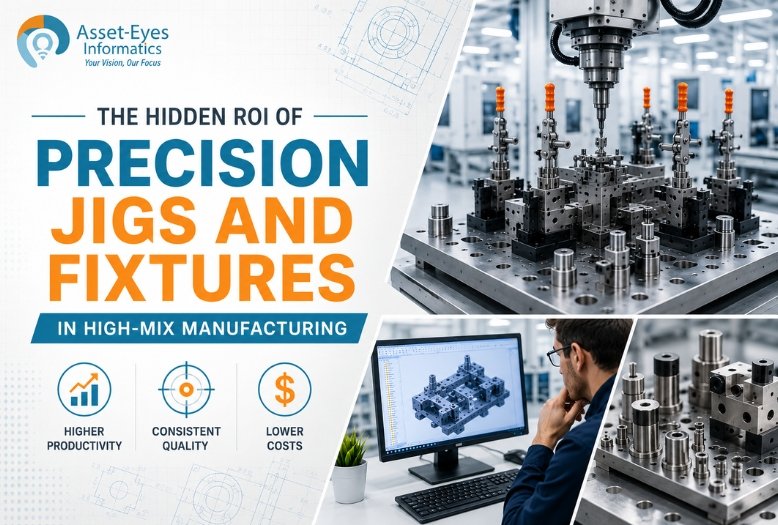
Walk through any manufacturing trade show, and you’ll see the headliners: six-axis robots performing intricate welds. Autonomous vehicles navigating warehouse floors, and million-dollar automated workcells that promise to revolutionize production. These technologies grab attention, earn press coverage, and dominate capital equipment budgets. Yet behind many successful production lines. Simple but critical tools like Jigs and Fixtures quietly ensure accuracy, repeatability, and faster manufacturing cycles every day.
What about your typical high-mix manufacturing facility? What actually keeps production moving? More often than you’d expect, a precisely machined fixture positions complex weldments perfectly every time. A custom jig simplifies tricky drilling operations. An assembly aid helps one operator handle tasks that once needed two people working together.
These tools don’t make trade show keynotes or company press releases. But in high-mix manufacturing environments (where you’re building many different products in smaller batches). Precision jigs and fixtures often deliver more immediate results. measurable ROI than the headline automation everyone talks about.
This article explores how investing in properly engineered manufacturing support tools transforms assembly quality. Operator performance and production consistency yield substantial returns without requiring million-dollar robotic installations.
1. Why High-Mix Manufacturing Demands Better Jigs and Fixtures Tooling
High-mix manufacturing creates a uniquely challenging environment that generic tooling can’t address effectively. When you’re producing dozens of different configurations through the same workstation in a single week. Operators face a punishing combination of challenges that don’t exist in high-volume, single-product lines.
The cognitive load alone is exhausting. Operators must constantly remember which variant they’re building. Which components apply to this configuration? What sequence to follow? and which dimensions matter for this particular assembly. This mental burden accumulates over a shift, leading to fatigue that directly impacts both speed and accuracy.
Meanwhile, setup and changeover time consume a larger proportion of total production time. In high-volume manufacturing, you might justify complex setups because the same product runs for weeks or months. In high-mix environments, you need tooling that adapts quickly to new configurations while maintaining the precision that quality demands.
This is where precision jigs and fixtures become transformative. You don’t have to ask operators to manage all this variability through skill and memory because the well-designed tooling standardizes the work itself. Even when the products vary significantly.
2. The Three Critical ROI Mechanisms of Jigs and Fixtures
Here’s how precision tooling delivers returns that justify the engineering investment required to do it properly.
2.1 Eliminating Assembly Errors Through Physical Jigs and Fixtures Design
The most valuable function of a well-engineered fixture isn’t just holding parts, it’s making incorrect assembly physically difficult or impossible. This is poka-yoke. The error-proofing philosophy that builds mistake prevention into the process rather than relying on inspection to catch problems afterward.
Consider a fixture designed with asymmetric locating pins that only accept parts in the correct orientation or interfering geometry that blocks component installation if attempted upside down. These design features remove entire failure modes from the process. The operator doesn’t need to remember the correct orientation or double-check their work because the fixture’s geometry enforces correctness automatically.
This directly reduces scrap rates, eliminates rework loops, and prevents quality escapes that make it to customers. More importantly, it removes the cognitive burden of constant verification from operators. Allowing them to focus on execution rather than error prevention.
2.2 Reducing Operator Fatigue and Cycle Time Variability
Manufacturing work is both physically and mentally demanding, and high-mix environments amplify both challenges. When operators must manually balance heavy components while performing assembly operations. Maintain awkward positions to access work areas, or constantly reposition bulky parts, fatigue accumulates rapidly throughout their shift.
Precision fixtures address this by taking over the physical burden of part support and positioning. Instead of an operator holding a heavy subassembly with one hand while driving fasteners with the other, A well-designed fixture presents the work at the optimal height and angle. Freeing both hands and reducing strain.
The result is more than just operator comfort. It’s consistent cycle times throughout the shift and across different operators. When the tooling handles positioning and support, performance becomes less dependent on individual strength, reach, and endurance.
2.3 Achieving Repeatable Quality Across Variables
High-mix manufacturing often suffers from the “star operator” problem: one experienced worker usually handles the most complex assemblies. And product quality often depends on whether that person is on shift. Training new operators is slow and painful because much of the process knowledge exists only in experienced workers’ heads.
Precision jigs and fixtures level this playing field by embedding expertise directly into the tooling. Datums and locators replace “feel” and “experience.” Hard stops replace “about this far.” Integrated gauge features let operators verify their own work without relying on separate measurement tools.
When engineers build process knowledge directly into Jigs and Fixtures. Product quality no longer depends on who is working the shift. Instead, it depends on how well the tooling is designed and maintained.
3. The Engineering That Makes the Difference in Jigs and Fixtures Design
The difference between tooling that transforms a process and tooling that gets abandoned comes down to design quality and systematic thinking.
3.1 Locating Principles and Geometric Control
Effective fixture design thinks like a coordinate measuring machine: it locates parts based on clearly defined datums. constraining all six degrees of freedom in a repeatable, predictable way. This means choosing primary, secondary, and tertiary locating surfaces that correspond to the part’s functional requirements and avoiding over-constraint that can distort flexible components.
When datums in your fixture match datums in your drawings and inspection procedures. The entire quality system speaks the same language. Variation in finished parts drops dramatically because the primary source of variation. Human judgment about positioning has been engineered out of the process.
3.2 Material Selection and Durability Planning
A fixture that wears out after a thousand cycles in a process that runs ten thousand cycles annually becomes a liability rather than an asset. Material selection must reflect the actual operating environment: cycle counts, clamping forces, exposure to coolants or weld spatter, and the consequences of dimensional drift as wear accumulates.
This might mean hardened tool steel for high-wear locating pins, lightweight aluminum for fixture bodies where ergonomics matter, and non-marring polymers for contact surfaces on cosmetically sensitive parts. Each material choice requires deliberate engineering based on the specific application requirements.
3.3 Designing for Product Family Coverage
In high-mix environments, the most cost-effective approach often involves modular fixture systems designed to accommodate entire product families through interchangeable components rather than dedicated fixtures for every part number. This requires upfront analysis to identify which geometric features remain consistent across variants and can serve as common locating references.
The result is tooling that scales with your product line rather than multiplying costs with every new configuration, while maintaining the locating precision of dedicated fixtures.
4. How 3D Modeling Transforms Fixture Development
The shift to comprehensive CAD drafting services for fixture development isn’t just about producing better drawings; it fundamentally changes what’s possible during the design process itself.
When fixtures are modeled in SolidWorks design environments alongside actual part geometry, interference checking happens before fabrication rather than during assembly trials. Clearances between clamp arms and protruding features get resolved in the model, not discovered on the shop floor. Operator reach envelopes can be simulated, and loading sequences can be walked through virtually.
This capability becomes especially valuable in high-mix environments where tooling often needs to be developed quickly to support new product introductions. A design process that catches problems in the 3D model rather than in physical prototypes compresses development cycles and reduces the cost of getting to functional tooling. Accurate 3D models also generate superior fabrication documentation. When locating pin positions, clamp mounting features, and body geometry are fully defined in the model, the general assembly drawings that follow are precise and unambiguous. Toolmakers work faster and with greater confidence, and the resulting fixtures match design intent from the first piece.
5. Asset Eyes’ Systematic Approach to Manufacturing Support
As a machine design company working across industrial machinery, manufacturing support, and custom automation applications, Asset Eyes approaches jigs and fixtures with the same engineering rigor we apply to complete industrial systems. We understand that production quality can never exceed the quality of the tooling that positions and supports your parts.
Our CAD drawing services deliver fully developed 3D models of manufacturing support tools alongside comprehensive fabrication documentation. This means toolmakers receive drawings that reflect real part geometry, actual clearance requirements, and genuine operator ergonomics, not idealized assumptions that break down in practice.
For manufacturers developing new product lines or expanding into additional variants, we work through the product family analysis that makes modular tooling strategies viable. Understanding the geometric logic of your product family becomes the foundation for tooling that grows with your business rather than creating cost multipliers with every new configuration.
Because we work across heavy industrial equipment, parts & components, and broader machine design applications, we bring a systems perspective to every tooling project. Each fixture is designed not in isolation, but as a component of your larger manufacturing system.
Conclusion
While robotic automation captures headlines and capital equipment budgets, the hidden ROI in high-mix manufacturing often lies in the precision tooling that touches your parts every single day.
Properly engineered jigs and fixtures deliver immediate, measurable improvements: fewer assembly errors through mistake-proofing design, reduced operator fatigue through ergonomic optimization, and consistent quality through embedded process knowledge. These benefits compound over time and don’t require million-dollar automation investments to access.
What they do require is treating tooling development as a genuine engineering discipline, designing fixtures with the same systematic approach applied to the products they support, modeling them comprehensively in 3D, and building them to serve the production volumes they’re asked to handle.
If your team is fighting quality inconsistency, operator fatigue, or setup time challenges in a high-mix environment, the highest-impact conversation might be about your manufacturing support strategy.
Contact Us Now:
📞 +91 9840895134
Frequently Asked Questions
Precision jigs and fixtures deliver superior ROI in high-mix manufacturing because they address core challenges of building many different products in smaller batches without requiring million-dollar investments. While robots dominate headlines, precisely machined fixtures that position complex weldments perfectly every time or custom jigs making tricky drilling foolproof deliver immediate, measurable improvements in quality, cycle time consistency, and operator performance that compound across every production shift.
High-mix manufacturing creates punishing cognitive and physical demands because operators must constantly remember which product variant they’re building, which components apply, what sequence to follow, and which dimensions matter for each configuration. This mental burden accumulates over shifts, causing fatigue that directly impacts speed and accuracy. Setup and changeover consume larger proportions of production time, demanding tooling that adapts quickly while maintaining precision across constantly changing configurations.
Poka-yoke builds mistake prevention directly into fixture geometry rather than relying on inspection afterward. Asymmetric locating pins only accept parts in the correct orientation, while interfering geometry blocks incorrect component installation, removing entire failure modes from the process. Operators don’t need to remember orientations or double-check work because fixtures enforce correctness automatically. This directly reduces scrap rates, eliminates rework loops, prevents quality escapes, and removes the constant verification burden from operators.
Precision fixtures take over the physical burden of part support and positioning, eliminating the need for operators to manually balance heavy components while performing assembly operations or maintain awkward positions. Instead of holding heavy subassemblies with one hand while driving fasteners, fixtures present work at optimal height and angle, freeing both hands and reducing strain. Performance becomes consistent throughout shifts and across different operators, independent of individual strength, reach, and endurance.
The “star operator” problem occurs when quality depends on one trusted person handling complex assemblies, with critical process knowledge existing only in experienced workers’ heads. This makes training slow and creates production vulnerability. Precision fixtures solve this by embedding expertise directly into tooling: datums and locators replace “feel,” hard stops replace “about this far,” and integrated gauge features enable self-verification. Quality becomes a function of fixture design rather than who’s working the shift.
Effective fixture design uses coordinate measuring machine principles, locating parts based on clearly defined datums and constraining all six degrees of freedom repeatably without over-constraining flexible components. Primary, secondary, and tertiary locating surfaces must match functional requirements. When fixture datums align with drawing and inspection datums, the entire quality system speaks the same language. Material selection must reflect actual operating conditions, including cycle counts, clamping forces, and environmental exposure.
Modular fixture systems accommodate entire product families through interchangeable components rather than requiring dedicated fixtures for every part number. This requires upfront analysis identifying geometric features that remain consistent across variants to serve as common locating references. The result is tooling that scales with product lines rather than multiplying costs with every new configuration, while maintaining the locating precision of dedicated fixtures through systematic product family analysis.
SolidWorks design environments enable interference checking before fabrication rather than during costly assembly trials. Clearances between clamp arms and protruding features get resolved in models, not discovered on shop floors. Operator reach envelopes can be simulated, and loading sequences can be walked through virtually. This compresses development cycles significantly in high-mix environments where tooling must be developed quickly for new product introductions, catching problems digitally rather than in expensive physical prototypes.
Comprehensive fixture documentation should include fully developed 3D models reflecting real part geometry, actual clearance requirements, and genuine operator ergonomics rather than idealized assumptions. When locating pin positions, clamp mounting features, and body geometry are fully defined in models, the resulting general assembly drawings become precise and unambiguous. Toolmakers work faster with greater confidence when documentation captures complete design intent, ensuring fixtures match specifications from the first piece without iterative corrections.
Asset Eyes applies the same engineering rigor to jigs and fixtures as complete industrial systems, recognizing that production quality cannot exceed tooling quality. Their CAD design services deliver fully developed 3D models alongside comprehensive fabrication documentation reflecting real part geometry and operator ergonomics. For manufacturers developing new product lines, Asset Eyes conducts product family analysis, enabling modular tooling strategies. Working across heavy industrial equipment and machine design applications, every fixture is designed as a component of the larger manufacturing system.