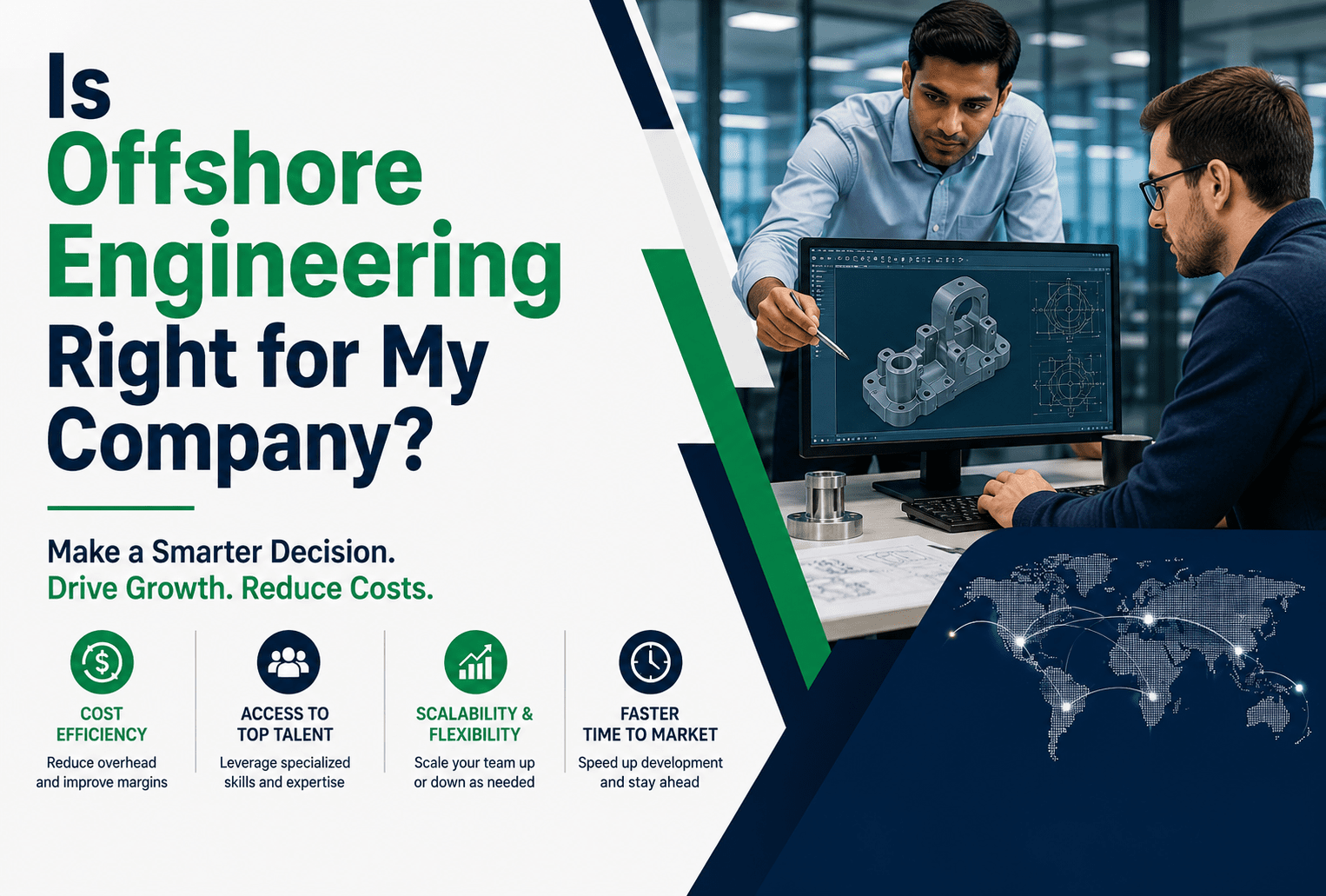
Is Offshore Engineering Right for My Company? Questions to Ask Before You Decide
Offshore engineering is right for your company if you have a persistent gap between workload and domestic capacity, if a meaningful share of that workload is execution-heavy with defined inputs and outputs, and if your internal processes are mature enough to direct a remote team. It’s not the right fit if your competitive advantage depends on proprietary design knowledge that carries real IP risk, if your work demands constant physical presence, or if your organization lacks the process documentation an outside team would need to follow. The following questions, organized by category, are designed to help you answer honestly rather than in the abstract.
Why This Deserves More Than a Yes-or-No Answer
Offshore engineering has a complicated reputation, shaped by both real success stories and visible failures. The failures share common root causes: engaging before internal processes were ready, delegating work that required judgment rather than execution, or choosing a partner on price alone. The successes share the opposite pattern: clear scope, documented standards, functioning communication infrastructure, and realistic expectations. The question isn’t whether offshore engineering works in principle — it’s whether your organization, right now, has the conditions in place to make it work for you.
Questions About Your Workload and Capacity
Is your capacity problem persistent or episodic?
If you’re overwhelmed because of a single unexpected large order, offshore onboarding may not be worth the investment. If you’ve been consistently stretched for two or more quarters, the structural case is much stronger.
What percentage of your backlog is execution-heavy?
Audit your backlog honestly. If 30% or more consists of drawing production, documentation updates, or standard configurations rather than design decisions, you have the right type of work to delegate.
Are your best engineers spending time on work below their expertise?
If senior mechanical or electrical engineers are regularly buried in production drawings or ECO processing, you have a task-allocation problem offshore support can directly solve.
Questions About Your Internal Process Readiness
Do you have documented drawing standards and templates?
An offshore team can follow your standards precisely — but only if those standards exist somewhere they can access, not only in senior engineers’ heads.
Can you clearly define what “acceptable” looks like?
If your quality criteria are subjective or inconsistently applied internally, they will be even harder to apply externally.
Do you have functioning revision control and file management?
Remote collaboration adds complexity to version control. If internal file management is already inconsistent, adding an offshore team will amplify the problem, not solve it.
Questions About Your Communication Infrastructure
Do you have a designated internal contact who can manage the relationship?
Someone needs to be available, responsive, and empowered to give direction and feedback — without this role, the partnership underperforms regardless of the offshore team’s skill.
Are your handoffs typically clear and complete?
Output quality is directly tied to input quality. If tasks are routinely handed off with incomplete specs, an offshore team will struggle for the same reason an internal hire would.
Can your team adapt to asynchronous communication?
Time-zone differences make real-time back-and-forth impractical for routine questions. Teams accustomed to walking over to a colleague’s desk need to build comfort with written briefs and scheduled check-ins.
Questions About Risk, IP, and Compliance
Does your work involve proprietary IP that creates real exposure risk?
For most standard production drawings and documentation, this is manageable with proper vetting and agreements. For work defining your core competitive advantage, the calculus changes.
Do customer contracts or regulations restrict external collaboration?
Some defense, aerospace, or government-adjacent work legally restricts where engineering can be performed. Confirm this before assuming offshore work is permissible.
Questions About Your Long-Term Objectives
Are you solving a capacity problem or building a permanent capability?
Offshore support is best suited to absorbing execution work and scaling with your pipeline — not to building deep, proprietary institutional knowledge you want to own internally.
What does your pipeline look like over the next 12 months?
Sustained, growing demand strengthens the case for investing in an offshore relationship now; an expected slowdown weakens it.
When Offshore Engineering Is a Strong Fit
Your bottlenecks are execution-heavy rather than high-risk R&D, your standards are documented (or you’re ready to document them), you’re open to structured asynchronous communication, and you view offshore capacity as an extension of your team rather than a replacement for having an engineering organization.
When It’s Probably Not the Right Fit Yet
Your products are in fast-changing R&D phases requiring daily physical iteration, your biggest problems are unclear requirements or unstable leadership rather than sheer workload, you lack documented standards or systems discipline, or regulatory and IP restrictions tightly limit who can access your design data.
How Asset-Eyes Helps You Answer These Questions
Asset-Eyes doesn’t pursue engagements where the conditions for success aren’t in place. Before we begin work, we assess your workload profile, process maturity, and communication readiness against what actually makes offshore partnerships succeed. Where the fit is right, we integrate as a functional extension of your team; where it isn’t yet, we tell you what needs to change first.