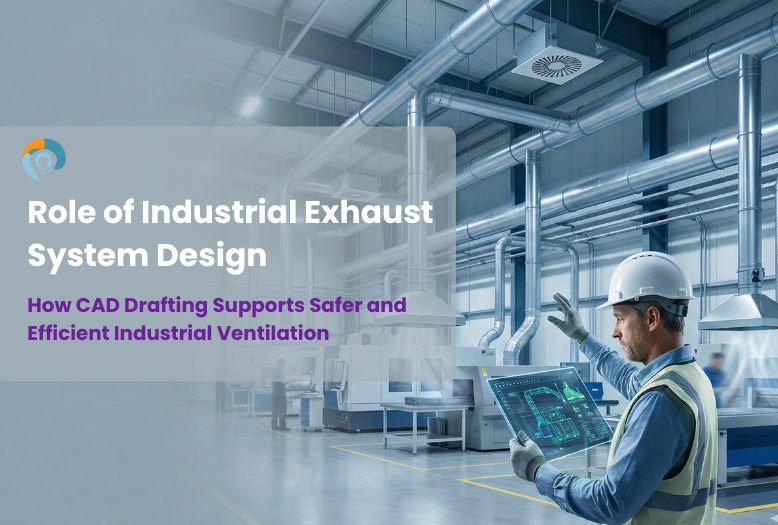
Industrial facilities such as factories, workshops, and manufacturing plants generate dust, smoke, fumes, heat, and harmful gases during daily operations. If these pollutants are not properly managed, they can accumulate, creating an unsafe environment for employees and potentially damaging machinery. Poor air quality can also reduce productivity, affect product quality, and even result in legal or regulatory complications. industrial Exhaust system design are specifically designed to remove contaminated air from these spaces and safely discharge it outside while allowing fresh air to enter, maintaining a clean and healthy workplace.
Designing an industrial exhaust system, however, requires more than just placing ducts and fans. It demands careful planning to ensure safety, efficiency, and regulatory compliance. This is where CAD drafting (Computer-Aided Design) becomes crucial. CAD enables engineers to create accurate 2D and 3D models of exhaust systems, helping them plan airflow, duct layouts, fan placement, and safety mechanisms with precision. By using CAD, designers can minimize errors, optimize system performance, and ensure the industrial exhaust system operates effectively and safely. In this blog, we will explore the role of industrial exhaust system design and explain how CAD drafting enhances its effectiveness, safety, and efficiency.
Why Industrial Exhaust System Design Is Important
Industrial exhaust system design is more than just installing fans and ducts. A well planned system serves multiple purposes:
1. Protecting Worker Health
Industrial operations often produce dust, smoke, fumes, and harmful chemicals. Exposure to these pollutants can lead to respiratory problems, skin irritation, headaches, and long-term health risks. A well designed exhaust system removes contaminants at the source, keeping workers safe.
2. Improving Indoor Air Quality
Clean air is crucial for a comfortable and safe workplace. Exhaust systems remove stale and polluted air while supplying fresh air, ensuring a healthy indoor environment.
3. Maintaining Temperature and Comfort
Industrial machines produce heat, which can make working conditions uncomfortable. Proper exhaust system design helps remove hot air and maintain comfortable temperatures for workers.
4. Regulatory Compliance
Industrial facilities must follow safety and environmental regulations. Exhaust system design ensures that the facility meets OSHA, EPA, and other local regulatory requirements, avoiding fines or penalties.
5. Protecting Equipment and Products
Accumulated dust, fumes, and corrosive gases can damage equipment and affect product quality. An efficient exhaust system keeps machines clean, prolongs their life, and maintains consistent product quality.
6. Supporting Productivity
Clean air and a comfortable environment increase employee efficiency, reduce fatigue, and boost overall productivity.
Role of Industrial Exhaust System Design
Industrial exhaust systems are critical for maintaining a safe, efficient, and compliant industrial environment. Their role includes:
1. Removing Harmful Contaminants: Exhaust systems capture dust, smoke, chemical fumes, and other pollutants produced during industrial processes. Removing these contaminants protects worker health and reduces workplace hazards.
2. Controlling Temperature and Humidity: Heat and moisture generated by machinery and chemical reactions can create uncomfortable and unsafe conditions. Exhaust systems help regulate indoor temperature and humidity levels.
3. Maintaining Airflow and Fresh Air Supply: Exhaust systems create airflow that removes polluted air and allows fresh air to enter the facility. Proper airflow ensures that the entire space maintains a healthy and breathable atmosphere.
4. Ensuring Safety and Regulatory Compliance: By effectively removing pollutants, exhaust systems help industries meet safety and environmental standards, reducing legal and operational risks.
5. Protecting Equipment and Products: Dust, moisture, and corrosive gases can damage machinery and compromise product quality. Industrial exhaust systems help prevent equipment failure and maintain high-quality production.
6. Enhancing Productivity and Worker Comfort: Clean, ventilated air makes work areas comfortable, reduces fatigue, and improves worker focus, leading to higher productivity.
How CAD Drafting Supports Industrial Exhaust System Design
Designing an industrial exhaust system is complex. Accurate CAD drafting is essential for creating precise layouts, avoiding errors, and ensuring optimal performance. The benefits of CAD drafting include:
1. Accurate Layout Planning: CAD allows engineers to create detailed layouts of ducts, hoods, fans, and vents. Accurate measurements ensure that every component fits perfectly and works efficiently.
2. 3D Visualization: 3D CAD models let designers and clients visualize the complete system before installation. This helps detect potential issues such as duct collisions, improper clearances, or poor fan placement.
3. Airflow Simulation: Advanced CAD software allows airflow simulation within ducts and hoods. This predicts how air moves through the system, ensuring effective ventilation and pollutant removal.
4. Compliance and Documentation: CAD drafting produces detailed drawings required for regulatory approvals, permits, and client documentation. Designs can be checked against industrial safety standards for compliance.
5. Reducing Installation Errors and Costs: Precise CAD drawings reduce mistakes during installation. Fewer errors save material costs, labor, and time, ensuring the system works as intended from day one.
Types of Industrial Exhaust Systems
The choice of exhaust system depends on the type of pollutants and the industrial facility layout. Common types include:
1. Local Exhaust Ventilation (LEV): LEV captures contaminants at their source using hoods, ducting, and fans. It is highly effective for processes that produce concentrated pollutants, such as welding, painting, or chemical processing.
2. General Exhaust Systems: These systems remove air from large areas, diluting and reducing overall contaminant levels. They are suitable for factories with uniform pollutant distribution.
3. Dilution Exhaust Systems: Dilution systems mix fresh air with contaminated air to reduce pollutant concentration. This is used for low-risk pollutants or large areas where source capture is not practical.
Key Components of an Industrial Exhaust System
A successful exhaust system includes several key components, all of which benefit from CAD drafting:
- Exhaust Hoods: Capture polluted air directly from the source. CAD helps design hoods for maximum efficiency.
- Ductwork: Transports polluted air to fans and filters. CAD ensures correct diameter, minimal bends, and optimal airflow.
- Fans and Blowers: Drive the airflow. CAD helps choose correct fan sizes and placement.
- Filters and Scrubbers: Clean the air before discharge. CAD ensures proper integration into the system.
- Control Systems: Sensors and automation maintain airflow based on pollutant levels. CAD helps plan sensor placement.
- Exhaust Outlets: Release air safely outside the facility. CAD ensures outlets are positioned for safe dispersion.
Design Process Using CAD Drafting
Step 1: Site Analysis
Engineers measure the facility layout, locate machinery, and identify sources of contaminants.
Step 2: Conceptual Layout
CAD drafting creates initial layouts showing ducts, hoods, fans, and outlets.
Step 3: 3D Modeling
3D CAD models provide a complete visualization, helping detect potential clashes with existing equipment.
Step 4: Simulation
CAD airflow simulations predict performance. Designers adjust duct sizes, fan speeds, and hood placements for optimal airflow.
Step 5: Final Drawings
Detailed 2D and 3D CAD drawings are prepared for client approval, installation, and regulatory compliance.
Step 6: Installation Support
CAD drawings guide installers, reducing errors and ensuring the system operates as designed.
Benefits of CAD-Based Exhaust System Design
- Precision: Accurate layouts reduce design errors.
- Visualization: Clients can see the system before installation.
- Efficiency: Optimized airflow improves performance and reduces energy costs.
- Compliance: CAD drawings meet regulatory standards.
- Cost Savings: Fewer mistakes, lower material and labor costs.
- Maintenance Planning: CAD models help plan access points for maintenance.
Common Challenges and How CAD Helps
1. Complex Facility Layouts: Factories with machinery and equipment in tight spaces make duct routing difficult. CAD drafting ensures proper fit and efficient airflow.
2. Balancing Airflow: Airflow must be uniform across all areas. CAD simulations allow designers to adjust ducts, fans, and hoods for balanced ventilation.
3. Regulatory Compliance: Industrial exhaust systems must meet safety and environmental rules. CAD drafting produces accurate, standards compliant drawings for approvals.
4. Minimizing Rework: Incorrect designs lead to costly installation rework. CAD drafting reduces errors and ensures installation goes smoothly.
Looking for Expert Help with Industrial Ventilation & Exhaust System Design?
Designing a high-performance industrial exhaust system requires precision, technical knowledge, and advanced CAD drafting skills. At Asset Eyes, we specialize in providing expert CAD drafting service for industrial ventilation system design, HVAC equipment design, and HVAC CAD drafting. We also offer professional electrical control panel design and general assembly drawing, ensuring your industrial facility operates safely, efficiently, and in compliance with all standards.
Why Choose Asset Eyes for Your Industrial Design Needs?
- Comprehensive CAD Drafting: 2D and 3D designs tailored for industrial ventilation systems, HVAC equipment, and complex industrial layouts.
- Precise System Planning: Accurate airflow simulations and layouts to optimize performance and energy efficiency.
- Regulatory Compliance: Designs meet industrial safety, environmental, and energy standards.
- Cost-Effective Solutions: Efficient designs that reduce operational costs without compromising safety or quality.
- End-to-End Support: From initial concept and HVAC CAD drafting to electrical control panel design and general assembly drawing, we provide full lifecycle support.
With Asset Eyes, you get more than just CAD drawings, you get reliable, efficient, and fully compliant solutions for all your industrial ventilation and exhaust system needs.
Conclusion
The role of industrial exhaust system design is essential for safety, health, and efficiency in industrial facilities. A properly designed system removes harmful pollutants, regulates temperature, protects equipment, and ensures compliance with regulations. CAD drafting is a key tool in this process. It allows engineers to create accurate layouts, visualize complex systems, simulate airflow, and produce detailed documentation. This ensures exhaust systems are safe, efficient, and cost effective.Investing in professional CAD drafting for your industrial exhaust system design is not just a technical requirement, it is an investment in worker safety, operational efficiency, and long term sustainability.
Contact Us Now:
📞 +91 9840895134