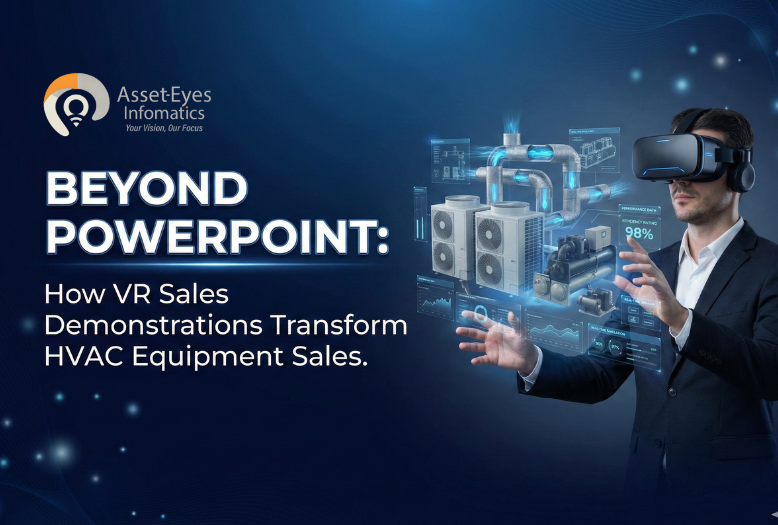
Have you ever watched a promising sales pitch fall flat despite your competitive pricing and perfect technical specifications? If you’ve experienced the frustration of seeing prospects nod politely through your presentation only to request “more time to think about it,” you’re facing one of the biggest challenges in complex HVAC equipment sales: helping customers truly understand what they’re buying before they commit significant capital.
In today’s competitive HVAC-R manufacturing landscape, traditional sales presentations struggle to convey the true value and functionality of complex systems. This blog explores how immersive VR sales demonstrations are revolutionizing HVAC equipment sales by allowing prospects to experience complete systems before making purchasing decisions, dramatically reducing sales cycles and building unshakeable confidence.
1. The Traditional Sales Challenge: When Good Presentations Aren’t Enough
Picture this scenario, You’ve spent weeks preparing for a major chiller plant proposal presentation. Your PowerPoint slides showcase detailed specifications, energy efficiency calculations, and professional renderings from your SolidWorks design team. The general assembly drawings look impressive, and your pricing is competitive.
The presentation day arrives, and you deliver a polished presentation to the facility management team. They appreciate the thoroughness of your proposal and acknowledge your company’s expertise. However, as the meeting concludes, you sense familiar hesitation in the room.
“This looks like a solid proposal,” the facilities director says, “but we’ve had a challenging year financially. We need to be absolutely certain this investment will deliver the results we need. It’s hard to really get a feel for how it will integrate with our existing space from these drawings. We’ve had some issues in the past where reality didn’t match the documentation.”
You leave the meeting knowing you’ve done everything right from a traditional sales perspective, yet the deal feels uncertain. The prospects are struggling to visualize how this significant investment will actually transform their operations, and their recent financial challenges make them extremely risk averse. Without the ability to truly experience the proposed system, they default to caution and delay.
2. The VR Transformation: When Prospects Become Believers
Now imagine the same scenario with a different approach. After presenting the technical specifications and project overview, you invite the team to experience their proposed chiller plant firsthand.
“Instead of trying to imagine how this will look and function,” you say, “let me show you exactly what we’re proposing.” You hand the facilities director a VR headset and guide him through a simple setup process.
Within moments, he’s standing in a perfectly rendered version of his mechanical room, but instead of the aging equipment currently there, he sees the new chiller system exactly as specified in your HVAC CAD drafting documentation. He can walk around the equipment, examine the piping connections, and observe the clearances for maintenance access.
“This is incredible,” he says, removing the headset momentarily. “I can actually see how the technicians will access the heat exchanger tubes for cleaning. And the control panel placement makes so much more sense now.”
From Visualization to Confident Decision Making
You guide him through different operational scenarios showing him how the system responds to varying load conditions and demonstrating the backup redundancy features. The abstract energy savings calculations from your presentation suddenly become tangible as he watches the system optimize itself in real time.
Then comes a pivotal moment that transforms the entire sale: “Could we see what it would look like if we moved the chiller about three feet to the left? We’re planning to install a new electrical panel next year, and I want to make sure we have adequate access.”
“Absolutely,” you respond. Within minutes, you’ve reconfigured the virtual environment based on your flexible CAD data. The facilities director can immediately see how the adjustment improves the overall room layout and provides better access for both current and future needs.
“And what if we went with the larger capacity model you mentioned?” asks the chief engineer. Again, you quickly swap the virtual equipment, and the team can instantly compare both options in context.
By the end of the VR session, the entire dynamic has shifted. Instead of trying to imagine abstract concepts, the prospect team has experienced their future facility. “When can we move forward with this?” the facilities director asks. “We would like to move forward with the revised layout we just reviewed.”
3. Why VR Sales Demonstrations Accelerate Decision Making
The transformation from hesitant prospects to confident buyers happens because VR addresses the fundamental challenges that plague traditional HVAC equipment design sales:
Spatial Understanding and Integration Confidence
HVAC systems exist in three dimensional space with complex relationships between components, utilities, and building infrastructure. Traditional drawings require prospects to mentally reconstruct these relationships, often leading to misunderstandings. VR eliminates this interpretation barrier by allowing prospects to experience actual spatial relationships and identify potential issues before they become expensive problems.
Risk Perception and Investment Confidence
Large capital equipment purchases represent significant financial commitments, particularly for organizations facing budget constraints. When prospects can’t fully visualize what they’re purchasing, they perceive higher risk and delay decisions. VR demonstrations transform abstract proposals into concrete experiences, dramatically reducing perceived risk and building confidence in the investment.
Stakeholder Alignment and Consensus Building
Complex HVAC projects typically involve multiple stakeholders, facilities managers, engineers, financial decision makers, and operations staff each with different priorities. Traditional presentations struggle to address all perspectives simultaneously. VR allows each stakeholder to explore the system from their own viewpoint, ask specific questions, and see immediate answers, leading to faster consensus and approval.
Real Time Customization and Problem Solving
The ability to modify configurations instantly during the presentation as demonstrated in our chiller plant example transforms the sales meeting from a one way presentation into a collaborative design session. This responsiveness builds trust and demonstrates your commitment to meeting specific customer needs.
4. Implementation Strategy for HVAC Equipment Sales
Successfully implementing VR sales demonstrations requires understanding both technology capabilities and your specific sales process requirements:
Content Development and Customization
Your VR demonstrations should showcase your equipment in realistic environments that prospects can relate to. Develop virtual representations of common installation scenarios mechanical rooms, rooftops, industrial facilities that allow prospects to see your equipment in contexts similar to their own facilities. The ability to quickly customize these environments becomes a powerful differentiator.
Hardware Selection and Portability
For sales applications, prioritize portability and ease of use over maximum performance. Modern standalone VR headsets provide sufficient visual quality while eliminating complex setup requirements. This allows sales teams to conduct demonstrations in prospect facilities, conference rooms, or trade show environments.
Integration with Existing Sales Processes
VR demonstrations work best when integrated thoughtfully into existing sales workflows. Use conventional presentations to establish credibility and present technical specifications, then transition to VR for the experiential portion that builds confidence and addresses specific concerns.
Key Success Factors:
- Start with clean, organized models
- Maintain alignment between VR scenes and current general assembly drawing revisions
- Include relevant detail for sales decisions while avoiding performance slowing minutiae
- Prepare common configuration alternatives for instant demonstration
- Train sales teams on smooth transitions between traditional and immersive content
Measuring Success and ROI
The effectiveness of VR sales demonstrations can be measured through several key metrics:
Sales Cycle Acceleration: Traditional HVAC equipment design sales often involve extended evaluation periods. VR demonstrations typically reduce these cycles by providing immediate clarity and confidence.
Close Rate Improvement: When prospects can experience solutions firsthand and see immediate answers to their concerns, close rates improve significantly.
Proposal Accuracy: VR demonstrations often reveal spatial or integration issues that would otherwise surface during installation, reducing change orders and project delays.
5. How Asset-Eyes Transforms Your Sales Vision Into Reality
At Asset-Eyes, our VR sales demonstration services build upon our proven expertise in HVAC CAD drafting and solidworks drafting services to create compelling sales experiences that close deals faster. We understand that exceptional technical documentation forms the foundation for realistic and accurate virtual demonstrations.
Foundation Services: We provide precise CAD drafting service and detailed general assembly drawings that ensure your VR demonstrations accurately represent your equipment specifications, spatial requirements, and installation details.
Sales-Focused VR Development: Using your approved designs, we create interactive virtual environments that prospects can explore, customize, and experience firsthand. These demonstrations support real time modifications, allowing you to address specific prospect requirements during the presentation.
Clear Service Boundaries: You maintain complete ownership of HVAC equipment design decisions, pricing strategies, and customer relationships. Asset-Eyes delivers precise drafting and immersive sales content that communicates your solutions clearly without altering your technical specifications or sales approach.
Our expertise in both traditional solidworks design and cutting edge VR technologies ensures seamless integration with your existing workflows while opening new possibilities for sales effectiveness and customer engagement.
The Competitive Advantage of Immersive HVAC Equipment Sales
VR sales demonstrations represent more than impressive technology; they’re becoming essential tools for competitive differentiation in complex equipment sales. When prospects can experience your vision firsthand, see immediate solutions to their concerns, and customize configurations in real time, the odds in your favor dramatically increase
The transformation from traditional presentations to immersive experiences fundamentally changes how prospects interact with and understand your solutions. In an industry where significant capital investments require absolute confidence, the ability to let customers experience their future systems before purchasing provides an unmatched competitive advantage.
Ready to transform your sales presentations from static slides to immersive experiences that close deals? The technology is proven, the benefits are measurable, and the competitive advantages are waiting for manufacturers bold enough to let their prospects experience the future.
Contact Us Now:
📞 +91 9840895134
FAQs
Traditional PowerPoint presentations fail because prospects struggle to visualize how complex HVAC systems will integrate with their existing spaces. Even with detailed specifications, energy calculations, and professional renderings from SolidWorks design teams, prospects face interpretation barriers when mentally reconstructing three-dimensional spatial relationships from flat drawings. Risk-averse buyers, especially those facing budget constraints, default to caution and delay purchasing decisions when they can’t truly experience the proposed system.
VR eliminates interpretation barriers by allowing prospects to experience actual spatial relationships firsthand rather than imagining abstract concepts from static drawings. In chiller plant demonstrations, facilities directors can walk around equipment, examine piping connections, observe maintenance clearances, and understand control panel placement in ways that traditional drawings cannot convey. This transforms hesitant prospects into confident buyers ready to move forward with purchasing decisions.
Real-time configuration changes transform sales meetings from one-way presentations into collaborative design sessions. When prospects request modifications—like moving a chiller three feet to accommodate future electrical panel installation or swapping to larger capacity models—sales teams can instantly show the results in the virtual environment. This responsiveness builds trust, demonstrates commitment to meeting specific customer needs, and accelerates decision-making by addressing concerns immediately during the presentation.
VR allows each stakeholder—facilities managers, engineers, financial decision-makers, and operations staff—to explore systems from their own perspective and ask specific questions with immediate visual answers. Unlike traditional presentations that struggle to address all priorities simultaneously, VR provides personalized exploration experiences where every decision-maker’s concerns are addressed visually and concretely during the same session, leading to faster consensus and approval.
Modern standalone VR headsets provide sufficient visual quality while eliminating complex setup requirements, prioritizing portability and ease of use over maximum performance. This allows sales teams to conduct demonstrations in prospect facilities, conference rooms, or trade show environments without technical complexity. Prospects can be inside a virtual mechanical room within moments of receiving the headset, maintaining sales momentum throughout the presentation process.
VR demonstrations work best when integrated thoughtfully into existing sales processes rather than replacing them entirely. Use conventional presentations first to establish credibility and present technical specifications, then transition to VR for the experiential portion that builds confidence and addresses specific concerns. Success requires maintaining alignment between VR scenes and current general assembly drawing revisions, and training sales teams on smooth transitions between traditional and immersive content.
ROI from VR sales demonstrations can be measured through three key metrics: sales cycle acceleration by reducing extended evaluation periods, close rate improvement when prospects experience solutions firsthand, and proposal accuracy by revealing spatial or integration issues before installation. VR typically shortens decision cycles by providing immediate clarity, increases conversion rates, and reduces costly change orders and project delays that would otherwise surface during actual installation.
Successful VR sales content requires developing virtual representations of common installation scenarios—mechanical rooms, rooftops, and industrial facilities—that prospects can relate to their own environments. Content must maintain alignment between VR scenes and current general assembly drawing revisions, include relevant detail for sales decisions while avoiding performance-slowing minutiae, and prepare common configuration alternatives for instant demonstration during prospect meetings.
Asset-Eyes builds VR sales demonstrations upon their proven HVAC CAD drafting and SolidWorks drafting expertise, ensuring virtual demonstrations accurately represent equipment specifications, spatial requirements, and installation details. Using approved designs, they create interactive virtual environments supporting real-time modifications during prospect presentations. Asset-Eyes maintains clear service boundaries—manufacturers retain complete ownership of design decisions, pricing strategies, and customer relationships while receiving precise immersive sales content.
Early adopters gain significant advantages through improved customer engagement quality, accelerated sales cycles, and enhanced proposal accuracy. VR shifts sales from static slides to immersive experiences where customers experience their own spaces, test configurations, and receive immediate answers to concerns. In a market where large capital investments require absolute confidence, this ability to let prospects experience future systems before purchasing provides unmatched competitive differentiation and measurable business results.