
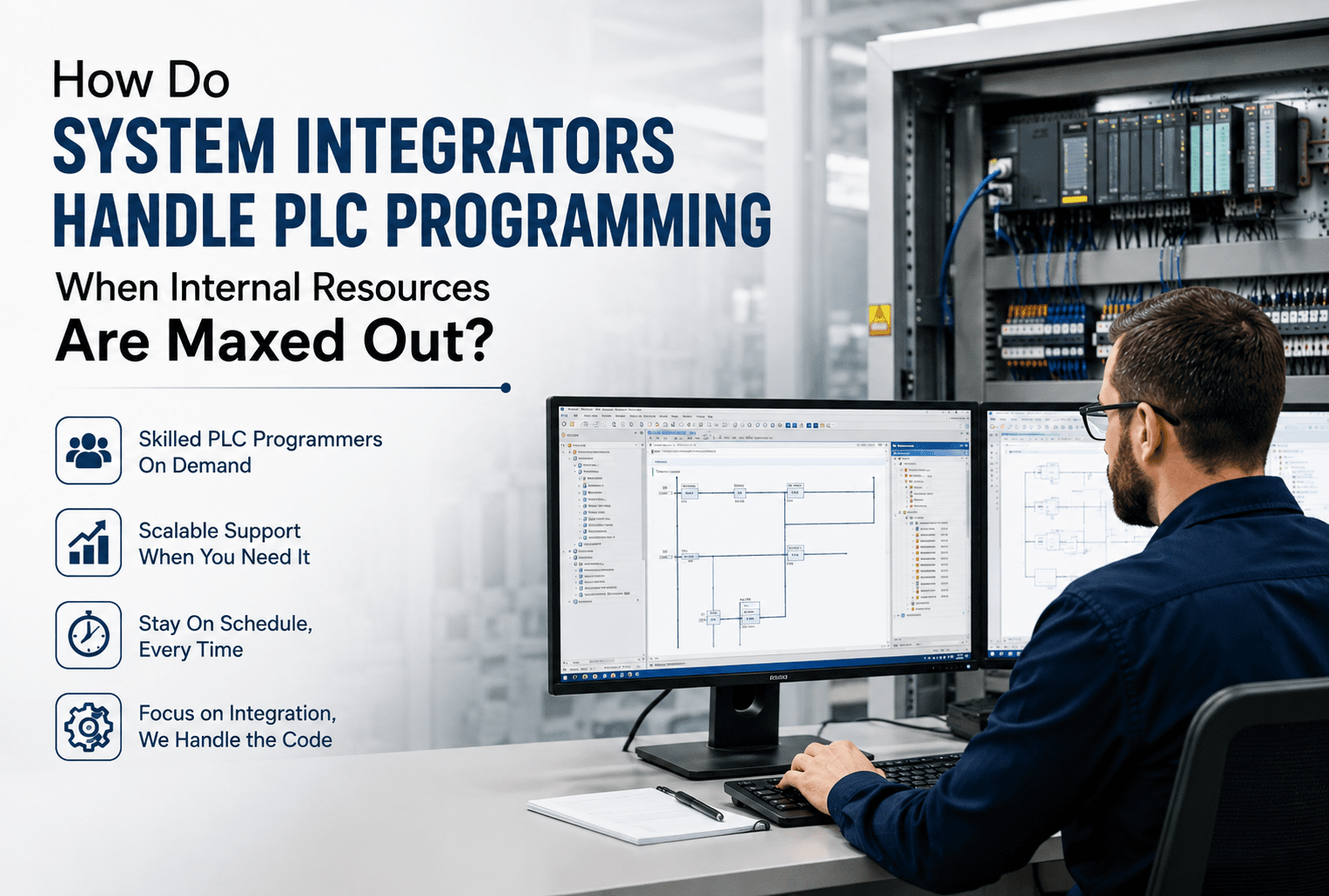
When internal PLC programming capacity is maxed out, the realistic options are extending the project timeline, delaying the start of new commitments, engaging a specialized controls engineering firm for a tightly defined scope, or offloading everything that surrounds the programming hardware documentation, I/O mapping, HMI drafting — so your programmers spend their hours on logic instead of everything adjacent to it. What isn’t realistic is treating PLC programming like drafting overflow: the logic encodes your process knowledge, your safety philosophy, and often your competitive differentiation, so it doesn’t delegate to a general resource the way a wire list does. The rest of this page works through each lever and when it actually applies.
Why PLC Programming Doesn’t Delegate Like Drafting Does
Drafting and documentation are execution tasks given clear standards and inputs, a qualified external team can produce them without touching your engineering judgment. PLC programming is different in kind, not just in degree. The logic a programmer writes encodes the machine’s behavior, its safety responses, and often the proprietary sequencing that differentiates your integration work from a competitor’s. Handing that logic to an outside resource transfers both intellectual property and liability for machine behavior a materially different risk than handing over a wire list and it requires deep, hard-to-transfer context about the customer’s process and mechanical reality. This doesn’t mean programming can never be delegated; it means the decision needs a different framework than “we’re behind, find capacity.”
The Four Realistic Levers When Programming Capacity Is Exhausted
1. Offload Everything Around the Programming
A programmer spending thirty percent of project hours on I/O list reconciliation, hardware documentation, and HMI drafting is effectively a thirty-percent-capacity programmer for the work only they can do. Offloading those surrounding deliverables to an external documentation team frees that capacity without transferring any programming IP. For most maxed-out shops, this is the highest-leverage move available, because it requires finding a documentation team that can follow your standards, not a programmer who understands your application.
2. Extend the Timeline Before Committing to It
The most underused lever is refusing to commit to a completion date that current capacity can’t support. Most schedule compression happens because commitments were made before resource availability was honestly assessed. Extending a committed programming timeline by two to four weeks at the quoting stage costs far less than missing a FAT date after the fact.
3. Engage a Specialized Controls Firm for a Defined Scope
Where offloading surrounding work and extending the timeline aren’t enough, bringing in a specialized controls engineering firm not a general staffing resource for a tightly bounded scope is the appropriate external option. A firm developing one specific functional module or porting a well-specified sequence to a new platform is working from a contained brief; the risk of IP transfer rises sharply as the scope definition loosens.
4.Engage a Specialized Controls Firm for a Defined Scope
Where offloading surrounding work and extending the timeline aren’t enough, bringing in a specialized controls engineering firm not a general staffing resource for a tightly bounded scope is the appropriate external option. A firm developing one specific functional module or porting a well-specified sequence to a new platform is working from a contained brief; the risk of IP transfer rises sharply as the scope definition loosens.
Comparing Your Two Real Outsourcing Paths
| Criteria | Offload Hardware & Documentation | Outsource Defined PLC Logic |
| IP risk | Minimal — logic stays entirely in-house | Real — requires sharing process-specific detail |
| Ramp-up speed | Fast — follows your existing standards | Slower — requires application onboarding |
| Cost structure | Predictable, execution-level rates | Premium, specialist consulting rates |
| Best fit when | Programmers are doing drafting/documentation work | You lack a specific platform skill for a defined module |
What Doesn’t Work
Routing PLC overflow to a general engineering outsourcing partner without a defined scope is the most common and most expensive mistake here it produces logic that requires extensive internal review before it can be trusted, and any rework it triggers can consume more of your programmers’ time than doing it internally would have. A close second is waiting until a project is already behind before addressing capacity; at that point every remaining lever costs more than it would have at project start.
How Asset-Eyes Supports System Integrators at Capacity

Asset-Eyes handles the documentation, panel layout, and I/O mapping work that surrounds PLC programming built inside your CAD environment, to your standards so your programmers spend their time on logic and application-specific decisions rather than the deliverables around it. We don’t write your code; we clear the drafting backlog out of your programmers’ way.