
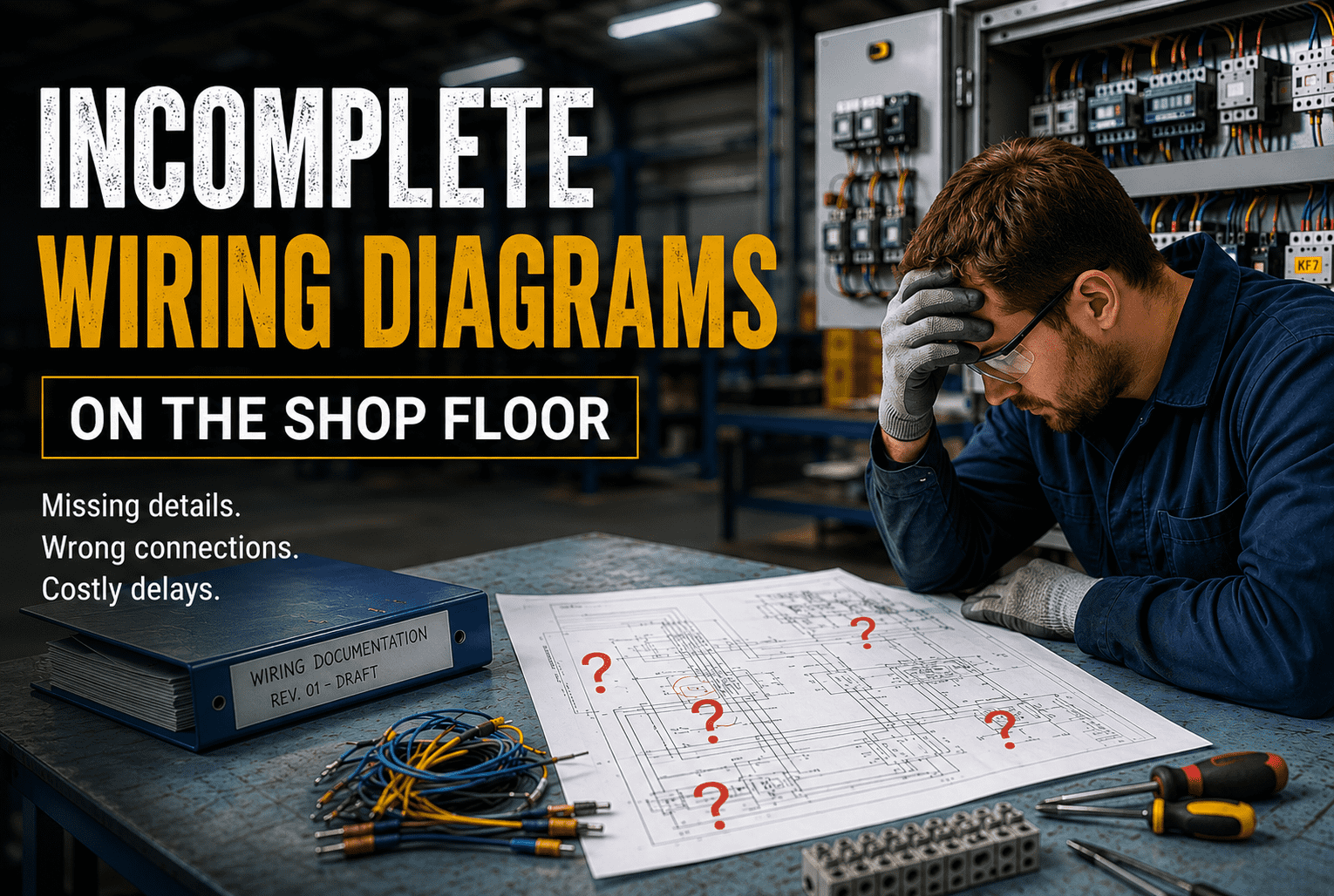
What Is the Cost of Incomplete Wiring Diagrams on the Shop Floor?
The cost of incomplete wiring diagrams shows up as shop floor wait time, rework from judgment calls made on ambiguous drawings, delayed FAT and shipment dates, and in the worst cases field failures traced back to a documentation gap rather than a fabrication error. It rarely appears as a single line item, which is exactly why it persists across projects without triggering a fix. Once the hours are tracked honestly across a build cycle, incomplete documentation typically costs several times what a complete package would have cost to produce up front.
The Line-Item Problem: Why This Cost Persists
The expense of incomplete drawings doesn’t land in a documentation budget it lands in shop labor, in project management time, in expedited freight for components ordered against a mismatched BOM, and in commissioning overruns. A fabricator who stops for twenty minutes to call engineering about an ambiguous wire number is logged as ordinary shop labor. A late FAT that pushes a ship date and triggers a penalty clause is logged as a project overrun. Neither is ever labeled “documentation problem” on a job cost report, which is precisely what allows the same gap to repeat, project after project, without ever generating the urgency a single visible invoice would.
Shop Floor Wait Time and Idle Labor
When a fabricator hits a missing wire number or a schematic that doesn’t match the layout, fabrication stops. Waiting converts engineering delay directly into idle shop labor a cost regardless of whether the tech is building or standing still. A single incomplete package in a multi-panel shop can cascade: one panel stalls, the team shifts to another, and resuming the first requires a re-orientation pass before work continues.
2. Rework From Judgment Calls on Ambiguous Drawings
When a fabricator makes a reasonable guess on an ambiguous drawing — a wire color, a terminal assignment — some percentage of those guesses will be wrong, especially on safety or control circuits. Rework costs more than the original task, because the assembler must first undo work already integrated into a partially built panel before correcting it.
3. Delayed FAT, Shipment, and Contractual Consequences
Documentation delays propagate forward: a panel that ships two weeks late because drawings weren’t ready may trigger a late-delivery clause, force a customer to reschedule their own commissioning crew, or require expedited freight to partially recover schedule. A single late-delivery penalty on a mid-size project can exceed the cost of outsourcing an entire drawing package.
4. Field Failures and Warranty Risk
The most severe cost is a field failure traced to a documentation gap rather than a build error. Beyond repair cost, this includes field investigation time, customer downtime, and warranty disputes that are especially hard to resolve because the gap is visible in retrospect the drawing simply didn’t specify the critical detail.
A rough planning model makes the scale visible:
$$\text{Cost of Incomplete Diagrams} = (\text{Clarification Events} \times \text{Avg. Resolution Time} \times \text{Shop Rate}) + \text{Rework Cost} + \text{Schedule Impact Cost} + \text{Field Impact Cost}$$
Where clarification events are stoppages caused by missing or conflicting information, rework cost covers both tech and engineering hours spent correcting wrong assumptions, schedule impact cost covers delayed revenue and overtime premiums, and field impact cost covers service hours plus any contractual penalties.
Estimation Traps: Why the Cost Is Almost Always Underestimated
- Tracking engineering time but not shop wait time.CAD hours get logged meticulously; the hours a technician spends standing at a bench waiting for an answer usually don’t.
- Treating rework as normal.When redlining a panel is common, tearing out and rewiring a section gets accepted as a standard cost of doing business rather than flagged as a preventable documentation failure.
- Ignoring opportunity cost.The time a senior engineer spends walking the shop floor to explain a missing schematic detail is time not spent on the next billable design.
What Compresses vs. Extends This Cost
Compresses it: fully synchronized BOMs and wire lists generated from the schematic; scaled physical layouts validated before drilling starts; a defined design-freeze gate before the package is released to production.
Extends it: “schematic-only” handoffs that leave layout and terminal detail unresolved; relying on technicians to size duct or spacing on the fly; updating drawings through verbal instructions rather than formal revisions.
How Asset-Eyes Reduces Documentation-Sourced Shop Floor Cost
 Asset-Eyes produces complete, internally consistent drawing packages schematics, layouts, wire lists, terminal plans, and BOMs generated from a single source of truth so your shop floor builds from documentation that agrees with itself rather than one requiring interpretation. Reducing clarification events and rework at the fabrication stage is a direct, measurable consequence of documentation quality once you start tracking it against your current baseline.