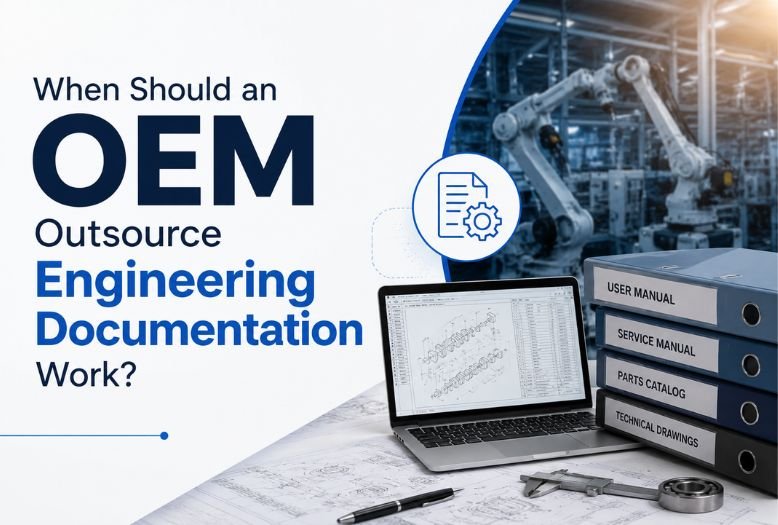
Outsource engineering documentation work when your engineers spend more than 20% of their time on repetitive drawing and documentation tasks instead of design work, when project delays are caused by documentation backlogs rather than engineering decisions, or when variable workloads make full-time in-house staff financially inefficient. The right time is when you have clear standards and processes but lack the capacity to execute them consistently.
The Strategic Decision Framework
Most OEMs face this decision when growth outpaces their ability to hire and train qualified engineering staff, or when senior engineers become expensive documentation resources instead of innovators. The key is recognizing whether you have a temporary capacity spike or a structural need for flexible engineering support.
Use this four-question framework to evaluate your situation:
1. Where is your engineering time actually going?
- Are senior engineers spending 20-40% of their week creating production drawings, updating BOMs, and processing ECOs?
- Is “waiting on drawings” a common reason for project delays?
- Are engineers working evenings and weekends to catch up on documentation?
2. What does your workload pattern look like?
- Do you experience seasonal spikes or project-driven surges in documentation needs?
- Is your backlog growing faster than your team can clear it?
- Would you struggle to keep a full-time hire busy year-round?
3. How standardized are your processes?
- Do you have documented standards, templates, and naming conventions?
- Can you clearly define what constitutes acceptable deliverables?
- Would an external team be able to follow your established procedures?
4. What’s the real cost of your current approach?
- Are you paying engineer rates for lower-level documentation work?
- Is inconsistent documentation causing manufacturing delays or errors?
- Are you turning down projects because you can’t staff the documentation requirements?
Signs It’s Time to Outsource
Your engineering team is misallocated: Senior engineers regularly complain about being stuck on routine documentation instead of solving design problems. Manufacturing waits for drawings while engineers work overtime on tasks that could be handled by a dedicated external team.
Project timelines are driven by documentation, not design: The engineering work is complete, but projects slip because drawing packages aren’t ready. Your bottleneck is in execution, not decision-making.
You have variable, project-driven workloads: Large custom orders create documentation surges followed by quiet periods. You can’t justify permanent headcount for inconsistent demand, but you can’t afford to miss deadlines during peak periods.
Quality and consistency are suffering: Different engineers produce different drawing styles. Manufacturing frequently returns drawings with questions about dimensions, tolerances, or assembly details.
You’re avoiding growth opportunities: Sales hesitates to quote complex projects because the engineering team lacks confidence in their documentation capacity.
Signs It’s Not the Right Time
Your processes aren’t documented: You lack standard templates, naming conventions, or clear quality criteria. An external team would have no framework to follow.
The work requires constant physical collaboration: Your products are in active R&D phases where staff need daily access to prototypes, test setups, or manufacturing floors for real-time adjustments.
Your team has adequate capacity: Engineers aren’t stretched, projects aren’t delayed, and the real problem lies elsewhere — perhaps in project scoping, customer requirements, or manufacturing processes.
Compliance restrictions prevent external partnerships: Your work involves classified information, highly sensitive IP, or regulatory requirements that legally mandate in-house-only documentation.
What to Expect from a Professional Engineering Partner
A qualified partner should integrate seamlessly with your existing workflows rather than creating parallel processes. They should work in your systems, follow your standards, and communicate like engineers — not like a vendor executing instructions.
How Asset-Eyes Extends Your Engineering Team
Asset-Eyes operates as your dedicated external engineering bench — not a generic service provider. We learn your standards, adopt your processes, and integrate with your project workflows to deliver production-ready documentation that meets your quality requirements.
Our approach eliminates the documentation bottleneck so your engineers can focus on design, innovation, and customer problem-solving. Whether you need overflow support during peak periods or ongoing engineering capacity, we scale with your needs without the overhead of permanent headcount.