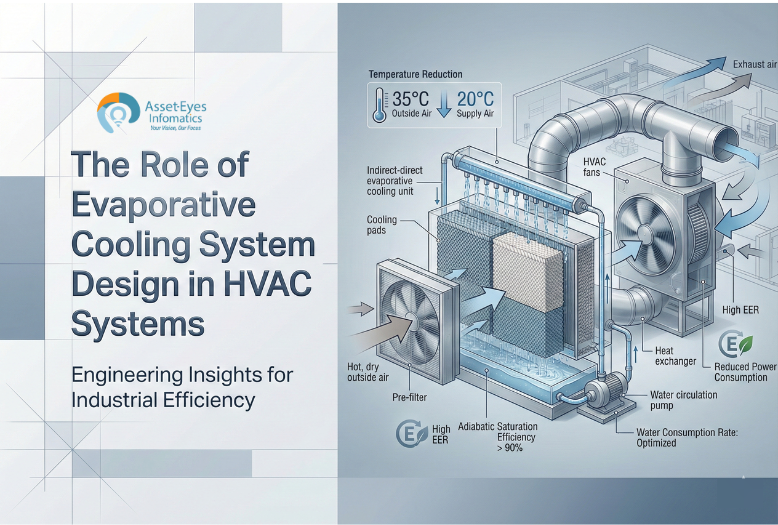
In the realm of modern heating, ventilation, and air conditioning HVAC systems, evaporative cooling has emerged as an energy efficient and sustainable cooling alternative particularly in hot, dry climates where traditional air conditioning can be costly and less effective. However, the success of any evaporative cooling solution depends not just on selecting the technology but on how well the system is designed, engineered, and implemented. At Asset Eyes, we view evaporative cooling system design as a critical foundation for HVAC performance, comfort, indoor air quality, and long term operational efficiency.
Proper design ensures that systems not only cool effectively but also maintain balanced humidity, integrate seamlessly with other HVAC components, and operate sustainably over their entire lifecycle. In this comprehensive guide, we explore why evaporative cooling system design matters, the key factors that influence performance, common challenges, and proven best practices all backed by practical insights and engineering expertise.
Table of Contents
- What Is Evaporative Cooling in HVAC Systems?
- How Evaporative Cooling Systems Work
- Role of Evaporative Cooling System Design in HVAC Systems
- Key Design Considerations for Evaporative Cooling Systems
- Benefits of a Well-Designed Evaporative Cooling System
- Common Design Challenges and Practical Solutions
- Best Practices for Evaporative Cooling System Design
- Asset Eyes’ Expertise in Evaporative Cooling System Design
1. What Is Evaporative Cooling in HVAC Systems?
Evaporative cooling is a process that leverages the natural heat absorbing properties of water evaporation to cool air. Unlike conventional refrigeration based air conditioning systems that rely on compressors and refrigerants, evaporative systems cool air through water evaporation, resulting in lower energy consumption and simpler mechanical components.
Evaporative cooling is widely used in:
- Industrial facilities and warehouses
- Commercial buildings and office spaces
- Retail environments
- Workshops
- Large open plan structures where traditional cooling is too expensive or inefficient
By drawing fresh outside air through saturated pads or media, evaporative cooling systems can significantly reduce the temperature of incoming air before delivering it into occupied spaces all while maintaining fresh air exchange.
2. How Evaporative Cooling Systems Work

The basic operation of an evaporative cooling system involves drawing warm outside air through water-saturated cooling pads. As the air passes through the pads, water evaporates and absorbs heat from the air. This process reduces the air temperature before it is distributed into the indoor space.
The performance of this process depends on several factors, including airflow rate, pad efficiency, water distribution, and ambient humidity. This is why system design is crucial without proper design, the cooling effect may be inconsistent or insufficient.
3. Role of Evaporative Cooling System Design in HVAC Systems
The role of evaporative cooling system design in HVAC systems goes far beyond equipment selection. It defines how effectively the system meets cooling requirements while maintaining indoor comfort and energy efficiency.
1. Ensuring Effective Cooling Performance
A well-designed system ensures that the evaporative cooling capacity matches the actual cooling load of the building. Proper design prevents under-cooling during peak conditions and avoids over sizing that leads to unnecessary energy and water consumption.
2. Maintaining Indoor Air Quality
Evaporative cooling systems continuously introduce fresh air into the space. Design plays a key role in managing air exchange rates, exhaust paths, and pressure balance to prevent stale air buildup and maintain healthy indoor environments.
3. Controlling Humidity Levels
One of the biggest challenges with evaporative cooling is managing humidity. Effective system design ensures that moisture levels remain within acceptable limits through proper airflow planning, exhaust ventilation, and system placement.
4. Optimizing Energy and Water Efficiency
System design directly impacts energy and water usage. Correct fan selection, duct sizing, and water distribution reduce wastage and ensure the system operates at peak efficiency with minimal resources.
5. Supporting HVAC System Integration
In many buildings, evaporative cooling works alongside conventional HVAC systems. Proper design ensures smooth integration, allowing evaporative cooling to handle primary loads while mechanical systems provide backup when required.
4. Key Design Considerations for Evaporative Cooling Systems
1. Climate and Environmental Analysis
Design begins with understanding local climate conditions, including temperature, humidity, and seasonal variations. This helps determine whether evaporative cooling is suitable as a standalone solution or part of a hybrid HVAC system.
2. Cooling Load and Space Assessment
Accurate load calculations consider building size, occupancy, heat generating equipment, and insulation. These calculations help determine system capacity and airflow requirements.
3. Airflow Distribution and Ventilation
Balanced airflow ensures even cooling across the space. Proper ventilation design allows warm and moist air to exit the building, preventing humidity buildup and improving comfort.
4. Water Quality and Management
Water quality affects pad life and system efficiency. Design considerations include filtration, bleed off systems, and easy access for maintenance.
5. Material Selection and Durability
Since evaporative cooling systems operate in moist environments, materials must be corrosion resistant and durable to ensure long service life.
5. Benefits of a Well Designed Evaporative Cooling System
A properly designed evaporative cooling system delivers multiple advantages:
- High energy efficiency with low power consumption
- Reduced operating and maintenance costs
- Environmentally friendly operation without refrigerants
- Improved indoor air quality through continuous fresh air supply
- Enhanced thermal comfort in large and open spaces
These benefits make evaporative cooling an attractive HVAC solution when supported by sound engineering design.
6. Common Design Challenges and Practical Solutions
- Excessive Indoor Humidity: Poor exhaust planning can cause moisture accumulation. Proper ventilation design and airflow balance help maintain humidity control.
- Uneven Cooling Distribution: Incorrect duct layout or fan sizing may lead to hot spots. This issue can be resolved through careful airflow modeling and distribution planning.
- High Water Consumption: Efficient water distribution systems and regular maintenance help minimize water usage and prevent wastage.
7. Best Practices for Evaporative Cooling System Design
- Conduct detailed climate and load analysis
- Use simulation tools to study airflow and temperature patterns
- Design effective exhaust air paths
- Select high quality cooling media and corrosion resistant materials
- Plan for easy maintenance and system access
Following these best practices ensures reliable and efficient system performance.
8. Asset Eyes’ Expertise in Evaporative Cooling System Design
At Asset Eyes, we deliver high performance evaporative cooling system design backed by expert CAD drafting service and precise CAD drawing services. Our team specializes in HVAC equipment design, HVAC CAD drafting, and industrial ventilation system design, ensuring cooling systems are efficient, reliable, and easy to implement. Every design is developed with accurate airflow planning, proper equipment placement, and seamless integration with industrial exhaust system design to improve indoor air quality and energy efficiency.
In addition to cooling and ventilation design, Asset Eyes provides detailed general assembly drawings and professional electrical control panel design to support smooth system installation and operation. From concept development to final CAD deliverables, we offer end-to-end support that meets safety, environmental, and industry standards. With Asset Eyes, you get more than drawings; you gain a trusted design partner delivering compliant, cost-effective, and future ready evaporative cooling and HVAC solutions.
Conclusion
The role of evaporative cooling system design in HVAC systems is critical to achieving efficient, sustainable, and comfortable indoor environments. Proper design ensures effective cooling, controlled humidity, optimized energy usage, and seamless HVAC integration.
With thoughtful planning and engineering expertise, evaporative cooling can serve as a powerful solution for modern HVAC challenges. At Asset Eyes, we help organizations design evaporative cooling systems that perform reliably, reduce costs, and support long term sustainability goals.