What Causes Documentation Bottlenecks in Electrical Panel Manufacturing?
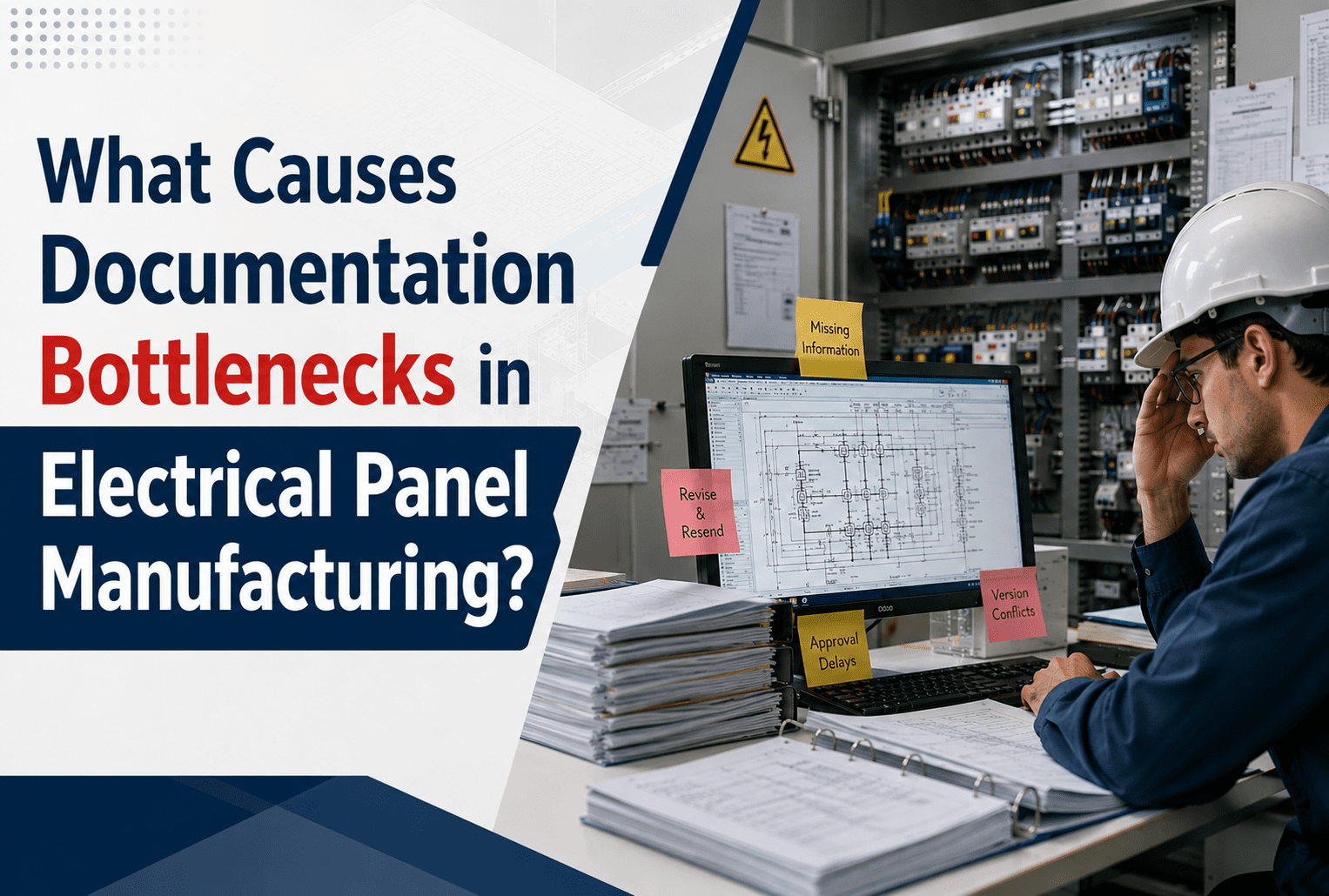
Documentation bottlenecks in electrical panel manufacturing are rarely caused by a lack of engineering skill. They’re overwhelmingly caused by a predictable set of process failures: late-stage design changes invalidating work already in progress, a single designer carrying all documentation responsibility across every active project, CAD environments that require manual reconciliation between schematics and BOMs, undocumented standards that keep every drawing dependent on one person’s judgment, and unclear handoffs that force drafters to guess rather than draft. These causes are distinct and call for different fixes throwing more drafting hours at a broken process doesn’t solve it, it just produces errors faster.
Why Electrical Documentation Is Uniquely Vulnerable
Unlike mechanical design, where a single 3D model can often drive the entire downstream process, electrical panel documentation is deeply interdependent. A single change ripples across every layer of the package. Consider something as small as swapping a 10-amp motor for a 20-amp one: the schematic symbol changes, conductor sizing has to be recalculated, the overload relay part number changes, the panel’s SCCR needs to be reverified, the physical layout has to be checked to confirm the new component still fits within spacing requirements, and the bill of materials needs updating to match. If your tools and process don’t link these tasks automatically, every minor design change triggers a cascade of manual updates across five or six separate documents and that cascade, repeated across every active project, is what turns a manageable workload into a chronic bottleneck.
The Primary Causes of Documentation Bottlenecks
1. Late-Stage Design Changes Invalidating Work Already in Progress
The most common and most expensive bottleneck isn’t a drafting problem it’s a change management problem. When a customer requests a scope modification, a specified component becomes unavailable and a substitute changes the power circuit, or a mechanical dimension shifts and the enclosure layout needs rework, drawings already in progress get partially or fully invalidated. Without a clear gate between design freeze and drafting start, you’ll spend significant time redrafting work that was technically complete, and your apparent drafting velocity will look far slower than it actually is. The fix isn’t faster drafting it’s a defined design-freeze protocol that separates the decision phase from the execution phase.
2. Single-Point-of-Failure Designers
When one person holds all electrical drafting responsibility across your active project load, their personal capacity becomes your entire shop’s throughput ceiling. If they’re out sick, on vacation, or pulled into troubleshooting a field issue, every project waiting on electrical documentation stalls simultaneously. This configuration is extremely common in shops that grew from a small team where one skilled person naturally absorbed all the drafting work and it’s the most structurally fragile setup a panel shop can operate under.
3. Disconnected CAD and BOM Workflows
In a properly configured intelligent electrical CAD environment, the bill of materials is a live output of the schematic add a component, it appears in the BOM; change one, the BOM updates automatically. In many panel shops, the BOM is still maintained separately in a spreadsheet, requiring manual updates every time the schematic changes. This doubles the effort required to keep documentation current through revisions and introduces a persistent risk of schematic-BOM discrepancies that surface only when the shop floor orders parts or an inspector reviews the package.
4. Undocumented Standards and Tribal Knowledge
When component spacing rules, wire color codes, preferred vendor selections, and drawing conventions exist only in the mind of your senior engineer, every drawing has to pass through that person for creation or approval. Without documented standards, reusable macros, and pre-configured templates, every new panel gets treated like a custom project, drastically increasing the time required to produce even a routine drawing package — and making it impossible to delegate work to anyone, internal or external, without extensive hand-holding.
5. Unclear or Incomplete Handoffs to Drafters
Documentation bottlenecks don’t always originate in the documentation phase. When a drafter receives an I/O list with unlabeled signals, a markup with ambiguous component references, or a verbal description rather than a structured specification, they spend time resolving ambiguity instead of producing drawings. Each clarification question adds latency a question asked at 4 PM may not get answered until the next morning and a complex schematic can generate a dozen such questions. The fix is a defined handoff format specifying exactly what a drafter needs before starting: device list, I/O assignments, power architecture, applicable standards, and approved component selections.
Is Your Bottleneck a Process Problem or a Capacity Problem?
Not every panel shop suffers from the same root cause, and the fix depends entirely on which one you’re actually facing.
Signs your bottleneck is a process problem:
Rework is constant: Drawings are frequently kicked back from the shop floor due to mismatched part numbers, physically impossible component placements, or missing wire numbers.
Intelligent software is underutilized: You’ve paid for EPLAN or AutoCAD Electrical, but your team uses it like a digital whiteboard, ignoring the automated BOM and reporting features it was purchased to provide.
Onboarding is nearly impossible: New hires take months to become productive because they have to learn how your shop “prefers” things rather than referencing a written standard.
Signs your bottleneck is a capacity problem:
Processes are tight, but hours are short: Your team uses intelligent CAD, generates automated BOMs, and works from standard macros but the sheer volume of incoming orders still exceeds available hours.
Engineers are efficient but burning out: The team executes flawlessly, without errors, but is working consistent overtime just to keep pace.
Fixing It Process First, Capacity Second
You cannot outsource or hire your way out of a broken process. Address the fundamentals first or at minimum in parallel with any additional capacity: standardize symbols, title blocks, and naming conventions; define minimum input criteria before drafting begins (a frozen I/O list, agreed component selections, an approved mechanical envelope); and use your CAD tool’s built-in intelligence component libraries, automatic wire lists, terminal reports — instead of recreating that data manually in spreadsheets. Once that foundation is in place, additional drafting capacity internal or external actually increases throughput instead of amplifying existing confusion.
How Asset-Eyes Helps Eliminate Documentation Bottlenecks

Asset-Eyes works with control panel builders and system integrators to absorb the execution-heavy drafting that creates documentation bottlenecks schematics, panel layouts, wire lists, terminal plans, and BOM reconciliation while working within your existing standards and CAD environment. Where process gaps are contributing to the bottleneck, we flag them during onboarding rather than quietly working around them, because more drafting hours applied to a broken process just produces errors faster. Our goal is to function as a reliable extension of your documentation capacity and help you fix the structural causes that keep the backlog from clearing on its own.