Picture this scenario: You’re reviewing an industrial ventilation system design and the first suggestion from the team is to upsize all the ductwork, add more gentle transitions, and spec a bigger fan—all to minimize pressure drop. The system gets built, commissioned, and then reality hits. Airflow distribution is uneven, the controls are constantly hunting, and what looked perfect on paper performs poorly in the plant.
What went wrong? The team solved for the wrong problem.
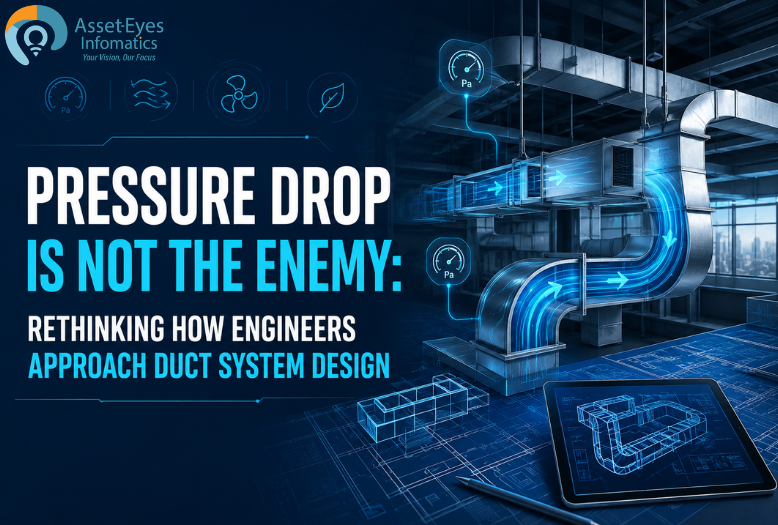
Engineers are often conditioned to treat pressure drop like a villain that must be eliminated at all costs. But this mindset leads to oversized fans, poorly controlled systems, and designs that work beautifully in spreadsheets but struggle in real-world operation. The truth is, pressure drop isn’t your enemy it’s valuable diagnostic information that, when understood properly, leads to smarter hvac ductwork design decisions.
This article reframes pressure drop as a design tool rather than a design penalty, exploring how understanding where resistance originates helps create more effective industrial ventilation systems.
1. The Core Problem: Treating All Pressure Drop as Equal
Think of pressure drop like friction in a machine. If your only goal was “reduce all friction,” you might oversize components, use exotic materials unnecessarily, and complicate the design all the while overlooking more important questions about stiffness, safety, cost, and control.
The same thing happens in duct system design. When “minimize pressure drop” becomes the primary objective, engineers often create systems that are:
- Oversized and inefficient: Fans selected for unrealistically low resistance that never operate at their intended duty point
- Difficult to control: Uniform low resistance makes it nearly impossible to balance airflow between branches
- Sensitive to changes: Systems optimized for ideal conditions that become unstable when filters load up or operators make adjustments
The real issue isn’t pressure drop itself it’s failing to distinguish between useful resistance and wasteful resistance.
2. Understanding Where Pressure Drop Actually Comes From
Before you can use pressure drop as design information, you need to understand its sources. Not all resistance is created equal, and the location tells you what’s happening in your system.
2.1 Friction Losses represent the baseline energy cost of moving air through ducts. These losses follow well-established fluid mechanics principles, described by the Darcy-Weisbach equation:

Where pressure loss (Delta P) increases with the square of velocity (V^2), meaning even small changes in duct sizing can have significant effects. These losses are predictable and scale with duct length, velocity, and surface roughness.
2.2 Dynamic Losses occur at fittings, transitions, bends, and junctions where airflow changes direction or cross-section. A poorly designed elbow can create more resistance than several meters of straight ductwork. These losses often represent the biggest opportunity for improvement—not by eliminating the fittings, but by designing them properly.
2.3 Component Losses come from necessary equipment like filters, dampers, heat exchangers, and silencers. A filter should have pressure drop—that’s how you know it’s working. The key is accounting for both clean and dirty conditions, and ensuring dampers have proper authority over the system.
2.4 System Effect Losses occur when fan inlet or outlet conditions don’t match the assumptions in the fan’s performance curve. Poor inlet transitions or inadequate clearances can rob a fan of its rated performance, regardless of the ductwork design.
Understanding which category your pressure drop belongs to is the first step toward using it constructively.
3. How “Minimize Pressure Drop” Thinking Backfires
When pressure drop minimization becomes the primary design driver, several predictable problems emerge:
3.1 Oversized Fans Become the Default Solution: If system resistance is uncertain, the instinct is to overspec the fan so it can “push through” whatever the system demands. The result is a fan operating far from its best efficiency point, consuming more energy and generating more noise than a properly sized unit.
3.2 Systems Become Unbalanceable: In branched duct networks, airflow distributes according to the path of least resistance. If designers haven’t deliberately introduced resistance into shorter branches, those branches will steal airflow while longer branches starve. The fix—adding throttled dampers after installation—recreates the pressure drop that should have been designed in from the start.
3.3 Low-Velocity Designs Create Maintenance Problems: Increasing duct sizes to reduce friction losses can drop air velocities below minimum transport requirements. In industrial exhaust system design handling particulates or moisture, this leads to settling, condensation, and fouling that creates bigger problems than the original pressure drop.
4. A Better Approach: Strategic Pressure Drop Allocation
Instead of asking “how do I minimize pressure drop?”, the better question is: “how do I distribute pressure drop so my system is efficient, controllable, and predictable?”
Think of total static pressure as a budget. You can spend that budget wisely or waste it, but you can’t eliminate it entirely.
Good Places to “Spend” Pressure Drop:
- Balancing dampers and control devices: These give commissioning teams tools to fine-tune flows and provide ongoing system control
- Well-designed capture hoods: Strategic resistance here improves capture effectiveness and containment at the source
- High-value filtration equipment: Pressure drop across filters, scrubbers, and separators directly supports safety and environmental performance
- Intentional velocity management: Maintaining minimum transport velocities in dust-laden exhaust prevents settling and blockages
- Wasteful Pressure Drop to Eliminate:
- Poor transitions: Abrupt area changes and sharp corners that create turbulence without benefit
- Unnecessary routing complications: Multiple elbows where a single long-radius bend would suffice
- Undersized critical sections: Choked velocities that drive noise, energy consumption, and wear
5. Designing for Real-World Performance
Smart industrial ventilation system design accounts for how systems actually operate, not just how they perform on day one:
5.1 Start from Process Requirements: Define what needs to be captured, exhausted, or supplied before worrying about pressure drop numbers. Required face velocities, capture distances, and safety margins should drive the design, not arbitrary resistance targets.
5.2 Use Velocity Intentionally: Higher velocities in risers and dust-laden segments prevent settling, while moderate velocities in long runs minimize energy waste. The goal isn’t minimum velocity—it’s appropriate velocity for each section’s function.
5.3 Design Balancing Into the System: Include balancing dampers in strategic locations and allow enough pressure drop in distribution branches so dampers have authority. A bit of extra designed-in resistance prevents major control problems later.
5.4 Size Fans for Reality: Account for dirty filter conditions, likely future modifications, and realistic safety margins. The goal is a fan that operates efficiently with the system’s expected resistance profile, not just the ideal case.
6. Where Digital Design Tools Add Value
Modern cad design services and simulation tools support this more sophisticated approach to pressure drop management. Using 3D CAD and airflow analysis, design teams can:
- Visualize complex duct routes in tight industrial spaces to identify potential problems early
- Check for poor transitions and unnecessary complexity before fabrication begins
- Test different branch arrangements to optimize pressure distribution
- Generate precise manufacturing drawings that capture design intent
- This isn’t about creating prettier drawings—it’s about building a design environment where pressure drop can be seen, understood, and deliberately managed rather than guessed at.
7. How Asset-Eyes Approaches Industrial Ventilation Design
As a machine design company, Asset-Eyes brings a broader perspective to ventilation challenges. Industrial ventilation rarely exists in isolation—it typically integrates with process equipment, custom machinery, enclosures, and support structures.
When we work on ventilation-related projects, our approach includes:
- Integrated system design: Coordinating duct routing with machinery layouts, conveyors, and production lines rather than treating ventilation as an afterthought
Custom capture solutions: Designing hoods and extraction systems as integral parts of the equipment, not bolt-on additions
Comprehensive documentation: Using solidworks design and similar tools to produce accurate 3D models and detailed manufacturing drawings that preserve design intent
Coordinated engineering: Ensuring ventilation systems work seamlessly with structural supports, access platforms, and maintenance requirements
Whether you’re dealing with dust extraction on custom machinery, exhaust for specialized process lines, or ventilation integrated with industrial equipment, you need more than an HVAC contractor—you need a design partner who understands both air movement and mechanical systems.

Key Takeaways: Using Pressure Drop as a Design Tool
The fundamental shift is treating pressure drop as information rather than a penalty:
- Pressure drop tells you what your system is doing: It’s feedback about airflow behavior, energy distribution, and system balance
- Location matters more than magnitude: Strategic resistance in the right places enables control; wasteful resistance in poor fittings should be eliminated
- Design for robustness, not just low numbers: Plan for dirty filters, operator adjustments, and future modifications
- Integration is key: Ventilation systems work best when designed as part of the overall mechanical system, not as isolated building services
When pressure drop is understood and managed strategically, it becomes one of your most valuable design tools for creating systems that perform reliably in real-world conditions.
If you’re working on an industrial system where airflow, equipment integration, and long-term performance all matter, having a design partner who thinks systematically about these interactions can make the difference between a system that works on paper and one that works in practice.
Contact Us Now:
📞 +91 9840895134
Frequently Asked Questions
1. Why is “minimize pressure drop” the wrong primary goal in industrial duct system design?
“Minimize pressure drop” is the wrong primary goal because it leads to oversized, poorly controlled systems that work beautifully in spreadsheets but struggle in real-world operation. When engineers treat all resistance as a penalty, they create systems with oversized fans that never operate at their intended duty point, uniform low resistance that makes airflow balancing nearly impossible, and sensitivity to changes that causes instability when filters load or operators make adjustments. The real issue isn’t pressure drop itself—it’s failing to distinguish between useful resistance that enables control and wasteful resistance that consumes energy without benefit.
2. What are the four main sources of pressure drop in industrial ventilation systems and what does each reveal about system behavior?
The four main sources reveal different aspects of system performance. Friction losses represent the baseline energy cost of moving air through ducts, following predictable fluid mechanics principles and scaling with duct length, velocity, and surface roughness. Dynamic losses occur at fittings, transitions, and bends where airflow changes direction, often representing the biggest improvement opportunity through better design. Component losses come from necessary equipment like filters, dampers, and heat exchangers—pressure drop that should exist because it indicates equipment is functioning. System effect losses occur when fan inlet or outlet conditions don’t match performance curve assumptions, robbing fans of rated performance regardless of ductwork quality.
3. How does the Darcy-Weisbach equation explain why small duct sizing changes have significant pressure effects?
The Darcy-Weisbach equation demonstrates that pressure loss increases with the square of velocity, expressed mathematically as:
$$\Delta P \propto V^2$$
This squared relationship means even small changes in duct sizing can have dramatic effects on system resistance. When engineers oversize ductwork to reduce friction losses, they’re not making linear improvements—they’re exponentially changing the energy balance of the entire system. This mathematical reality explains why oversizing pushes fans away from their best efficiency points and why seemingly minor dimensional changes can transform system behavior from stable to problematic.
4. Why do branched duct networks become unbalanceable when pressure drop minimization drives design decisions?
In branched duct networks, airflow automatically distributes according to the path of least resistance. When designers haven’t deliberately introduced resistance into shorter branches to balance the network, those branches steal airflow while longer branches starve. This creates systems where some zones receive excessive ventilation while others receive inadequate airflow. The post-installation fix requires adding throttled dampers to recreate exactly the pressure drop that should have been strategically designed into the system originally. This reactive approach costs more, complicates commissioning, and produces inferior control compared to systems where balancing resistance is allocated during the design phase.
5. What problems arise when duct velocities drop too low in industrial exhaust systems handling particulates or moisture?
Low velocities in industrial exhaust systems create serious maintenance and safety problems that exceed the original pressure drop concerns. When engineers increase duct sizes purely to reduce friction losses, air velocities often fall below minimum transport requirements needed to keep particulates entrained in the airstream. In systems handling dust or moisture, insufficient velocity causes settling, condensation, and fouling inside ductwork. This accumulation creates blockages, increases maintenance requirements, reduces system effectiveness, and can create safety hazards. The solution of minimizing friction losses becomes worse than the original problem it was meant to solve.
6. How should engineers think about total static pressure as a strategic budget rather than a penalty to minimize?
Engineers should treat total static pressure as a budget to be allocated wisely rather than eliminated entirely. Strategic spending includes balancing dampers and control devices that give commissioning teams tools to fine-tune flows and provide ongoing system control, well-designed capture hoods where resistance improves containment effectiveness at the source, high-value filtration equipment where pressure drop directly supports safety and environmental performance, and intentional velocity management in dust-laden sections to prevent settling and blockages. Wasteful spending includes poor transitions creating turbulence without benefit, unnecessary routing complications with multiple elbows where single bends would suffice, and undersized critical sections driving noise, energy consumption, and equipment wear.
7. What design practices create ventilation systems that perform reliably under real-world operating conditions?
Real-world performance requires starting from process requirements before worrying about pressure numbers, defining what needs to be captured or exhausted based on safety margins and operational needs. Engineers should use velocity intentionally with higher velocities in risers and dust-laden segments to prevent settling, while maintaining moderate velocities in long runs to minimize energy waste. Systems need balancing designed in with dampers in strategic locations having sufficient authority to control flows. Fan sizing should account for dirty filter conditions, likely future modifications, and realistic safety margins rather than optimizing only for day-one ideal conditions. This approach produces systems that remain stable and effective as operating conditions evolve over time.
8. How do modern CAD design services and 3D modeling tools improve pressure drop management in industrial ventilation projects?
Modern CAD design services and simulation tools create design environments where pressure drop can be seen, understood, and deliberately managed rather than guessed at. Teams can visualize complex duct routes in tight industrial spaces to identify potential problems early, check for poor transitions and unnecessary complexity before fabrication begins, test different branch arrangements to optimize pressure distribution across the network, and generate precise manufacturing drawings that capture design intent. This capability transforms pressure drop management from reactive problem-solving into proactive design intelligence, enabling engineers to make informed decisions about resistance allocation during the design phase when changes are still affordable to implement.
9. Why does industrial ventilation design require a systems perspective rather than treating it as isolated building services?
Industrial ventilation rarely exists in isolation—it integrates with process equipment, custom machinery, enclosures, and support structures simultaneously. Treating ventilation as an afterthought produces systems that conflict with machinery layouts, require bolt-on capture solutions rather than integrated hoods, and create maintenance access problems. Effective design coordinates duct routing with conveyors and production lines, designs capture hoods as integral equipment components, and ensures ventilation works seamlessly with structural supports, access platforms, and maintenance requirements. This systems approach produces solutions where airflow, equipment function, and operational requirements work together rather than competing for space and resources.
10. How does Asset-Eyes approach industrial ventilation projects differently from standard HVAC contractors?
Asset-Eyes approaches ventilation challenges as a machine design company bringing a broader mechanical systems perspective to airflow problems. Their integrated approach coordinates duct routing with machinery layouts and production lines from the design phase, creates custom capture solutions as integral parts of equipment rather than bolt-on additions, uses comprehensive SolidWorks design tools to produce accurate 3D models and detailed manufacturing drawings that preserve design intent, and provides coordinated engineering ensuring ventilation systems work seamlessly with structural supports, access platforms, and maintenance needs. This systems perspective recognizes that effective industrial ventilation requires understanding both air movement principles and mechanical systems integration throughout the equipment’s operational.